Wet Scrubber System Selection Guide
Evaluate critical wet scrubber specs, exhaust gas chemistry, airflow capacity requirements, and regulatory standards to specify the exact abatement configuration for your facility. Learn more about our about-us history and core values.
KOSEN SEMI delivers turnkey wet scrubbing solutions engineered to meet the most rigorous EHS and operational requirements in semiconductor and advanced manufacturing.
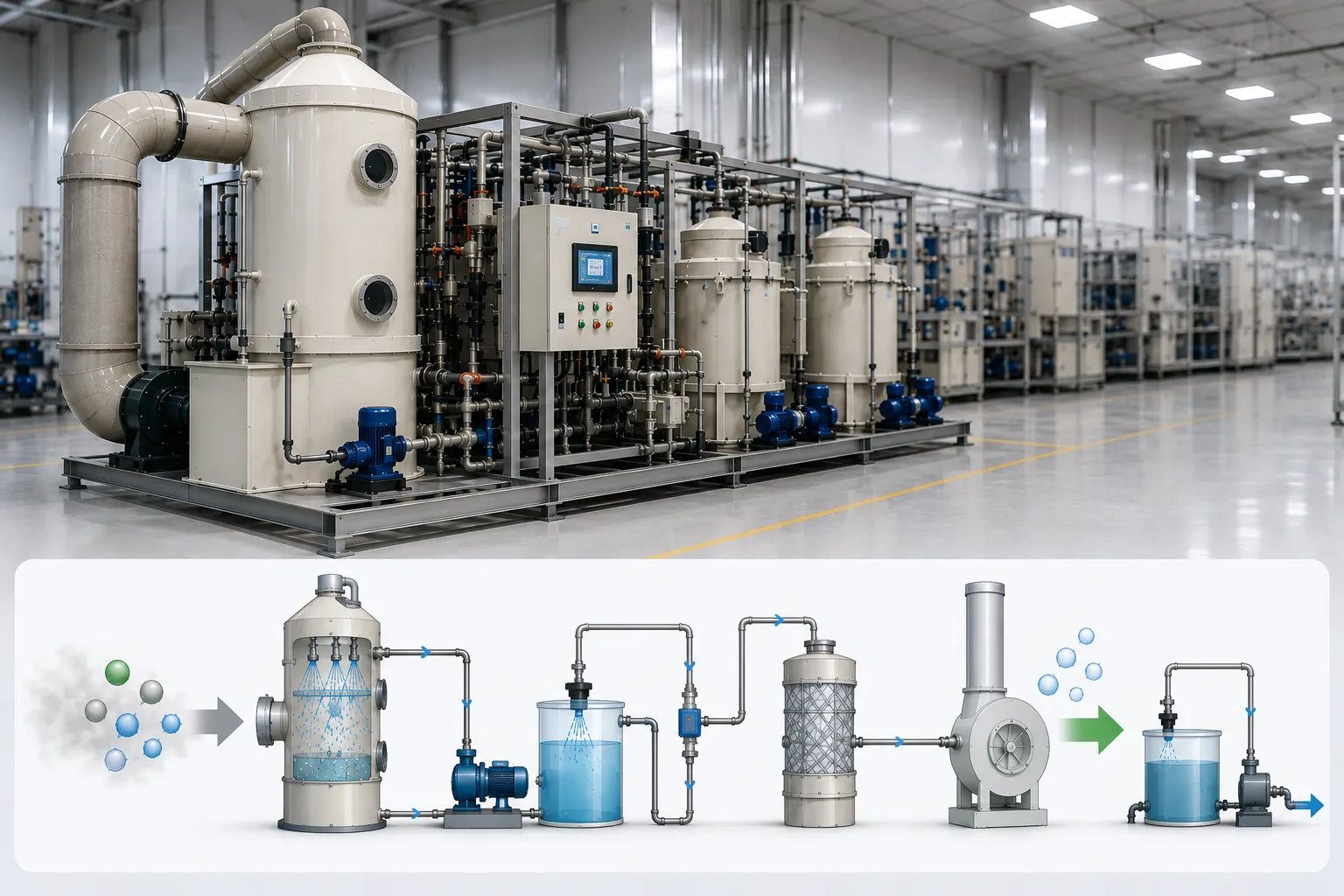
Multi-Stage Packed-Bed Wet Scrubbers for Acid Neutralization and Aerosol Entrapment
Corrosive wet process exhaust streams contain high concentrations of inorganic acid vapors such as hydrochloric acid (HCl), hydrofluoric acid (HF), nitric acid (HNO3), and alkaline gases like ammonia (NH3). KOSEN SEMI multi-stage acid gas scrubbers utilize vertical counter-current gas-liquid packed beds engineered for maximum mass transfer efficiency, neutralizing hazardous fumes and trapping corrosive aerosols prior to atmospheric discharge.
Technical Parameters & Key Performance Metrics
High DRE- Benchmark DRE Efficiency: 99.5% for HCl/HF; 99.0% for NH3
- Structural Materials: Polypropylene (PP), FRPP, PVDF, PFA
- Packing Media Type: High-surface Tellerette / Pall Rings
- Liquid-to-Gas (L/G) Ratio: 2.5 to 4.0 L/m³
- Operating Pressure Drop: 250 to 500 Pa per stage
- Dosing Automation: Dual-channel closed-loop pH & ORP
Engineering Note: Acid and base streams must be segregated into dedicated scrubber towers to avoid ammonium salt precipitation and severe ductwork clogging.
Target Applications & System Architecture Details
Fab Utility CoreAutomated wet benches, chemical etching stations, wafer cleaning systems, chemical dispensing cabinets, and acid chemical delivery units (CDU).
- • Dual-stage counter-current gas polishing packed-bed tower.
- • High-efficiency chevron mist eliminator to eliminate liquid carryover.
- • Integrated automated pH chemical dosing loop with redundant pumps.
- • Transparent inspection sight glasses and quick-release spray nozzles.
Our team leverages world-class Engineering Capability to custom-engineer corrosion-resistant scrubber architectures tailored to the unique exhaust profiles of modern wafer fabs and wet processing lines.
Zeolite Concentrator Rotor with Thermal Oxidation and Wet Hybrid Abatement
Volatile organic compound (VOC) emissions from photolithography processes, solvent wet benches, and wafer drying tools typically feature high airflow volumes with low solvent concentrations. KOSEN SEMI VOC removal equipment combines hydrophobic zeolite rotor concentration with regenerative thermal oxidation (RTO) or wet hybrid recovery, delivering ultra-high Destruction and Removal Efficiency (DRE) alongside rigorous explosion mitigation safeguards.
Technical Parameters & Key Performance Metrics
Energy Saving- Benchmark DRE Efficiency: 98.0% to 99.9% overall VOC removal
- Structural Materials: 304 / 316L Stainless Steel, Carbon Steel
- Concentration Ratio: 10:1 up to 25:1 air volume reduction
- Oxidation Temperature: 750°C to 850°C (RTO/TO Zone)
- Explosion Safety Rating: NFPA 86 & ATEX Zone 2 compliant
- Heat Recovery Rate: Up to 95% via ceramic bed exchanger
Safety Note: Continuous Lower Explosive Limit (LEL) monitoring interlocks automatically trigger emergency air dilution if VOC concentrations exceed 25% LEL.
Target Applications & System Architecture Details
Solvent Line FocusTrack coater/developer modules, lithography spin coaters, organic solvent wet stripping benches, IPA dryer systems, and solvent storage cabinets.
- • Multi-stage coalescing pre-filter capturing fine liquid mist and aerosols.
- • Continuous honeycomb hydrophobic zeolite adsorption wheel.
- • High-efficiency thermal oxidation unit with integrated energy recovery.
- • Automated isolation dampers and high-temperature safety purge valves.
Our engineering team custom-engineers corrosion-resistant scrubber architectures tailored to the unique exhaust profiles of modern wafer fabs and wet processing lines.
Point-of-Use Burn-Wet and Heated Wet Scrubbing Systems for Toxic Fumes
Process gases utilized in chemical vapor deposition (CVD), atomic layer deposition (ALD), and dry plasma etching—such as silane (SiH4), perfluorocarbons (PFCs), and metal-organic precursors—are extremely toxic, pyrophoric, or potent greenhouse gases. Point-of-Use (POU) burn-wet and heated wet scrubbing systems decompose toxic gas compounds at the tool exhaust outlet, quenching reactions and capturing particulate solids before gases enter central facility exhaust lines.
Technical Parameters & Key Performance Metrics
Ultra Safety- Benchmark DRE Efficiency: 99.99% for pyrophoric & toxic species
- Structural Materials: Hastelloy C-276, Inconel 625, PFA Lined
- Process Inlet Channels: 1 to 4 independent inlet lines
- Thermal Reaction Temp: 800°C to 1200°C combustion/decomposition
- Water System Type: Closed-loop recirculation with auto-bleed
- Safety Interlocks: Auto N2 purge, UV flame sensors, PLC link
Process Safety Note: Immediate water-spray quenching converts high-temperature gaseous byproducts (HF, SiO2 dust) into manageable liquid effluent.
Target Applications & System Architecture Details
POU Tool LevelChemical Vapor Deposition (CVD), PECVD, Atomic Layer Deposition (ALD), Metal Etch, Epitaxy reactors, and toxic gas storage cabinets.
- • High-temperature combustion reactor chamber with corrosion-resistant liner.
- • Direct water jet quenching zone preventing silica scaling and thermal stress.
- • Secondary packed tower water polishing stage capturing micro-particles and acids.
- • Dual containment design with fail-safe automatic nitrogen purging.
Our engineering team custom-engineers corrosion-resistant scrubber architectures tailored to the unique exhaust profiles of modern wafer fabs and wet processing lines.
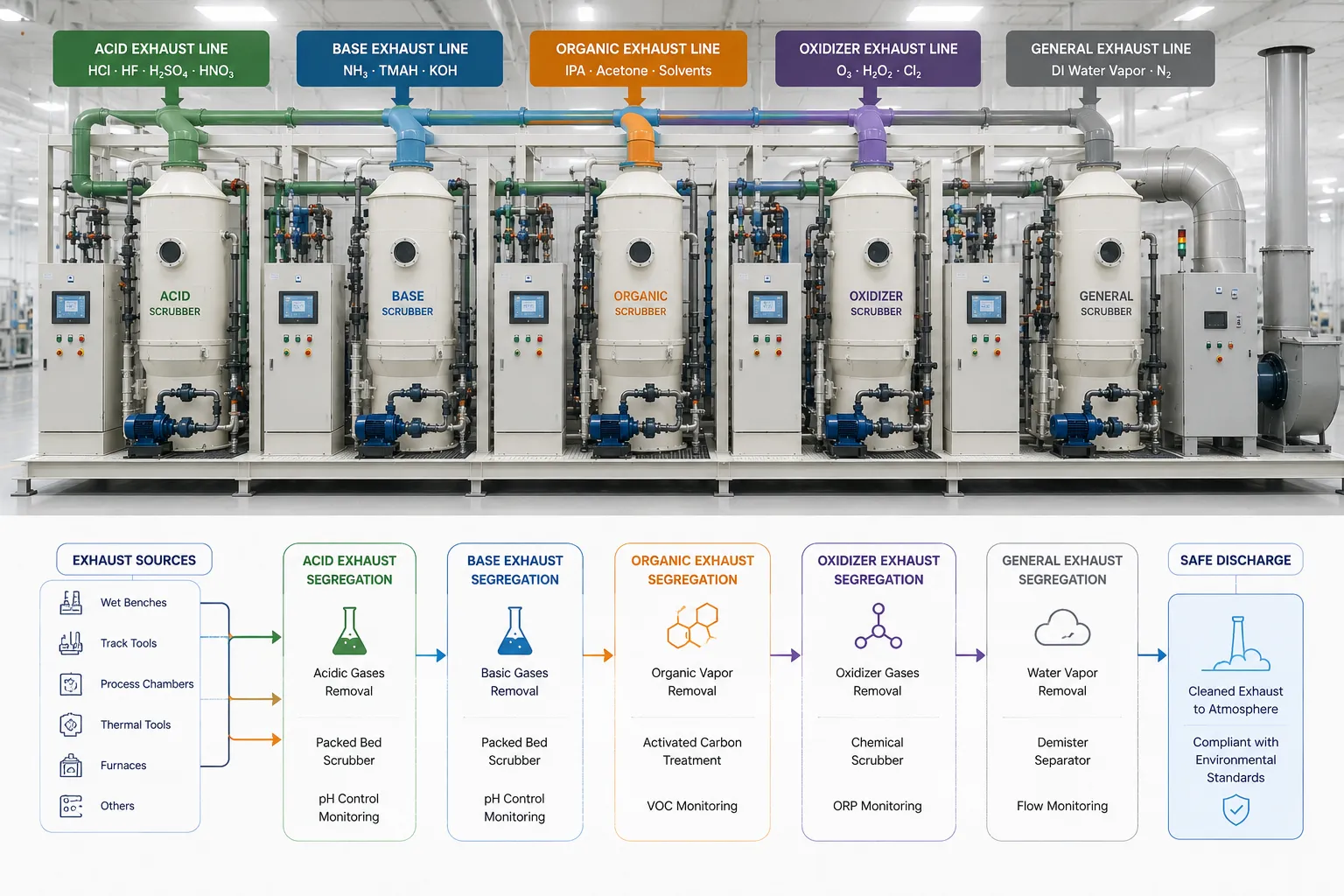
Comprehensive Exhaust Chemistry Segregation
Failure to properly segregate wet process exhaust types can lead to catastrophic chemical reactions, ductwork corrosion, ammonium salt crystallization, or severe atmospheric non-compliance. Selecting the correct wet process exhaust scrubber architecture requires rigorous baseline analysis of CFM requirements, temperature, chemical loading, and particulate size distribution.
As a specialized equipment manufacturer in wet process exhaust treatment with an advanced manufacturing facility, KOSEN SEMI provides turnkey wet scrubbing solutions meeting rigorous standards for semiconductor and advanced manufacturing industries.
| Exhaust Stream Category | Key Chemical Contaminants | Recommended Scrubber Route | Target Process Tools | Target DRE (%) | Primary Materials |
|---|---|---|---|---|---|
| Acid Exhaust | HCl, HF, HNO3, H2SO4, Cl2 | Multi-Stage Packed-Bed Wet Scrubber | Acid Wet Benches, Chemical Etchers | ≥ 99.5% | PP, FRPP, PVDF, PFA |
| Alkaline / Base Exhaust | NH3, NH4OH, Organic Amines | Acid-Dosed Counter-Current Wet Scrubber | Developer Benches, Cleaning Hoods | ≥ 99.0% | PP, FRPP, Stainless Steel |
| VOC Organic Exhaust | IPA, Acetone, PGMEA, Solvents | Zeolite Concentrator + RTO / Hybrid | Track Coater, Solvent Stripping | ≥ 98.0% - 99.9% | 304 / 316L Stainless Steel |
| Toxic & Pyrophoric Gas | SiH4, PH3, AsH3, B2H6, NF3 | Point-of-Use (POU) Burn-Wet Scrubber | CVD, PECVD, ALD, Plasma Etch | ≥ 99.99% | Hastelloy C-276, Inconel 625 |
Core Specification Factors for Wet Scrubber Sizing and RFP Drafting
Designing an effective industrial exhaust gas treatment system requires a strict balance between chemical reaction kinetics, fluid mechanics, and structural material compatibility. When formulating Request for Proposal (RFP) documentation or sizing scrubbers for semiconductor wafer fabs and chemical manufacturing lines, engineering teams must systematically evaluate core operational parameters including scrubber airflow capacity, DRE compliance, and system pressure drop. KOSEN SEMI supplies standardized parameter handbooks and advanced Computational Fluid Dynamics (CFD) simulation services to ensure an optimal balance between pressure drop and treatment efficiency.
Fluid Dynamics & Liquid-to-Gas Ratio
Sizing wet scrubbers requires balancing gas velocity against chemical liquid recirculation to maintain target contact time while preventing packing flooding and excessive mist carryover.
Optimal window: 10 to 20 gal / 1,000 CFM (1.3 to 2.7 L/m³). Higher L/G ratios increase mass transfer for low-solubility gases but elevate pump energy consumption.
Target velocity range: 300 to 500 FPM (1.5 to 2.5 m/s). Maintains gas dwell time between 1.5 and 3.0 seconds through packed beds.
Airflow Capacity & Dwell Time
Calculating total volumetric scrubber airflow capacity—measured in CFM (Cubic Feet per Minute) or CMH (Cubic Meters per Hour)—is the foundational step in wet scrubber engineering. System capacity must accommodate peak simultaneous exhaust loads from upstream wet benches, chemical storage cabinets, and process tool dump vents.
- • Superficial Velocity: Maintained under 2.5 m/s (500 FPM) to prevent packing flooding.
- • Bed Dwell Time: Minimum 1.5 to 2.5 seconds retention time for optimized reaction kinetics.
- • Turndown Ratio: Designed to sustain effective treatment during 30% idle airflow conditions.
DRE Compliance & Efficiency
Destruction and Removal Efficiency (DRE compliance) benchmarks demand verified contaminant neutralization exceeding 99.0% for toxic acid gases and alkaline vapors. Compliance requires precise chemistry control, liquid distribution uniformity, and high mass-transfer packing media.
- • Target Species: HCl, HF, Cl2, NH3, and HNO3 aerosol mist absorption.
- • Automated Neutralization: Multi-stage pH and ORP dosing loops using NaOH or H2SO4.
- • Mist Entrapment: High-efficiency chevron demister blades prevent chemical droplet carryover.
Pressure Drop & Energy
Evaluating static pressure drop across packing beds, mist eliminators, and duct transitions is critical to controlling exhaust fan energy consumption. Excessive pressure drop increases system flow resistance and elevates long-term operating expenditures.
- • Pressure Drop Window: Maintained between 1.0 and 2.5 in. w.g. (250–625 Pa) per stage.
- • Packing Optimization: High-voidage random packing minimizes gas flow resistance.
- • Recirculation Pump Head: Efficient hydraulics lower pump energy footprint by up to 25%.
Material Selection & Longevity
Selecting structural materials dictates the operational lifecycle of wet scrubbers in aggressive chemical environments. Equipment must withstand continuous exposure to concentrated acids, alkalis, and oxidative chemicals without stress cracking or thermal degradation.
- • Thermoplastics: Polypropylene (PP, PPs-FR) and PVC for standard acid/base wet process exhaust.
- • Fluoropolymers: PVDF and PFA for high-temperature or ultra-concentrated acid streams.
- • Fire Safety: FM 4910 plastic material compliance for cleanroom fire safety.
Structural Material Selection Matrix for Semiconductor Exhaust
Compare physical properties, chemical resistance, fire retardancy certifications, and lifecycle cost profiles across primary wet scrubber structural materials.
| Material Type | Max Operating Temp | Acid Resistance | Alkali Resistance | FM 4910 Compliance | Primary Application |
|---|---|---|---|---|---|
| Polypropylene (PP / PPs-FR) | 80°C (176°F) | Excellent | Excellent | Flame Retardant Grades (PPs-FR) | General wet bench acid/base exhaust ductwork & packing columns. |
| Fiberglass Reinforced Plastic (FRP) | 100°C (212°F) | High | Moderate | Specially Formulated Resins Only | Central municipal & industrial scrubbers, large duct headers. |
| Polyvinylidene Fluoride (PVDF) | 120°C (248°F) | Superior | High | Fully Approved | High-concentration acid fumes (HF, HNO3), semiconductor cleanrooms. |
| PFA / PTFE Fluoropolymer Linings | 180°C (356°F) | Maximum | Maximum | Fully Approved | Ultra-pure chemical lines, aggressive solvent-acid hybrid exhaust. |
CFD Simulation and Parameter Optimization by KOSEN SEMI
Need to verify liquid distribution, pressure drop limits, or air-to-liquid contact times for your fab expansion? Learn more Engineering Capability options or leverage KOSEN SEMI standardized parameter handbooks and full-scale Computational Fluid Dynamics (CFD) modeling to verify velocity profiles, mist eliminator loading, and chemical reaction rates prior to procurement.
Compliance and Safety Requirements for Wet Scrubber Systems
Integrating wet scrubbers into advanced semiconductor fabs requires absolute compliance with EHS regulations, fire containment standards, and regional environmental rules. KOSEN SEMI wet scrubbers are precision-engineered to meet every regulatory layer—from EPA atmospheric emission thresholds to FM 4910 fire-retardant certification—ensuring continuous exhaust safety and frictionless facility audits. Backed by our robust Engineering Capability, our solutions seamlessly integrate with complex fab infrastructure.
Environmental Emission Standards
To meet municipal EPA discharge permits and industrial park air quality standards, every KOSEN SEMI environmental compliance scrubber utilizes multi-stage mass transfer mechanisms designed for reliable abatement of corrosive and toxic exhaust gases.
- Full compliance with federal, state, and local EPA air quality regulations for acid gases (HCl, HF, HNO₃), caustic vapors, and fine particulates
- Strict adherence to industrial park atmospheric pollutant mass-loading and concentration limits
- Integrated telemetry interfaces for Continuous Emission Monitoring Systems (CEMS) and real-time EHS reporting
- Comprehensive Destruction and Removal Efficiency (DRE) verification documentation to streamline air permit applications
Semiconductor Equipment Safety — SEMI S2 and S8
Semiconductor fab integration demands baseline compliance with SEMI S2 environmental, health, and safety guidelines, as well as SEMI S8 ergonomic criteria to protect technicians during tool operation and routine maintenance across various wafer-cleaning-systems setups.
- SEMI S2: Exhaustive safety guidelines addressing electrical, chemical, mechanical, and operational hazard mitigations
- SEMI S8: Human-factors engineering optimized for ergonomic maintenance access, valve accessibility, and sight-glass placement
- Built-in electrical isolation, safety grounding, and standardized Lockout/Tagout (LOTO) hardware provisions
- Chemical splash protection, secondary containment basins, and integrated hazard labeling per SEMI protocols
Fire and Explosion Protection — FM 4910 and ATEX
Process exhaust handling reactive chemicals or organic vapors requires certified flame-retardant construction and explosion-proof engineering. KOSEN SEMI manufactures FM approved wet scrubber systems engineered for classified hazardous zones.
- FM 4910: All wetted internal bodies, packing media, and mist eliminators utilize FM-approved fire-retardant polymers (PP, PVDF, PFA)
- ATEX Zone Engineering: Explosion-proof electrical enclosures, intrinsically safe sensors, anti-static ducting, and grounding loops for VOC exhaust safety
- Fully documented flame-spread index and smoke development ratings to satisfy facility insurance underwriters and local fire marshals
- Direct hardware interlock interfaces for rapid integration with fab-wide fire detection and automated suppression networks
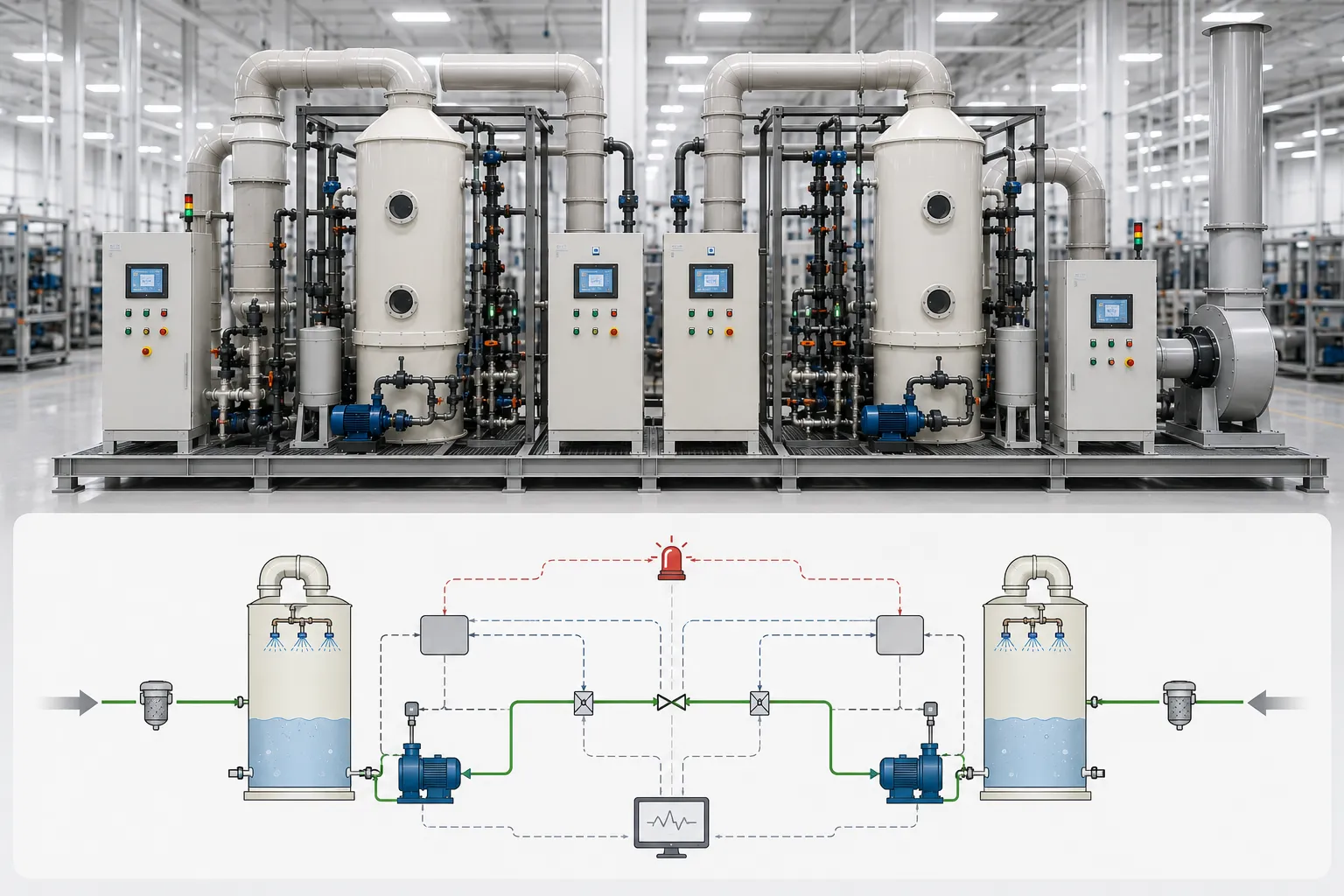
Dual Redundancy Safety Architecture
Unplanned exhaust downtime can lead to hazardous chemical buildup and costly cleanroom shutdowns. KOSEN SEMI scrubbers incorporate multi-layered safety redundancy to ensure continuous operation during component servicing or electrical faults.
- Automated Chemical Dosing: Dual-loop closed-loop dosing for NaOH and H₂SO₄ with digital flow verification and low-reagent predictive alarms
- Liquid Level Interlocks: Multi-point level sensors prevent pump cavitation, dry-running, and sump overfill conditions
- Real-Time pH/ORP Monitoring: Dual inline differential pH/ORP probes with automated PLC feedback preserve neutralization stoichiometry
- Emergency Backup Fan Failover: Automated high-speed dampers and redundant exhaust fans activate instantly upon detecting primary fan pressure drop
- Hardware-monitored safety interlocks operate independently of software logic for fail-safe emergency shutdowns
KOSEN SEMI wet scrubbers undergo rigorous dual validation against both SEMI and FM international standards. This comprehensive compliance strategy safeguards cleanroom assets, mitigates liability, and accelerates EHS sign-off during fab tool hookup and facility expansions.
Certification and Compliance Standards
Safety Redundancy Architecture
Key Safety Specifications
| Safety Parameter | Standard / Specification | KOSEN SEMI Compliance |
|---|---|---|
| Fire-Retardant Materials | FM 4910 | Certified |
| Equipment EHS Safety | SEMI S2 / S8 | Compliant |
| Explosion-Proof Zones | ATEX Directive | Zone 1 / Zone 2 Ready |
| pH Monitoring Range | Inline Real-Time (pH 0-14) | Dual Automated Control |
Total Cost of Ownership and Maintenance Comparison
Evaluating semiconductor exhaust treatment systems requires a comprehensive financial framework that balances initial Capital Expenditure (CAPEX) against ongoing Operational Expenditure (OPEX). While initial equipment procurement sets the capital baseline, continuous utility consumption, chemical reagents, and routine wet bench exhaust maintenance represent up to 70% of total lifecycle costs over a standard ten-year fab operating period.
Optimized closed-loop blowdown controls minimize fresh makeup water demand and wastewater output.
Precision automated dosing maintains target pH without chemical reagent over-injection.
Dual-pump auto-failover and redundant telemetry prevent unplanned fab process downtime.
Tool-free quick-release architecture simplifies routine preventative servicing and inspection.
Operational Expenditure Drivers and ROI Analysis
Uncontrolled utility consumption and inefficient dosing rapidly erode initial procurement savings. A rigorous scrubber TCO calculation integrates all utility streams to ensure optimized operational ROI across the entire equipment lifespan:
- Recirculation Water Management: Closed-loop conductivity monitoring controls blowdown discharge, maximizing water reuse ratios while preventing mineral crystallization inside the packed bed.
- Power Consumption Optimization: High-efficiency backward-curved fan impellers driven by Variable Frequency Drives dynamically modulate airflow in real time according to active tool exhaust demand.
- Automated Chemical Dosing: Closed-loop feedback using dual-redundant pH and ORP probes prevents over-feeding sodium hydroxide (NaOH) or sulfuric acid (H2SO4), curbing overall chemical consumption.
- Specialized Waste Liquid Disposal: Minimizing effluent volume through precise neutralization controls directly reduces municipal treatment surcharges and off-site hazardous waste disposal fees.
Maintenance-Friendly Design Features
Unscheduled fab line interruptions translate directly into lost wafer throughput. Simplifying routine wet bench exhaust maintenance guarantees high process equipment availability and ensures safe operating conditions for facility technicians:
- Tool-Free Quick-Release Spray Nozzles: Quarter-turn twist-lock nozzles allow technicians to clear, inspect, or replace spray headers without specialized hand tools or lengthy shutdown periods.
- Transparent Inspection Sight Glasses: Clear, chemical-resistant observation windows at every packing bed level facilitate visual health audits during active scrubber operation.
- Anti-Clogging Packing Media: High-voidage structured packing media resists particulate fouling and scale build-up, significantly extending deep-cleaning service intervals.
- Automated PLC Self-Diagnostic Alerts: Integrated control systems continuously monitor differential pressure, liquid flow rates, and pump telemetry to issue early predictive maintenance notifications.
10-Year Lifecycle Cost Matrix: CAPEX vs. OPEX Factors
When evaluating industrial wet scrubber options, relying solely on initial equipment purchase price can result in severe budget overruns during active fab operations. Below is a detailed comparative breakdown showing how system design choices directly influence long-term operational expenditure. Seamless integration with Automatic Wet Bench Systems further optimizes baseline efficiency.
| Evaluation Parameter | Standard Scrubber Design | KOSEN SEMI High-Efficiency Scrubber System |
|---|---|---|
| Primary CAPEX Impact | Lower initial equipment cost; utilizes basic single-speed pumps and manual chemical dosing controls. | Moderate initial investment; includes integrated VFDs, automated pH/ORP dosing, and premium corrosion-resistant thermoplastics. |
| Chemical Consumption | Higher chemical consumption driven by continuous fixed-rate dosing regardless of fluctuating exhaust loads. | Precision automated feedback loops lower chemical consumption by up to 25% through dynamic reagent adjustment. |
| Utility Water Usage | Fixed timer-based water purge cycles lead to excessive fresh water intake and higher wastewater discharge volumes. | Conductivity-driven blowdown management achieves up to 30% reduction in overall makeup water consumption. |
| Routine Maintenance Hours | High downtime required for manual nozzle clearing, packing media descaling, and routine sensor calibration. | Tool-free quick-release spray headers and PLC diagnostics reduce maintenance downtime by over 40%. |
Semiconductor Scrubber System Selection & Engineering FAQ
Find authoritative answers to critical engineering questions regarding wet scrubber sizing, wet bench tool exhaust integration, chemical stream segregation, FM 4910 fire safety compliance, and gas abatement efficiency.
How do I size a wet scrubber based on exhaust airflow (CFM) from my wet bench tools?
Sizing a wet scrubber accurately requires calculating the total volumetric airflow capacity in cubic feet per minute (CFM) or cubic meters per hour (CMH), balanced against duct static pressure head loss and chemical contaminant mass loading. The sizing process begins by establishing the required capture velocity across each wet bench tool exhaust port—typically demanding 150 to 300 CFM per process tank or lip exhaust enclosure to prevent chemical vapor escape into the cleanroom.
Key Fluid Dynamic Metrics
- Superficial Gas Velocity: Maintained strictly between 3.0 and 4.5 ft/sec (0.9 to 1.4 m/s) through the packing bed to maximize mass transfer while preventing liquid droplet carryover.
- Liquid-to-Gas (L/G) Ratio: Configured between 1.5 and 3.0 gal/1,000 CFM (0.2 to 0.4 L/m³) to ensure complete chemical absorption and packing bed wetting.
- Packed Bed Dwell Time: Designed for a minimum 1.5 to 2.5 seconds of gas-liquid contact time to guarantee >99% Destruction & Removal Efficiency (DRE).
Engineering Safety & Load Margins
- Tool Diversity Factor: Calculated across multi-tool sub-fab headers to account for realistic simultaneous process tool duty cycles.
- Static Pressure Head Loss: Evaluated across packing media, mist eliminators, and ductwork (typically 2.0 to 4.5 in. w.g.) for optimal exhaust fan sizing.
- Future Expansion Allowance: Recommended safety margin of 15% to 20% added to baseline CFM capacity to accommodate future fab line expansions.
Our KOSEN SEMI applications engineering team relies on superior Engineering Capability to conduct comprehensive on-site airflow auditing and Computational Fluid Dynamics (CFD) simulation to verify exact tool exhaust parameters, prevent duct static imbalances, and optimize system sizing before equipment fabrication.
Can acidic and alkaline exhaust streams be combined into a single scrubber system safely?
Combining acidic exhaust streams (containing HCl, HF, or HNO₃) and alkaline streams (containing NH₃) directly into a single scrubber vessel or duct header is strongly discouraged due to severe chemical safety hazards, equipment fouling, and regulatory violations.
To ensure continuous operational safety and maintain >99% Destruction & Removal Efficiency (DRE), semiconductor fabs must deploy dedicated acid gas scrubbers using caustic (NaOH) dosing and separate ammonia scrubbers using sulfuric acid (H₂SO₄) dosing. KOSEN SEMI engineers segregated dual-stream exhaust architectures equipped with automated pH and ORP dosing control to safely handle complex sub-fab chemical profiles.
What are the mandatory material requirements under FM 4910 certification for fab scrubbers?
FM 4910 (Factory Mutual Specification Test Standard for Cleanroom Materials) mandates that all wet scrubber shells, internal components, and exhaust duct plastics exhibit fire-retardant, self-extinguishing characteristics and extremely low smoke evolution. Unmodified polypropylene (PP) poses severe flame propagation risks and is prohibited in non-sprinklered cleanroom and sub-fab exhaust environments.
| Material Construction | FM 4910 Listed | Chemical Resistance | Recommended Application |
|---|---|---|---|
| FM Flame-Retardant PP (FRPP) | Yes | High (Acids & Bases) | Main Scrubber Shells & Exhaust Headers |
| Polyvinylidene Fluoride (PVDF) | Yes | Ultra-High (Strong Oxidizers/HF) | Packing Media, Spray Nozzles & High-Concentration Zones |
| Perfluoroalkoxy (PFA) | Yes | Extreme (Concentrated Hot Acids) | High-Temperature Chemical Tools & Injection Interfaces |
| Standard Polypropylene (PP) | No | Moderate | General Industrial Non-Cleanroom Exhaust Only |
Compliance with FM 4910 standards prevents catastrophic fire propagation through sub-fab exhaust networks during thermal events. Every KOSEN SEMI FM 4910-certified wet scrubber is manufactured using rigorous batch-tested materials to guarantee effortless EHS audit compliance and facility insurance sign-off.
What is the practical performance difference between packed tower and spray tower scrubbers for mist separation?
The fundamental performance trade-off between packed tower scrubbers and spray tower scrubbers revolves around gas-liquid contact surface area, wafer-cleaning-systems integration compatibility, pressure drop, particulate clogging tolerance, and overall contaminant removal efficiency.
Utilize high-surface-area packing media (e.g., Tellerettes or Pall rings) to maximize contact time between process exhaust gases and recirculating scrub liquor.
- DRE Benchmark: 99.0% (Soluble Acid/Base Gases)
- Pressure Drop: 1.5 – 3.5 in. w.g. (370 – 870 Pa)
- Aerosol Separation: High efficiency via mist eliminator stage
- Primary Fit: Highly soluble gases (HCl, HF, NH₃, Cl₂)
Rely exclusively on high-pressure atomizing spray nozzle arrays without internal packing beds, providing an unobstructed gas path with minimal flow resistance.
- DRE Benchmark: 80.0% – 90.0% (Lower absorption efficiency)
- Pressure Drop: < 1.0 in. w.g. (< 250 Pa)
- Fouling Tolerance: Exceptional (Zero packing media to clog)
- Primary Fit: Heavy particulate loading, quenching & pre-treatment
For semiconductor wet bench exhaust management, multi-stage packed tower wet scrubbers remain the industry standard due to their superior mass transfer performance, ensuring full compliance with stringent EPA emission limits and local clean air standards.
Require On-Site Airflow Auditing or System Sizing Verification?
Connect directly with our KOSEN SEMI applications engineers to calculate wet bench CFM requirements, verify chemical stream compatibility, or request custom CAD scrubber layouts for your fab.