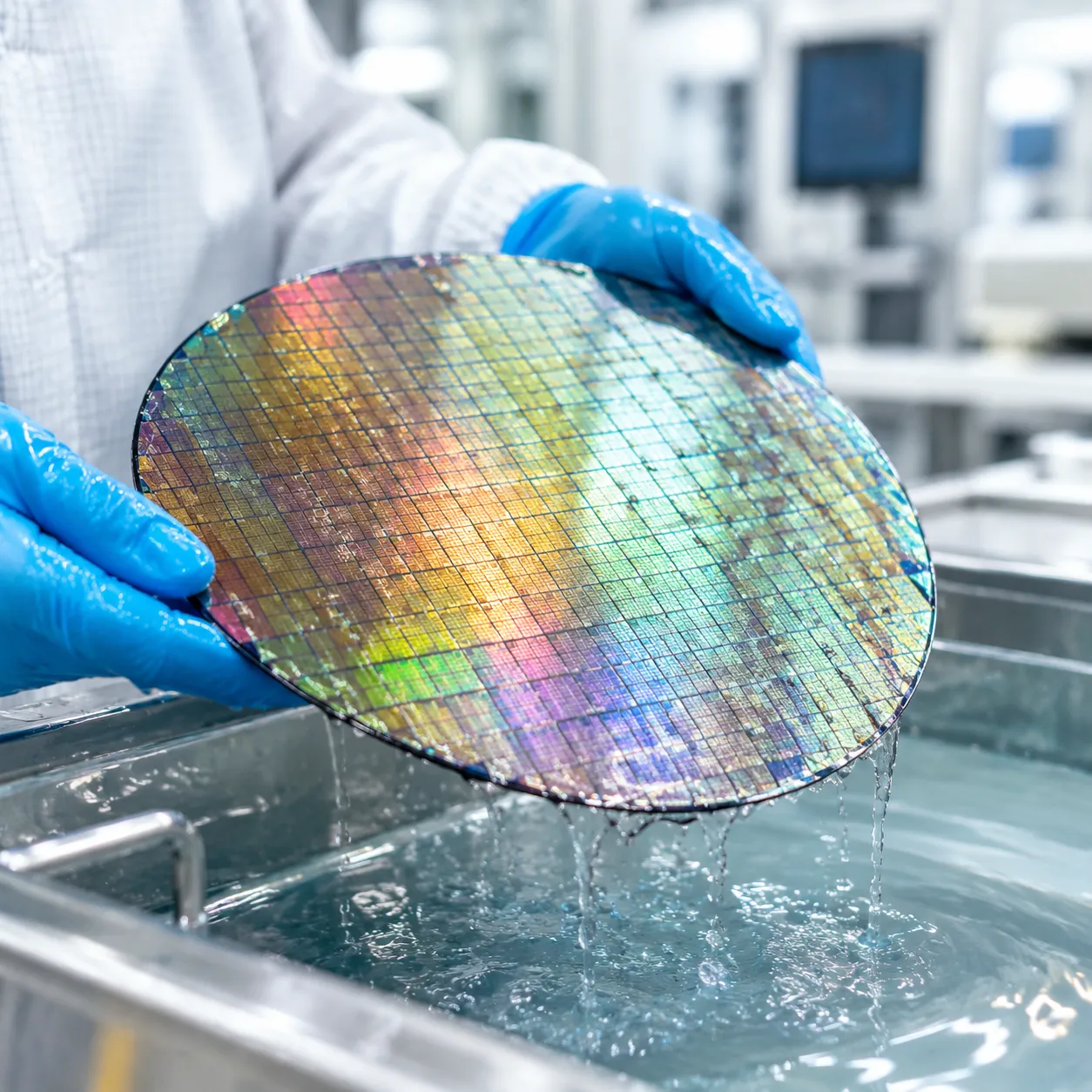
Formula details
Product Details
Overview
Chemical Wet Bench Technical Specifications Matrix
Substrate Sizing and Tank Metallurgy
Selecting the right tank material prevents chemical leaching and bath degradation. We match bath metallurgy directly to process chemistry:
| Parameter | Specification Range | Material / Metallurgy | Typical Application |
|---|---|---|---|
| Substrate Diameter | 2-inch, 100 mm, 150 mm, 200 mm, 300 mm (Custom carriers for odd shapes) | Natural Polypropylene / PTFE | Batch cassette or single-wafer processing |
| Acid Etch & Clean | Ambient to 180°C | High-purity Quartz, PVDF, PFA | SC-1, SC-2, Piranha (SPM), HF / BOE etching |
| Solvent Stripping | Ambient to 120°C | 316L Stainless Steel (Electropolished), PTFE | NMP, IPA, Acetone, photoresist stripping |
| Rinsing Units | Ambient to 80°C | PVDF, High-purity PFA | Quick Dump Rinse (QDR), Cascade overflow |
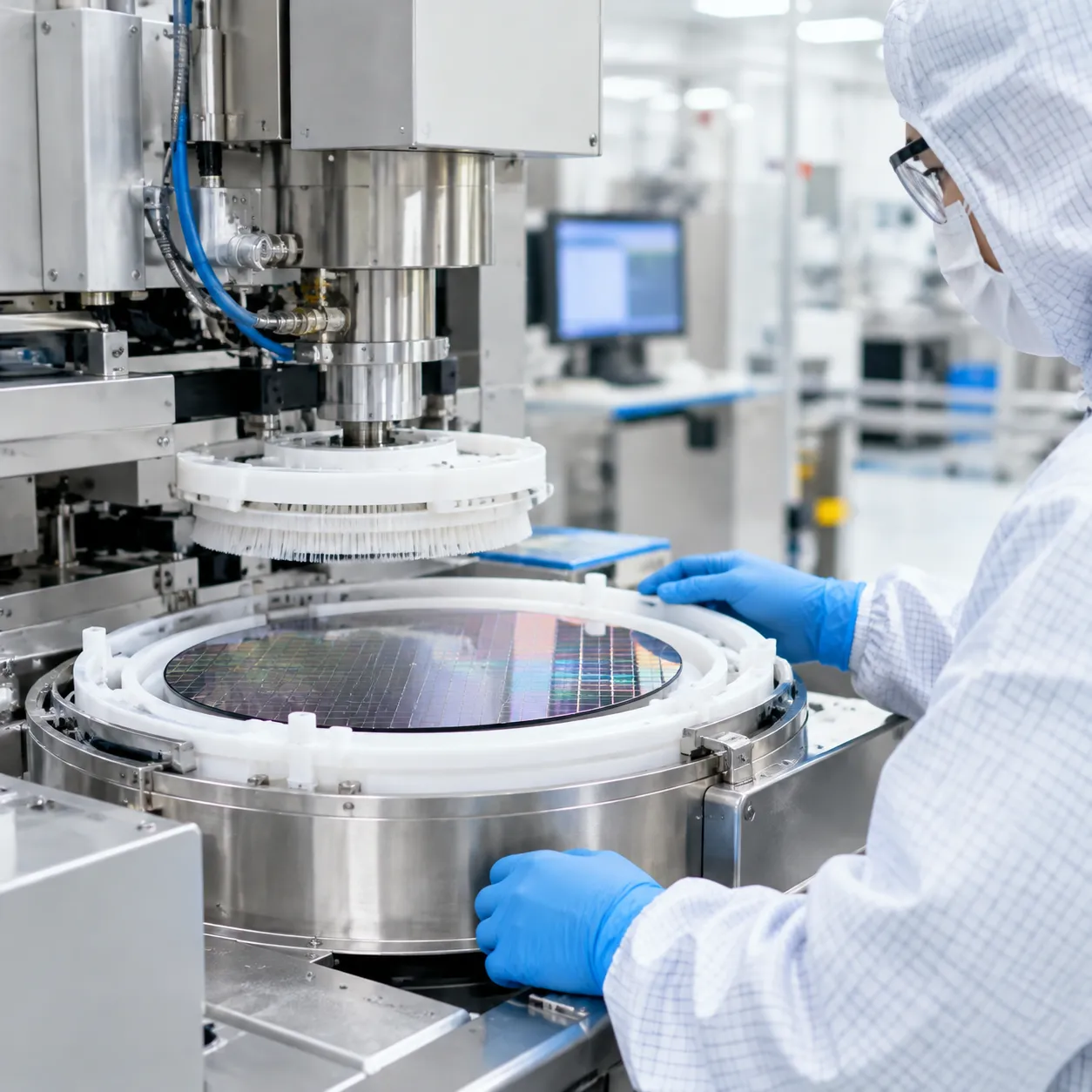
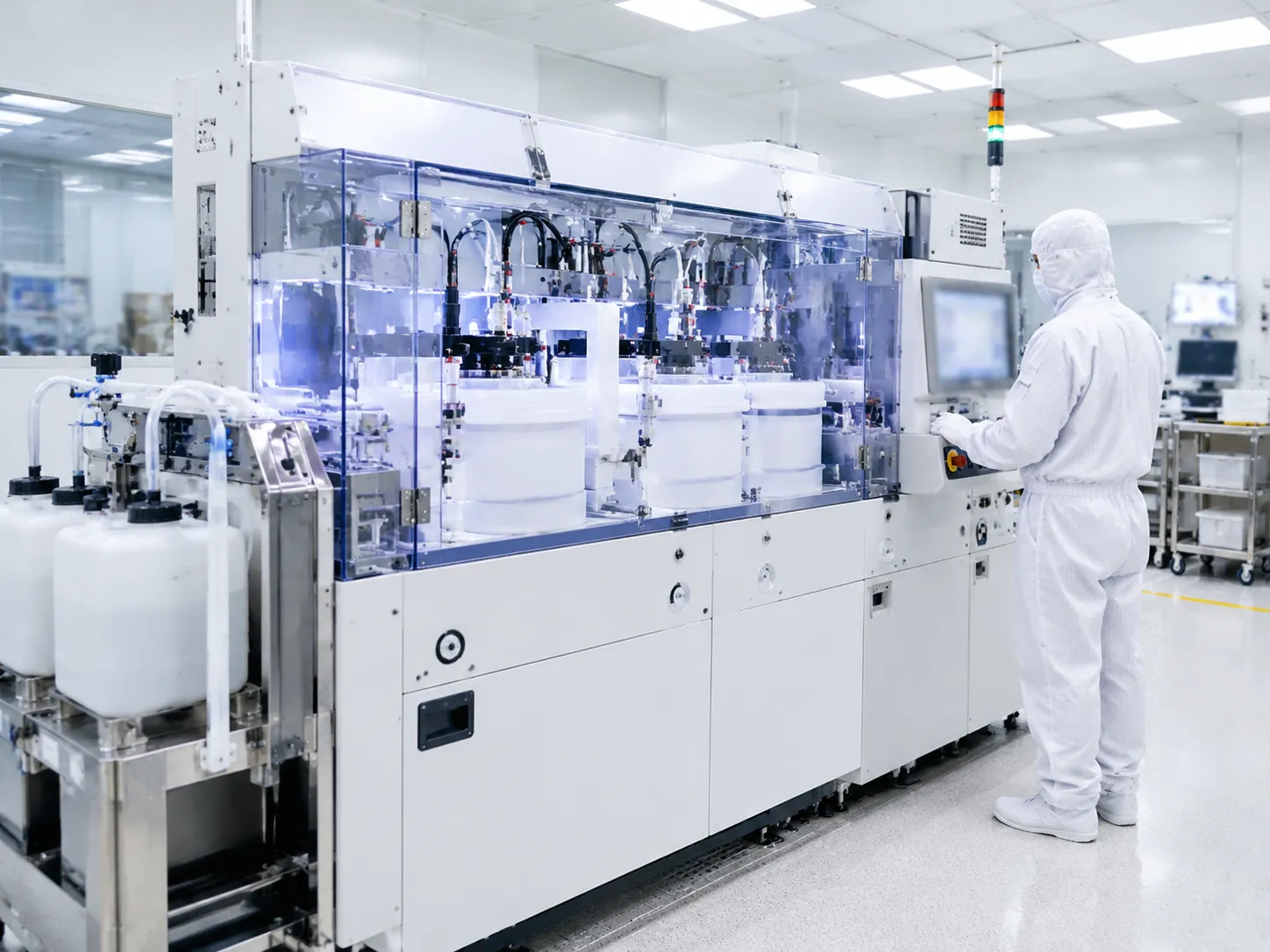
Our modular semiconductor wet bench systems feature isolated dry-side mechanicals and dedicated wet-process areas to eliminate cross-contamination between incompatible acid and solvent baths.
Cleanroom Footprint and Facility Utility Requirements
We design our wet process stations to minimize ballroom or grey-room footprint while maintaining clear service access:
-
- Footprint layouts: Modular linear configurations from 1.5 meters (manual 2-bath units) to over 6 meters (fully automated multi-tank lines).
- Exhaust management: Dedicated acid, solvent, and thermal exhaust ducting with built-in differential pressure sensors and fail-safe dampers.
- DI water feed: High-flow loops with point-of-use resistivity monitoring (>18.2 MΩ·cm) and zero dead-leg piping to eliminate bacterial buildup.
- Pneumatics and inert gas: Regulated CDA (Clean Dry Air) and high-purity N2 purge lines (minimum 99.999% purity) for tank blanketing and dry cycles.
- Power standards: Configurable 208V, 380V, or 480V 3-phase systems fully rated to SEMI S2/S8 standards.
Chemical Wet Bench for Wafer Cleaning and Precision Etching
RCA Clean Cycles and Megasonic Particle Removal
Our automated cleanroom wet process stations run full-sequence standard RCA clean recipes with direct chemical injection and real-time bath monitoring:
Standard Clean 1 (SC-1 / APM): Ammonium hydroxide and hydrogen peroxide mixtures heated to 70°C–80°C to strip organic films and light organics.
Standard Clean 2 (SC-2 / HPM): Hydrochloric acid and hydrogen peroxide mixtures to desorb trace metallic ionic contamination down to parts-per-trillion (ppt) levels.
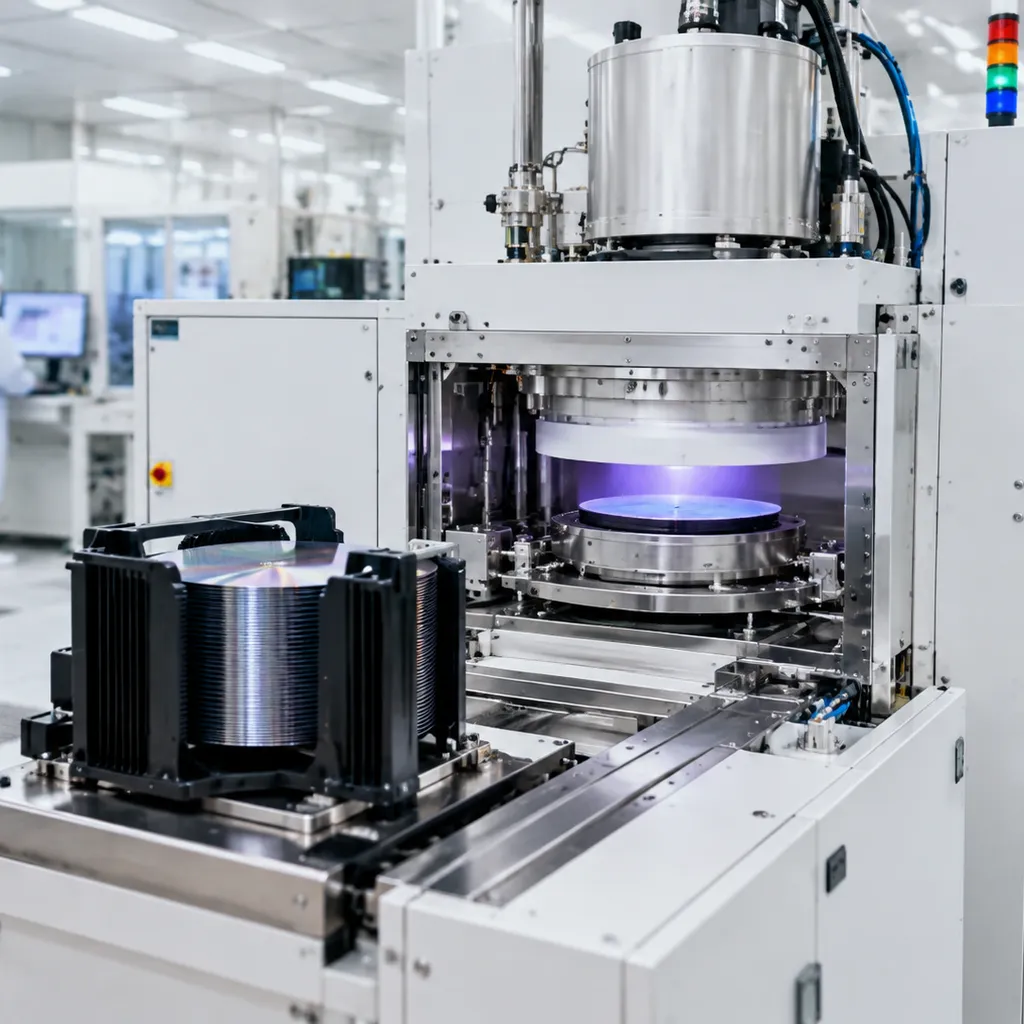
Megasonic Agitation: Multi-frequency megasonic transducers (0.8 MHz to 1.5 MHz) integrated into the quartz or PVDF bath floor. This removes particles smaller than 28 nm without inducing cavitation damage on high-aspect-ratio wafer patterns.
Silicon and Dielectric Precision Chemical Etching
Consistent wafer-to-wafer and within-wafer etch uniformity depends on stable boundary layer fluid dynamics:
Oxide Etching: Buffered Oxide Etch (BOE) and dilute hydrofluoric acid (DHF) baths engineered for repeatable oxide removal rates and sharp profile definitions.
Nitride Stripping: Boiling phosphoric acid ($H_3PO_4$) tanks running at 160°C–180°C with automated DI water spike replenishment to stabilize boiling points and maintain nitride-to-oxide selectivity.
Silicon Micromachining: Anisotropic etching using KOH or TMAH solutions with continuous bath recirculation, delivering cross-wafer etch rate uniformities tighter than ±1.5%.
Photoresist Stripping and Heated Solvent Immersion
We configure dedicated solvent processing tanks to handle heavy organic removal and cross-linked photoresist:
Sulfuric-Peroxide Mixture (SPM / Piranha): High-temperature (120 °C–140 °C) inline-mixed baths for aggressive resist stripping and clean surface oxidation.
Solvent Immersion Tanks: Heated NMP, DMSO, or proprietary strippers equipped with continuous point-of-use micro-filtration (down to 0.05 µm) to trap suspended resist residue and extend bath life.
Quick Dump Rinse (QDR) and Watermark-Free Drying
Rapid transition from chemical exposure to neutral rinsing stops etch reactions instantly and protects wafer topography:
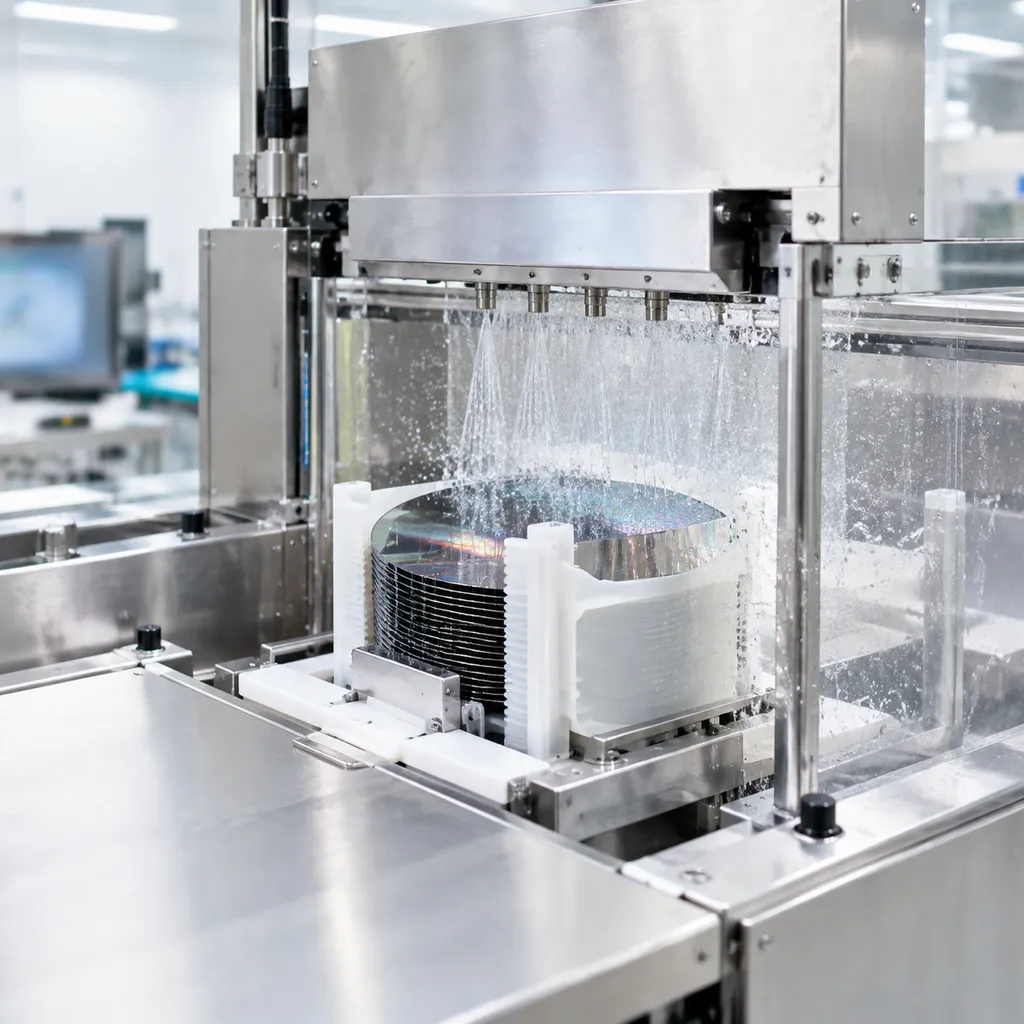
High-Speed Quick Dump Rinsing: Pneumatic bottom-dump trapdoors evacuate bath volumes in under two seconds. Top-mounted DI water spray manifolds and bottom N2 bubbling eliminate dead zones and sweep stagnant boundary layers.
Surface Tension (Marangoni) Drying: Ultra-low-velocity IPA vapor drying pulls wafers through a controlled surface tension gradient, preventing micro-capillary collapse on fragile structures.
Spin Rinse Dryers (SRD): High-throughput centrifugal drying with heated, filtered nitrogen purging ensures an absolute zero-watermark guarantee across full cassette batches.
Hardware Architecture and Cleanroom Contamination Control
FM4910 Plastics and Electropolished Stainless Steel
Bath longevity and cleanroom safety depend entirely on material compatibility. We match structural and tank materials directly to your chemical process:
-
- FM4910-compliant polymers: We construct acid and corrosive processing zones using white polypropylene, PVDF, and PTFE to prevent fire propagation and eliminate trace metal leach-out.
- Electropolished 316L stainless steel: Used for solvent processing modules, our solvent frames feature electro-cleaned surfaces (down to Ra < 0.4 µm) with passivated weld seams to prevent solvent permeation and static build-up.
- Thermal and chemical isolation: We separate acid and base exhaust sections from structural frameworks to eliminate long-term cabinet corrosion and micro-crack formation.
Our modular layouts follow strict semiconductor wet bench design and specification standards to deliver structural rigidity and zero-leak reliability under heavy thermal loads.
Point-of-Use Chemical Filtration and Recirculation
Bath longevity and particle counts rely on continuous chemical turnover:
-
- Sub-micron filtration: Integrated PFA/PTFE filter housings support 0.05 µm to 0.1 µm point-of-use filtration, trapping micro-particulates before baths contact active wafer surfaces.
- Recirculation flow optimization: High-purity PTFE bellows pumps circulate aggressive chemistries at configurable rates, avoiding dead legs and stagnation zones within the bath.
- Continuous bath health: Real-time chemical turnover cuts raw chemistry consumption while keeping particle baselines consistently within SEMI standards.
Closed-Loop Chemical Heating with Tight Temperature Control
Precise etch rates require absolute thermal stability. We integrate high-purity inline and immersion heating solutions using real-time feedback loops:
| Thermal Feature | Engineering Specification | Process Impact |
|---|---|---|
| Inline PFA Chemical Heaters | Indirect infrared or PFA-sheathed heating | Rapid ramp rates up to 180°C with zero metal exposure |
| Temperature Stability | PID-controlled closed-loop system | ±0.5°C bath uniformity across the entire carrier |
| Over-Temperature Protection | Redundant dual-thermocouple interlocks | Instant power cut-off prevents bath boiling and dry-run hazards |
Class 1 Laminar Airflow and Fume Exhaust Management
Controlling airborne micro-environments prevents ambient airborne debris from depositing onto freshly etched silicon:
-
- Class 1 mini-environment airflow: Integrated fan filter units (FFU) with HEPA/ULPA filtration drive uniform, vertical laminar air down over open process tanks at 0.45 m/s (±20%).
- Lip exhaust and vapor containment: Continuous slotted lip exhausts pull heavy acid and solvent vapors directly at the tank rim, eliminating cross-tank migration and protecting operators.
- Differential pressure monitoring: Smart exhaust sensors automatically throttle facility dampers, alerting operators and idling robotics if exhaust velocity dips below programmed safety thresholds.
Robotic Automation and SECS/GEM Software Controls
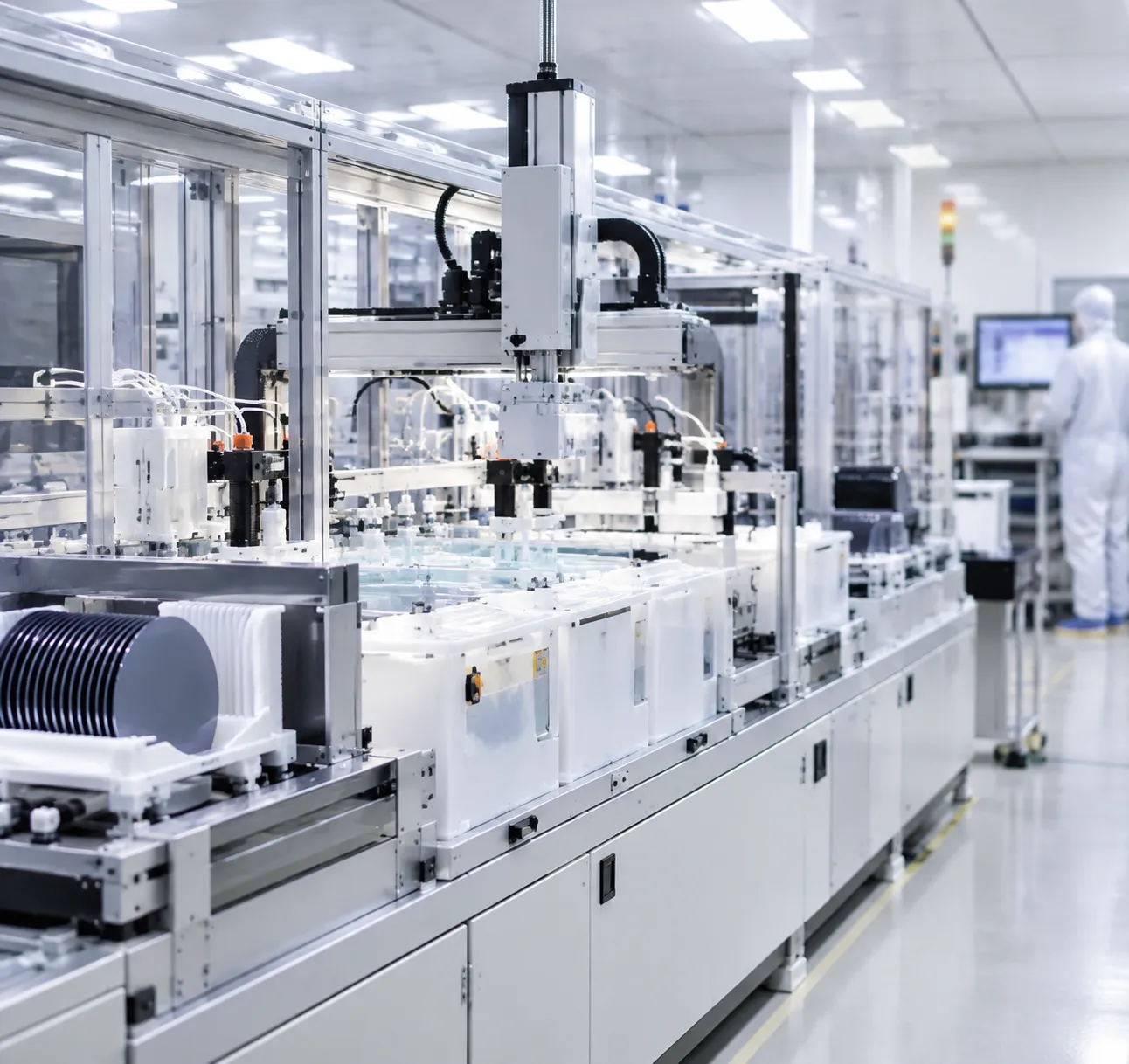
Manual transfer during acid etching and aggressive cleaning cycles introduces particle contamination, handling damage, and batch-to-batch variation. In our automated chemical wet bench for wafer manufacturing, we replace manual intervention with high-precision robotics and deterministic software to ensure maximum yield, repeatability, and operator safety.
Cassette-to-Cassette Robotic Wafer Transfer Systems
Our batch handling uses high-speed, multi-axis robotic transfer arms built specifically for cleanroom environments:
-
- Smooth Motion Control: Servo-driven linear drives eliminate bath slosh, vibration, and wafer micro-chatter during tank-to-tank transfers.
- Corrosion-Proof End-Effectors: Constructed from high-purity PEEK, PTFE, or PVDF to prevent chemical degradation and metallic cross-contamination.
- Positioning Accuracy: Precise sub-millimeter positioning repeatability ensures seamless loading and unloading across standard cassettes and custom carriers.
- Integrated Safety Sequences: Continuous payload monitoring prevents dropped wafers, misaligned cassette seating, or mid-cycle transfer lockups.
Our proprietary automation and process control architecture synchronizes robotic arm speeds with process tank liquid levels to minimize fluid drag and chemical drag-out between process baths.
Dynamic Recipe Management via Touchscreen HMI
We run an industrial PC platform paired with a cleanroom-compatible touchscreen HMI, giving process engineers granular control over every step:
-
- Step-by-Step Parameter Tuning: Set precise immersion times, chemical spike volumes, megasonic power levels, and tank temperatures.
- Dynamic Rinsing Cycles: Customize Quick Dump Rinse (QDR) dump counts, overflow purge durations, and nitrogen purge sequences per recipe.
- Multi-Level Access Control: Role-based authentication isolates operator cycle starts from engineering parameter modifications.
- Comprehensive Data Logging: Real-time tracking of chemical temperatures, bath lifespans, resistivity values, and exhaust pressure drops.
SEMI-Standard SECS/GEM Integration for Fab Automation
For lights-out fab automation, our cassette-to-cassette wet bench communicates directly with your central Manufacturing Execution System (MES) using industry-standard SEMI communication protocols:
-
- SEMI Standards Compliance: Fully certified for SEMI E4 (SECS-I), SEMI E5 (SECS-II), SEMI E30 (GEM), and SEMI E37 (HSMS).
- Automated Lot Tracking: Validates incoming carrier IDs, matches recipes to lot parameters, and prevents incorrect chemical processing.
- Real-Time Fault Diagnostics: Immediately broadcasts bath level drops, exhaust flow variances, or heater interlock trips straight to host monitors.
- Traceability & Auditing: Exports complete per-wafer and per-cassette process histories for full quality compliance and yield root-cause analysis.
Safety Systems and Cleanroom Risk Mitigation
Handling aggressive chemistries such as hydrofluoric acid, hot phosphoric acid, and heated solvents requires zero-compromise safety engineering. We build every chemical wet bench for wafer processing to exceed SEMI S2/S8 standards, protecting cleanroom personnel, facilities, and active lots from chemical, thermal, and mechanical hazards.
Multi-Tiered Cleanroom Risk Defense
-
- Secondary Containment & Continuous Leak Detection: Heavy-duty, welded FM4910 secondary sumps provide 110% containment volume beneath all fluid loops. Continuous optical and conductivity leak sensors trigger instant chemical isolation and nitrogen purge sequences.
- Automatic Solvent Fire Suppression: Dedicated CO2 or Novec 1230 fire suppression units mount directly over heated solvent baths. High-speed IR/UV optical flame detectors and mechanical over-temperature cutoffs activate automated tank lids and fire-extinguishing discharges within milliseconds.
- Exhaust Differential Fail-Safes: Differential pressure transmitters constantly verify negative draft pressure at the process lip. If exhaust flow drops below safety thresholds, the system halts chemical dosing and routes vapors safely toward facility acid gas scrubbers.
- Safety Interlocks & Light Curtains: Category 4 safety light curtains guard robotic transfer envelopes, instantly freezing motion if an operator breaches the boundary during active wafer transfers.
Chemical Wet Bench Safety Architecture
| Risk Category | Detection Mechanism | Automated Safety Action |
|---|---|---|
| Chemical Leakage | Dual-point optical & conductivity sump sensors | Isolates pneumatic supply valves, initiates N2 purge |
| Solvent Overheat | Redundant PT100 RTDs & snap-action bimetal switches | Disconnects heater contactors, activates bath cooling |
| Ventilation Loss | Magnahelic differential pressure switches | Locks bath covers, alerts central chemical exhaust scrubbers |
| Mechanical Hazard | Integrated optical light curtains & latching EMO loops | Executes hard robotic axis stop (<20 ms response) |
Modular Upgrades and Custom Chemical Wet Bench Engineering
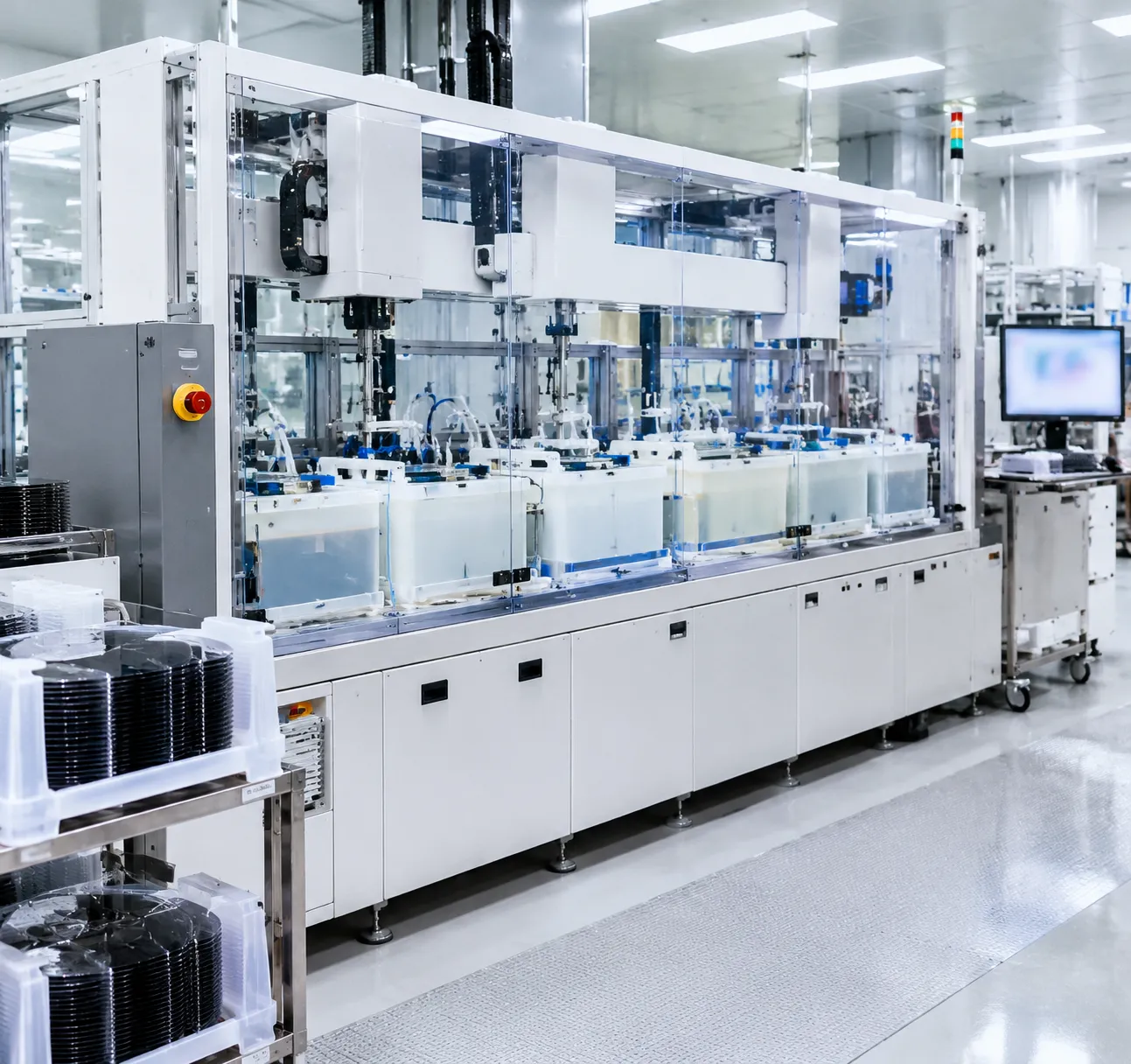
Every fab process has unique constraints. When standard platforms do not match your exact chemistry, substrate geometry, or throughput goals, we tailor our custom wet process stations with field-retrofittable modules. These upgrades extend process capabilities without requiring an entirely new tool installation.
Megasonic Transducer Integration for Delicate Wafer Patterns
Sub-micron particles demand high acoustic energy, but fragile structures (like high-aspect-ratio fin gates or MEMS beams) cannot tolerate destructive cavitation.
Direct-Bonded & Immersed Transducers: Uniform energy distribution across 0.5 to 3.0 MHz frequencies.
Pattern-Safe Power Control: Micro-stepped power wattage scaling prevents structural pattern collapse while lifting sub-40 nm contaminants.
Process Bath Uniformity: In-tank multi-angle arrays eliminate acoustic dead zones in every chemical wet bench for wafer processing.
Automated Chemical Spiking and Concentration Monitoring
Batch chemistry degrades over time through evaporation, drag-out, and active component depletion. We integrate closed-loop analytical and dosing loops:
In-Line Chemical Concentration Metrology: NIR, refractive index, and titration sensors monitor bath components (such as SC-1, SC-2, DHF, or BOE) continuously.
Closed-Loop Auto-Spike Dosing: Automated precision dosing valves inject replenishing reagents in real time to stabilize etch rates and cleaning efficiency.
Extended Bath Life: Reduces chemical usage up to 35% and maintains tight process repeatability without manual operator sampling.
Custom End-Effectors and Carriers for Thin or Warped Substrates
Compound semiconductors and advanced packaging substrates present unique mechanical challenges during wet transfers.
Low-Contact & Edge-Grip End-Effectors: Engineered from PVDF, PEEK, or PTFE to handle fragile substrates without backside contamination.
Warped Wafer Vacuum/Bernoulli Handling: Securely transfers warped SiC, GaN, or bonded wafers without slippage or mechanical stress.
Ultra-Thin Wafer Cassettes: Custom PFA cassettes prevent thin wafers (down to <100 µm) from flexing or touching during rapid fluid displacement cycles in high-precision wet benches.
Frequently Asked Questions: Chemical Wet Bench for Wafer Processing
How do manual and automated chemical wet benches compare in yield?
Manual processing introduces operator-dependent immersion timing, erratic pull speeds, and splash-back contamination. Implementing an automated wet bench semiconductor wet processing system removes human particulate shedding and standardizes recipe cycle times to the millisecond, typically increasing wafer batch yields by 5% to 15%. For pilot production, specialized academic research, or low-volume prototyping, manual wet bench systems offer a compact, budget-friendly alternative with built-in safety interlocks.
How do we guarantee etch rate uniformity across 200 mm and 300 mm wafers?
We achieve within-wafer and wafer-to-wafer etch rate uniformity below < 1.5% through balanced fluid dynamics and precision thermal management:
Four-Sided Weir Overflow: Sweeps away depleted boundary layers and prevents stagnant chemical zones.
Inline Recirculation Heating: Maintains bath process temperatures within ±0.5°C throughout the chemical volume.
Submerged Bottom Spargers: Delivers symmetrical upward chemical flow across every wafer slot in the carrier.
What safety standards keep operators safe around aggressive acid baths?
Every chemical wet bench for wafer fabrication that we build complies with SEMI S2, SEMI S8, and CE guidelines. Critical protective hardware includes:
FM4910-Rated Materials: PVDF, CPVC, and PTFE construction to eliminate flame propagation risks.
Exhaust Differential Interlocks: Halts chemical heating and delivery instantly if exhaust velocity drops below safe thresholds.
Dual-Containment Sumps: Continuous optical leak sensors detect leaks and isolate supply lines before fluids escape.
Light Curtains & Sealed Shields: Physical and optical barriers prevent manual exposure during robotic cycles.
Can a single wet bench safely handle both acids and solvents?
Mixing strong mineral acids (like Piranha or HF) and organic solvents in the same open environment poses severe fire and explosion risks. While dedicated, isolated stations are industry best practice, we engineer compartmentalized dual-chemistry platforms when cleanroom footprint is strictly limited. These systems feature completely segregated exhaust plenums, independent plumbing lines, isolated drainage sumps, and fire-rated physical bulkheads between process zones.
How does surface tension drying prevent micro-watermarks?
Surface tension (Marangoni) drying introduces an ultra-dilute IPA vapor stream as the wafer carrier slowly lifts from the hot deionized water bath.
-
- Meniscus Gradient: The IPA lowers the surface tension at the liquid-air interface, pulling water droplets off the wafer face.
- Residue-Free Dewetting: Water sheets off hydrophobic silicon surfaces smoothly without droplet evaporation.
- Pattern Preservation: Because no centrifugal force is applied, high-aspect-ratio microstructures avoid the pattern collapse and watermark defects typical of standard spin rinse dryers.