Formula details
Product Details
Overview
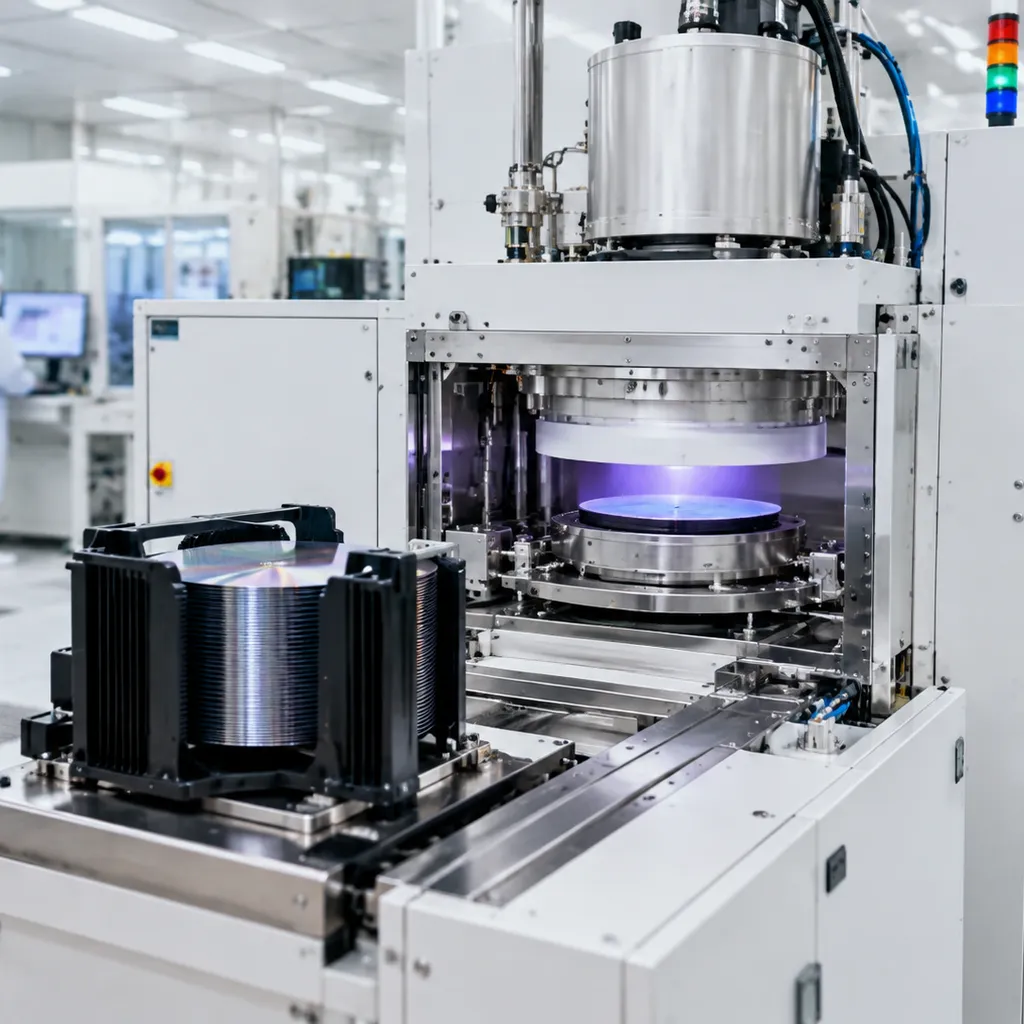
Semiconductor Wafer Etching Equipment
High-Selectivity Isotropic and Anisotropic Etching
Our wet etching platforms provide fine chemical selectivity across standard silicon and wide-bandgap compound semiconductors, including Silicon Carbide (SiC), Gallium Nitride (GaN), and Gallium Arsenide (GaAs).
-
- Isotropic Etch Control: Uniform chemical contact for omnidirectional oxide, nitride, and dielectric removal.
- Anisotropic Precision: Controlled crystallographic plane etching for trench formation, deep cavity release, and bulk micromachining.
- Material Versatility: Proven processing compatibility across silicon, quartz, sapphire, and compound semiconductor substrates.
Process Uniformity and Boundary Layer Fluid Control
Achieving high yield requires absolute control over fluid dynamics at the wafer surface. Our advanced bath agitation and chemical dispense architectures actively manage the fluid boundary layer to eliminate micro-loading effects and dead zones.
-
- Within-Wafer Non-Uniformity (WIWNU): Consistently maintains < 1.5% (1σ) across the entire wafer surface.
- Dynamic Bath Recirculation: Continuous inline chemical replenishment ensures constant etch rates from center to edge.
- Temperature Stabilization: Precise thermal loops eliminate localized heat variations during exothermic etching reactions.
Modular Platform Architecture
Our wet processing platforms scale flexibly to match your exact cleanroom footprint and throughput requirements.
-
- R&D and Pilot Stations: Manual and semi-automated bench configurations optimized for low-volume recipe development and material testing.
- High-Throughput Production: Fully automated, cassette-to-cassette platforms equipped for continuous fab-scale wafer manufacturing.
- Custom Integration: Modular tank layouts configured to your specific chemistry sequences, rinsing steps, and footprint constraints.
Wafer Etching Equipment Configurations and Automation
We configure our semiconductor wafer etching equipment to match your exact throughput requirements, cleanroom footprint, and process chemistry. From high-volume foundry manufacturing to flexible R&D labs, our platforms deliver consistent chemical delivery, precise immersion timing, and automated wafer handling.
Fully Automated Cassette-to-Cassette Wet Benches
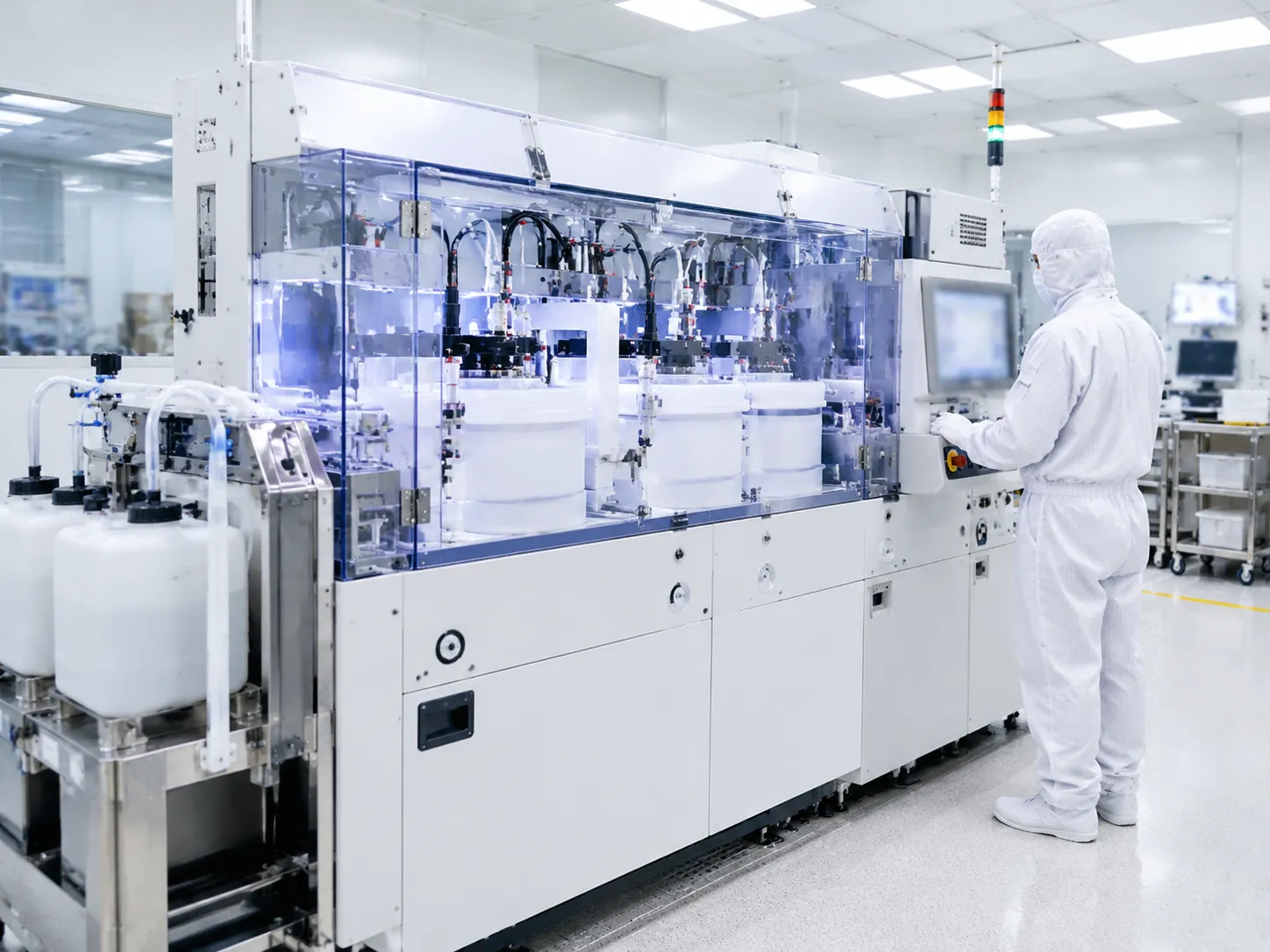
Designed for high-volume 100mm to 300mm manufacturing environments, our batch immersion wet bench systems provide automated multi-tank processing with zero operator chemical exposure.
-
- Robotic Transfer Mechanisms: Multi-axis robotic arms with automated grippers handle high-precision basket and wafer transfers between chemical baths, rinse tanks, and dryers.
- Factory Automation Ready: Full FOUP/SMIF load-port integration with SECS/GEM interface for real-time fab execution system (MES) recipe dispatch and lot tracking.
- High Chemical Integrity: Independent bath circulation loops, inline heating, and dedicated chemical spiked top-up modules maintain bath life and process repeatability.
Single-Wafer Precision Spin-Etch Systems
When batch processing cannot meet tight single-die uniformities or requires single-sided protection, our single-wafer spin etching tools provide controlled chemical dispensing.
-
- Selective Surface Etching: Dedicated dispense arms enable independent front-side or back-side etching without cross-contaminating opposing wafer surfaces.
- Substrate Thinning & Stress Relief: Closed-loop rotation and chemical flow controls achieve uniform wafer thinning and post-grind wet polishing across Silicon, SiC, and GaN substrates.
- Dynamic Fluid Delivery: Multi-nozzle spray and puddle arms handle aggressive acid mixtures, heated alkaline chemistries, and rapid DI water quenching in a single chamber.
Semi-Automated and Manual Wet Etch Stations
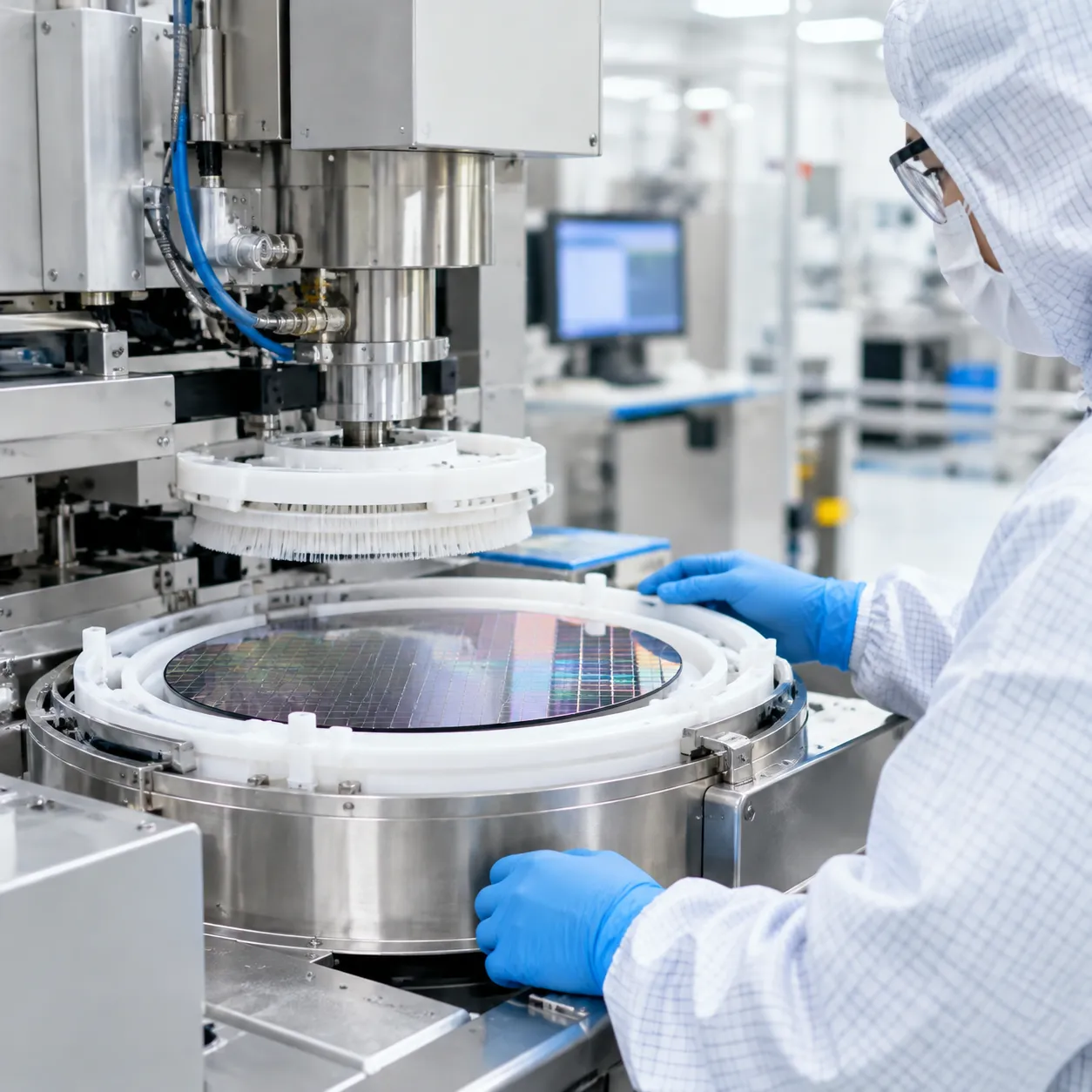
Built for pilot lines, failure analysis labs, and specialized R&D facilities, our standalone wet process bench configurations provide industrial-grade process safety in a compact footprint.
-
- Flexible Recipe Execution: PLC touchscreen interfaces allow operators to set automated bath immersion timers, pneumatic cover cycles, and quick-dump rinse routines.
- Modular Tank Layouts: Tailored arrangements of heated quartz tanks, fluoropolymer acid baths, and ultrasonic cleaning modules within a single exhaust-managed enclosure.
- Full Operator Safety: Manual stations feature continuous exhaust monitoring, transparent safety shields, physical chemical barrier lip exhausts, and manual EMO interlocks.
Configuration Overview
| Platform Type | Automation Level | Substrate Range | Primary Production Target |
|---|---|---|---|
| Batch Wet Bench | Fully Automated (FOUP / Cassette) | 100mm – 300mm | High-volume wafer fabs, mass etching, stripping |
| Single-Wafer Spin Tool | Automated / Semi-Automated | 2-inch – 300mm | Back-side thinning, reclaim, selective surface etch |
| Manual / Semi-Auto Station | Operator Loaded / PLC Timed | Pieces to 200mm | University R&D, pilot lines, low-volume specialty devices |
Substrate Compatibility and Chemical Processing Capabilities
Our semiconductor wafer etching equipment is engineered to handle diverse materials, from standard silicon to brittle wide-bandgap compound semiconductors and fragile optical substrates. We build modular, chemical-resistant fluid paths tailored to your exact wet chemical recipes.
Substrate Dimensions: 2-inch, 3-inch, 4-inch, 6-inch, 8-inch, and 12-inch (300mm) wafers, plus irregular dies
Supported Substrates: Silicon (Si), Silicon Carbide (SiC), Gallium Nitride (GaN), Gallium Arsenide (GaAs), Quartz, Glass, Sapphire, and Ceramics
Our modular baths and single-wafer chambers integrate seamlessly into advanced semiconductor wet processing systems for 300mm wafers and smaller multi-size batch tools.
Dedicated Process Chemistries and Bath Modules
To prevent cross-contamination and ensure maximum process repeatability, we isolate wet chemical operations into specialized process stations:
-
- Acid Etching Stations: Constructed from ultra-pure, FM4910-compliant fluoropolymers (PTFE, PFA, PVDF) and high-purity quartz. Purpose-built for Hydrofluoric Acid (HF), Buffered Oxide Etch (BOE), Nitric Acid (HNO3), Phosphoric Acid (H3PO4), and Piranha solutions (H2SO4/H2O2) to process thermal oxides, native oxides, and nitrides.
- Alkaline & Anisotropic Silicon Etch Modules: Built for Potassium Hydroxide (KOH) and Tetramethylammonium Hydroxide (TMAH) processing. Equipped with precise bath heating and chemical condensation recovery to maintain accurate anisotropic crystal plane etch profiles (such as <100> and <110>).
- Metal Layer Etchant Systems: Engineered with targeted fluid delivery and material-matched plumbing (including electropolished SUS316L where required) for selective removal of Aluminum, Copper, Titanium, Nickel, Gold, and Platinum thin films.
| Process Module | Compatible Chemistries | Target Layer / Application | Primary Tank Construction |
|---|---|---|---|
| Oxide / Dielectric Etch | HF, BOE, H3PO4 | SiO2, Si3N4, Sacrificial Oxides | Ultra-Pure PTFE / PFA |
| Anisotropic Silicon Etch | KOH, TMAH | Cavity Etch, Trenching, MEMS | PVDF / PFA / Quartz |
| Compound Semi Etch | Acid/Alkali Blends, HNO3 mixes | SiC, GaN, GaAs Device Isolation | PTFE / Custom Quartz |
| Metal Film Strip & Etch | Dedicated Acid/Solvent Etchants | Al, Cu, Ti, Ni, Au, Pt Thin Films | PFA / Electropolished 316L |
Each bath module follows our rigid semiconductor wet bench design protocols to ensure stable etch rates, uniform chemical replenishment, and zero structural degradation under corrosive chemistries.
High-Yield Semiconductor Wafer Etching Equipment Engineering
Thermal Precision and Fluid Recirculation
Precise chemical reactions depend on absolute bath stability. Our process tanks use advanced fluid dynamics to eliminate stagnant zones and thermal gradients across every wafer:
Thermal Stability: Closed-loop heating and cooling coils hold process chemistry within ±0.5°C across the entire bath volume.
Continuous Particle Control: Sub-micron inline chemical filtration constantly strips particulates from recirculating etchants, protecting fine microstructures.
Uniform Boundary Layer Flow: Engineered overflow weirs and laminar chemical injection deliver steady chemical replenishment across both single-wafer and batch configurations.
Megasonic Agitation and Deep-Cavity Penetration
Reaching into high-aspect-ratio trenches, MEMS cavities, and narrow via structures requires active fluid delivery. We integrate:
Swept-Frequency Megasonic Arrays: Multi-angle acoustic energy breaks boundary layers without causing mechanical pattern collapse or surface damage.
Vertical Mechanical Oscillation: Programmable recipe-driven basket movement accelerates chemical exchange within deep vias and micro-trenches.
Post-Etch Quenching and Watermark-Free Drying
Terminating the etch profile at the exact target depth is critical for yield. Our high-precision wet benches integrate rapid-quenching rinsers and advanced drying modules directly into the automated sequence:
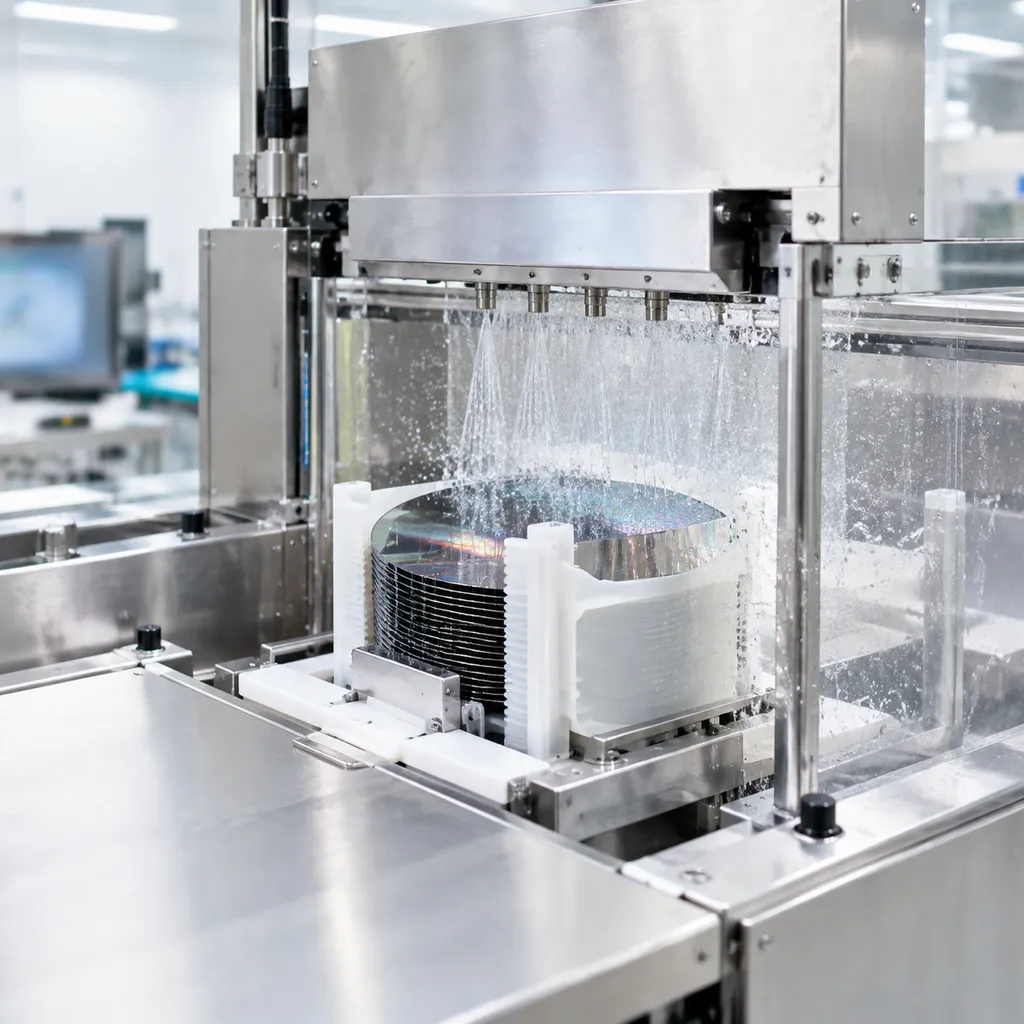
Instant Chemical Quenching: High-flow quick dump rinse system modules completely submerge and evacuate DI water in seconds, instantly stopping chemical etching.
Marangoni Vapor Drying: Ultra-low surface tension IPA vapor displacement dries high-aspect-ratio features without watermark formation or stiction.
Heated N2 Spin Rinse Dryers (SRD): High-speed rotational drying combined with filtered, heated nitrogen ensures complete moisture removal on standard planar and compound substrates.
Cleanroom Safety Standards and Smart Fab Automation
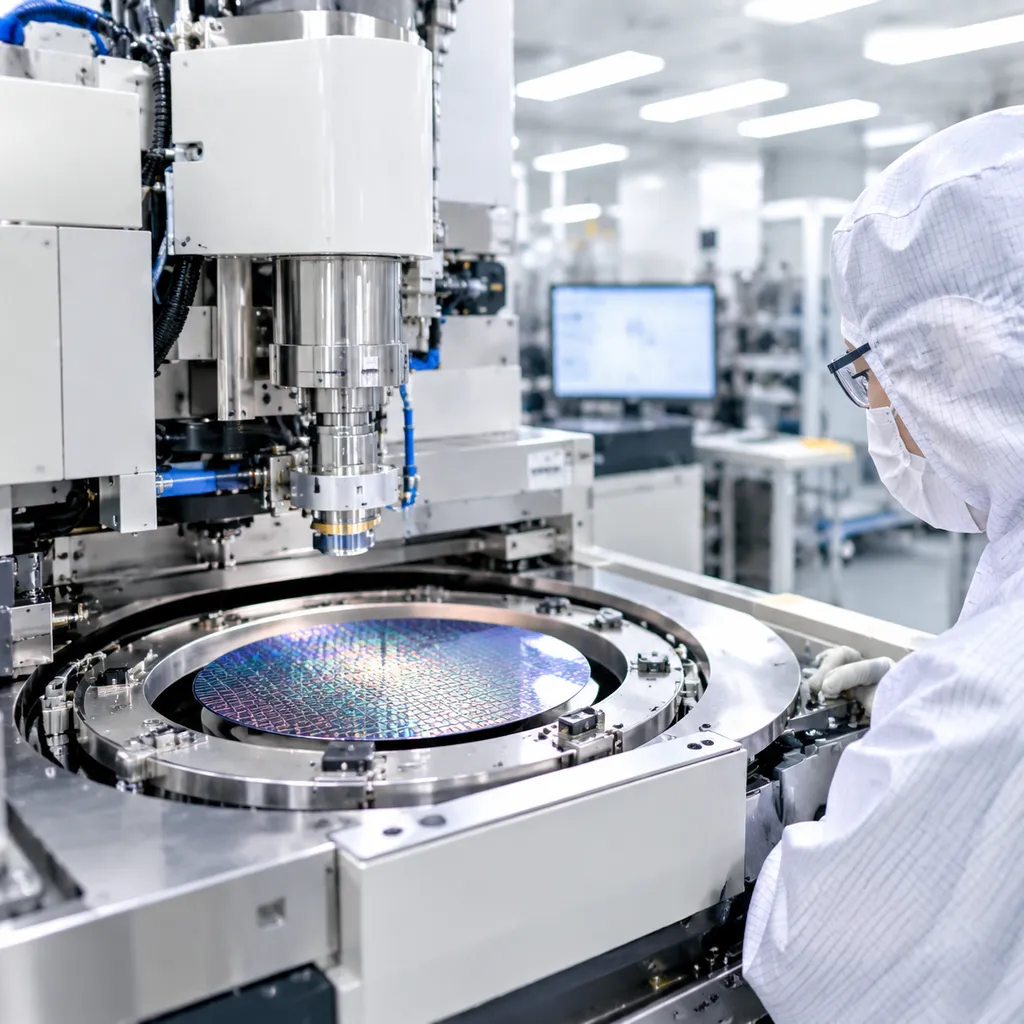
Corrosion-Proof and Fire-Safe Construction
-
- FM4910-Compliant Plastics: Process tanks and fluid handling circuits use flame-retardant, ultra-pure PVDF, NPP, PTFE, and PFA to resist hot acids and harsh oxidizers without chemical leeching.
- Dual Containment & Real-Time Leak Detection: Chemical routing lines feature dual-wall tubing and localized optical/conductivity sensors for instant leak isolation.
- Electropolished 316L Stainless Steel: Solvent-based process zones are enclosed in heavy-duty 316L stainless steel cabinetry, complete with dedicated fire suppression and Class 1 Div 1 / ATEX-compliant explosion-proof components.
- Continuous Exhaust Monitoring: Differential pressure transducers actively track facility exhaust to prevent hazardous vapor accumulation.
| Safety & Build Metric | Acid / Alkaline Wet Etch Modules | Solvent / Solvent Stripping Zones |
|---|---|---|
| Structural Materials | FM4910 PVDF, NPP, PTFE, PFA | Electropolished SUS316L |
| Cleanroom Compatibility | ISO Class 3 to Class 5 (10 / 100) | ISO Class 3 to Class 5 (10 / 100) |
| Leak & Vapor Monitoring | Dual-containment + Optical sensor | Continuous N₂ purge + Sniffers |
| Safety Compliance | SEMI S2, SEMI S8, CE | SEMI S2, ATEX / Class 1 Div 1, CE |
Industry 4.0 SECS/GEM and Recipe Control
Our automatic wet bench systems run on industrial PLC and IPC architectures with intuitive touchscreen HMIs, simplifying chemical management and bath sequencing.
-
- SEMI S2 / S8 Compliance: Ergonomic maintenance access, mechanical pinch-point guards, and integrated Emergency Off (EMO) loops protect fab personnel.
- SECS/GEM Integration: Native support for SEMI E4, E5, E30, and E37 standards connects the tool directly to your Manufacturing Execution System (MES) for automated wafer tracking, lot dispatching, and remote recipe management.
- Full Process Traceability: Real-time data logging captures bath temperatures, flow rates, chemical replenishment cycles, and filter differential pressures to maintain consistent wafer yields.
Key Semiconductor and Microelectronics Applications
Advanced Packaging and 3D Integration
We support high-density packaging architectures with precision wet etching tools designed for:
Through-Silicon Via (TSV) Processing: Uniform via cleaning, barrier layer prep, and silicon reveal etching.
Seed Layer & Metal Etching: Controlled removal of Cu, Ti, and Au seed layers without undercutting delicate microbumps or UBM structures in advanced semiconductor packaging lines.
Wafer Thinning: Controlled wet chemical back-thinning and stress relief to prepare fragile bonded substrates for stacking.
Compound Semiconductor Power Electronics
Wide-bandgap materials require robust chemical resistance and high thermal stability. Our systems support high-performance power semiconductor fabrication across SiC, GaN, and GaAs:
Gate Trench Etching: High-uniformity acid and base chemistries for precise trench depth and profile control.
Defect Delineation: High-temperature chemical etching to expose crystal dislocations and surface defects.
Substrate Thinning & Planarization: Fast, damage-free back-surface thinning with precise front-side surface protection.
MEMS and Microfluidics
Deep cavity features demand stable agitation and rapid fluid exchange to clear micro-channels:
Deep Anisotropic Silicon Etching: Precise bulk micromachining using KOH and TMAH baths with vertical agitation to eliminate bubble trapping.
Sacrificial Oxide Release: Safe BOE and HF etching modules that release suspended microstructures, sensors, and cantilevers without stiction damage.
Cavity and Channel Formation: Controlled etching of quartz, glass, and silicon substrates for microfluidic dies.
Logic, Memory, and Wafer Reclamation
For high-volume silicon manufacturing, our chemical processing stations maintain strict particle counts and surface cleanliness:
Gate Oxide and Dielectric Etching: Selective wet recess and oxide removal with bath filtration down to sub-micron levels.
Isotropic Recess: Uniform, omnidirectional etching for planarization and contact hole shaping.
Silicon Wafer Reclamation: High-throughput batch stripping of nitrides, oxides, and metals to reclaim test and monitor wafers with minimal raw silicon loss.
Semiconductor Wafer Etching Equipment Technical Specifications
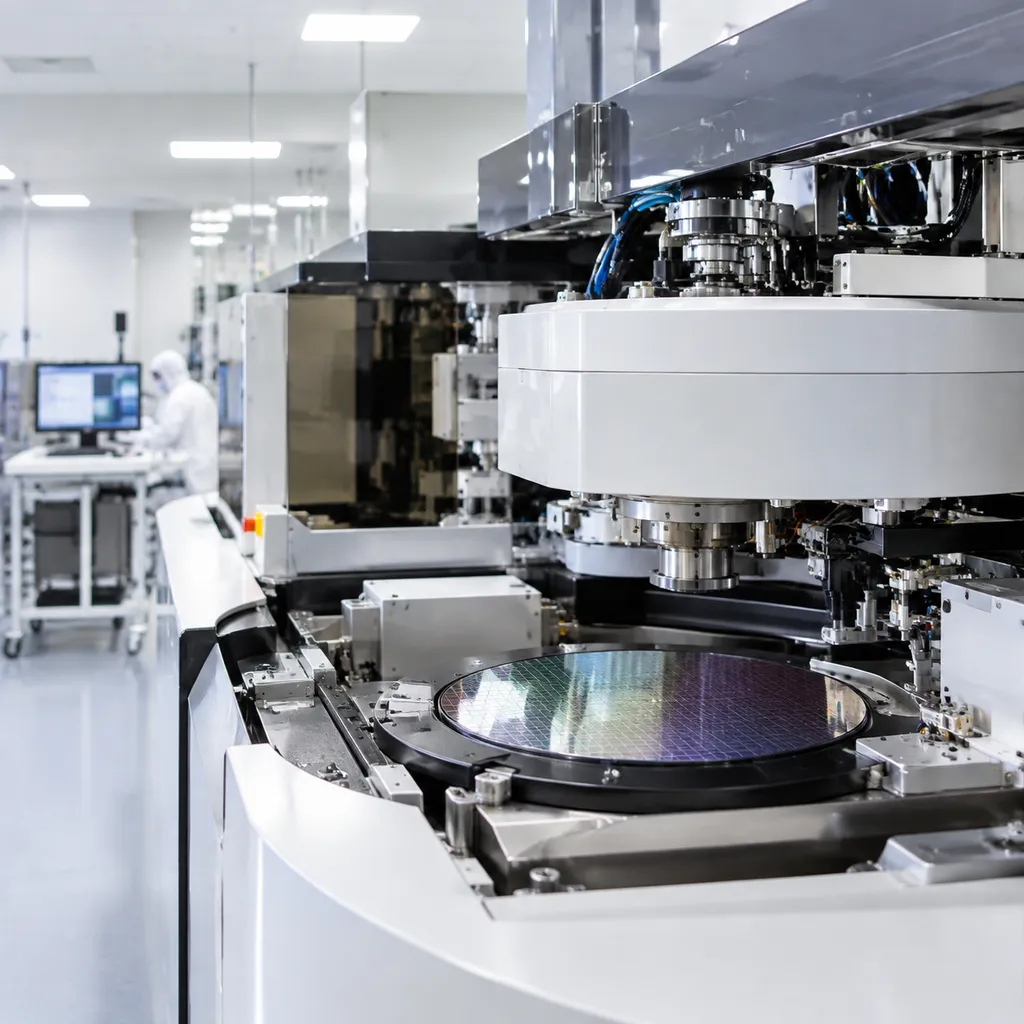
Substrate Handling & Physical Specifications
| Parameter | Specification |
|---|---|
| Supported Substrates | Silicon (Si), Silicon Carbide (SiC), Gallium Nitride (GaN), Gallium Arsenide (GaAs), Quartz, Glass, Sapphire, Ceramic |
| Wafer Sizes | 2-inch, 3-inch, 4-inch, 6-inch, 8-inch, 12-inch (300mm), and irregular substrate fragments |
| Active Bath Capacity | 10 L to 45 L per tank (batch configuration); dedicated single-wafer spin chambers |
| Automation Levels | Manual wet stations, semi-automated hoist transfer, and fully automated cassette-to-cassette robotics |
| Enclosure Footprint | Scalable modular footprint tailored to cleanroom bay layouts and utility access corridors |
Explore our dedicated single-wafer wet processing equipment for 300mm fabs for advanced single-substrate applications requiring specialized front- and back-side chemical dispense.
Process Performance & Thermal Control
| Performance Parameter | Operational Range & Tolerance |
|---|---|
| Etch Depth Uniformity | < 1.5% Within-Wafer Non-Uniformity (WIWNU, 1-sigma) |
| Temperature Control Range | Ambient up to 180°C with ±0.5°C inline precision |
| Recirculation & Flow Rates | 5 LPM to 30 LPM adjustable chemical bath flow rates with continuous overflow weir |
| Inline Filtration | 0.05 µm to 0.1 µm sub-micron PTFE/PFA high-purity filter elements |
| Rinse & Dry Execution | Quick Dump Rinse (QDR), heated high-purity N2 blow-off, Marangoni vapor, and Spin Rinse Dryers (SRD) |
Facilities, Cleanroom, and Factory Interface
| Interface Parameter | Standard Configuration |
|---|---|
| Cleanroom Rating | Class 10 / ISO 4 to Class 100 / ISO 5 cleanroom compatible |
| Wetted Materials | High-purity PFA, PTFE, PVDF, NPP, Quartz, and electropolished SUS316L (solvents) |
| Fire & Safety Compliance | FM4910-certified fluoropolymers, SEMI S2 / SEMI S8 standards, dual-containment leak detection |
| Facility Exhaust | Dedicated dual-exhaust paths (Acid/Corrosive and Alkaline/General) with differential pressure interlocks |
| Automation & MES Integration | Industrial PC/PLC touchscreen with full SECS/GEM (SEMI E4, E5, E30, E37) host connectivity |
Frequently Asked Questions About Wafer Etching Equipment
What is the difference between batch immersion wet benches and single-wafer spin-etch tools?
Choosing between batch immersion and single-wafer processing comes down to throughput needs and front-to-back selectivity:
| Feature | Batch Immersion Wet Bench | Single-Wafer Spin-Etch Tool |
|---|---|---|
| Throughput | High (25–50 wafers per run) | Moderate (Wafer-by-wafer serial processing) |
| Etch Application | Bulk oxide stripping, anisotropic Si etch, mass PR strip | Backside thinning, bevel clean, front/back isolated etch |
| Dispense Method | Recirculated immersion bath with weir overflow | Precision multi-chemical dynamic dispense arm |
| Substrate Handling | Full cassettes or custom carrier boats | Vacuum or non-contact Bernoulli/edge-grip chucks |
| Best Used For | High-volume silicon & compound production lines | High-precision packaging, TSV, and wafer reclaim |
For fabs prioritizing mass throughput across multi-tank recipes, our batch architectures mirror the high-reliability fluid controls found in our batch wafer cleaning systems. If you require isolated backside etching without chemical wrap-around to active device patterns, single-wafer spin configurations deliver targeted nozzle control similar to our single-wafer cleaning systems.
How does the etching equipment achieve and maintain WIWNU below 1.5%?
We maintain tight Within-Wafer Non-Uniformity (WIWNU) across 2-inch to 300mm substrates by controlling the fluidic and thermal environment across every square millimeter of the wafer:
-
- Thermal Uniformity: High-efficiency inline chemical heaters and inline heat exchangers hold bath temperatures within ±0.5°C, eliminating cold spots that cause etch rate drift.
- Fluid Dynamics & Overflow: Continuous filtered recirculation paired with precision overflow weir edges ensures fresh chemical continuously sweeps across the substrate surface without stagnant boundary layers.
- Active Agitation: Swept-frequency megasonic transducers and programmable vertical basket oscillation disperse micro-bubbles and refresh etchant inside high-aspect-ratio features.
Can a single system handle both aggressive acid (HF/BOE) and alkaline (KOH/TMAH) chemistries safely?
Yes. We engineer dual-chemistry semiconductor wafer etching equipment using dedicated process bays, physical separation zones, and segregated plumbing loops to prevent accidental chemical mixing.
-
- Material Compatibility: Acid modules utilize ultra-pure PTFE, PFA, and PVDF, while alkaline tanks leverage tailored polymers or quartz to resist caustic degradation.
- Segregated Exhaust & Drains: Dedicated acid and base exhaust paths prevent vapor reactions, paired with independent drain lines connected directly to fab neutralization facilities.
- Safety Enclosures: Wet benches use FM4910-rated flame-retardant materials and integrated dual-containment trays with automated optical leak sensors.
What drying options prevent watermark defects in high-aspect-ratio wafer features?
To eliminate capillary-force pattern collapse and watermark defects on hydrophobic surfaces, we integrate advanced drying technologies:
-
- Marangoni / IPA Vapor Drying: Uses surface tension gradients between DI water and isopropyl alcohol vapor to pull liquid cleanly out of deep trenches, MEMS cavities, and narrow vias without leaving residue.
- Spin Rinse Dryers (SRD): High-speed centrifugal rotation combined with heated, filtered ultra-pure nitrogen ($N_2$) purge to dry flat surfaces and bulk substrates rapidly.
- Heated $N_2$ Blow-Off: Deployed in single-wafer spin chambers to dry surfaces post-DI rinse without thermal shock.
How does SECS/GEM integration connect the wet bench to fab execution systems (MES)?
Our wet processing stations integrate Industrial PC (IPC) and PLC control systems fully compliant with SEMI E4, E5, E30, and E37 (SECS/GEM) communication standards. The interface enables automated fab execution:
-
- Recipe Management: Direct downloading and locking of validated multi-step etch, rinse, and dry recipes from the host MES.
- Real-Time Data Logging: Continuous tracing of bath temperatures, flow rates, filtration pressures, and chemical dispense volumes for yield analytics.
- Lot Tracking & Interlocks: Automated carrier identification, bath-life expiration tracking, and process lockouts if safety interlocks or exhaust flow thresholds drop out of spec.