Formula details
Product Details
Overview
How the Quick Dump Rinse System Works in Semiconductor Wet Processing
Halting Chemical Etch Kinetics and Dragout Carryover
When wafer carriers transfer from aggressive chemical baths—such as BOE, DHF, SC-1, or SPM (Piranha)—residual liquid films remain active on the topography. Our QDR system locks in exact etch depths by halting reaction kinetics on contact:
-
- Instant Reaction Quenching: Rapidly dilutes and displaces reactive chemicals to protect sensitive gate oxides and sub-micron trench profiles.
- Zero Chemical Carryover: Purges concentrated chemical dragout in the initial dump cycle, preventing contamination of downstream high-purity baths.
- Boundary Layer Collapse: Generates high fluid shear across the substrate face, disrupting stagnant fluid boundary layers within high-aspect-ratio structures.
Dual-Action Cross-Rinse Dynamics
Our QDR chambers combine overhead hydraulic spraying with ultra-fast bottom-dump evacuation for rapid dilution:
-
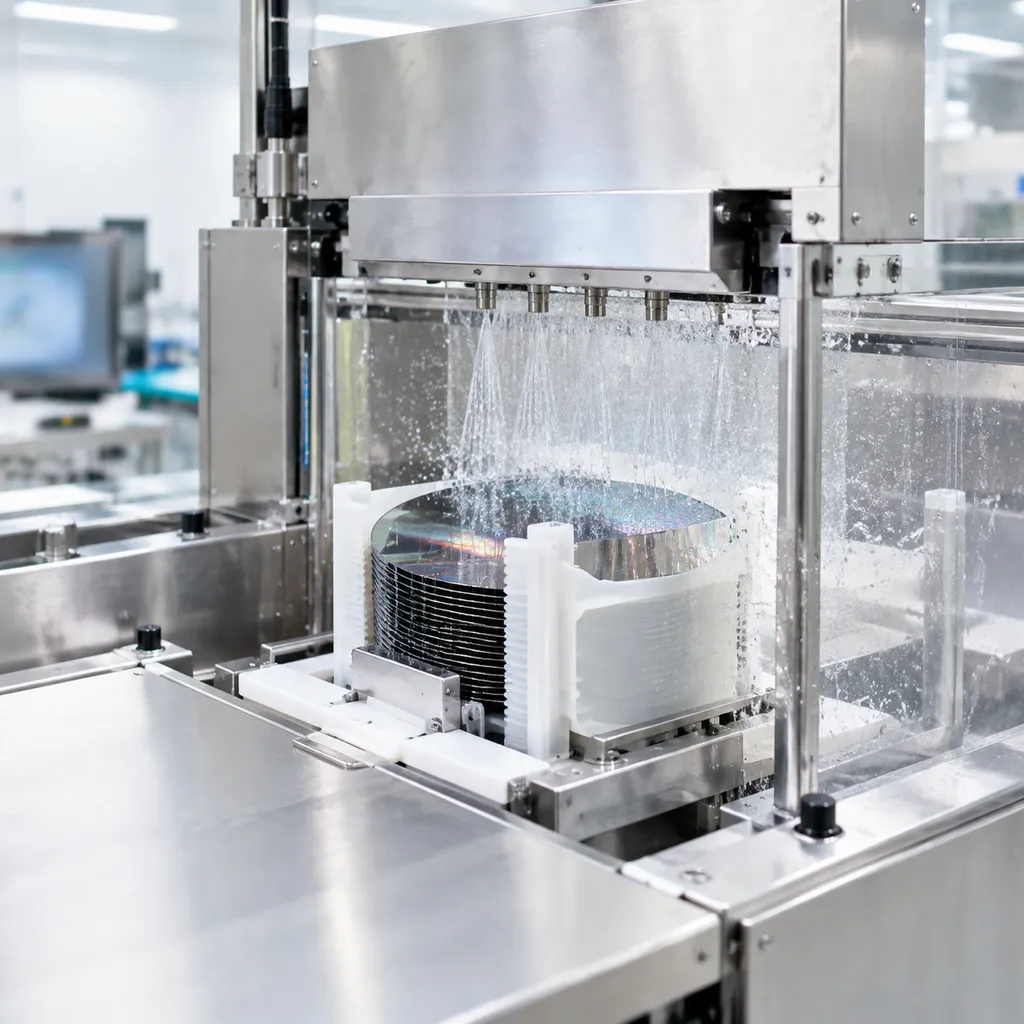
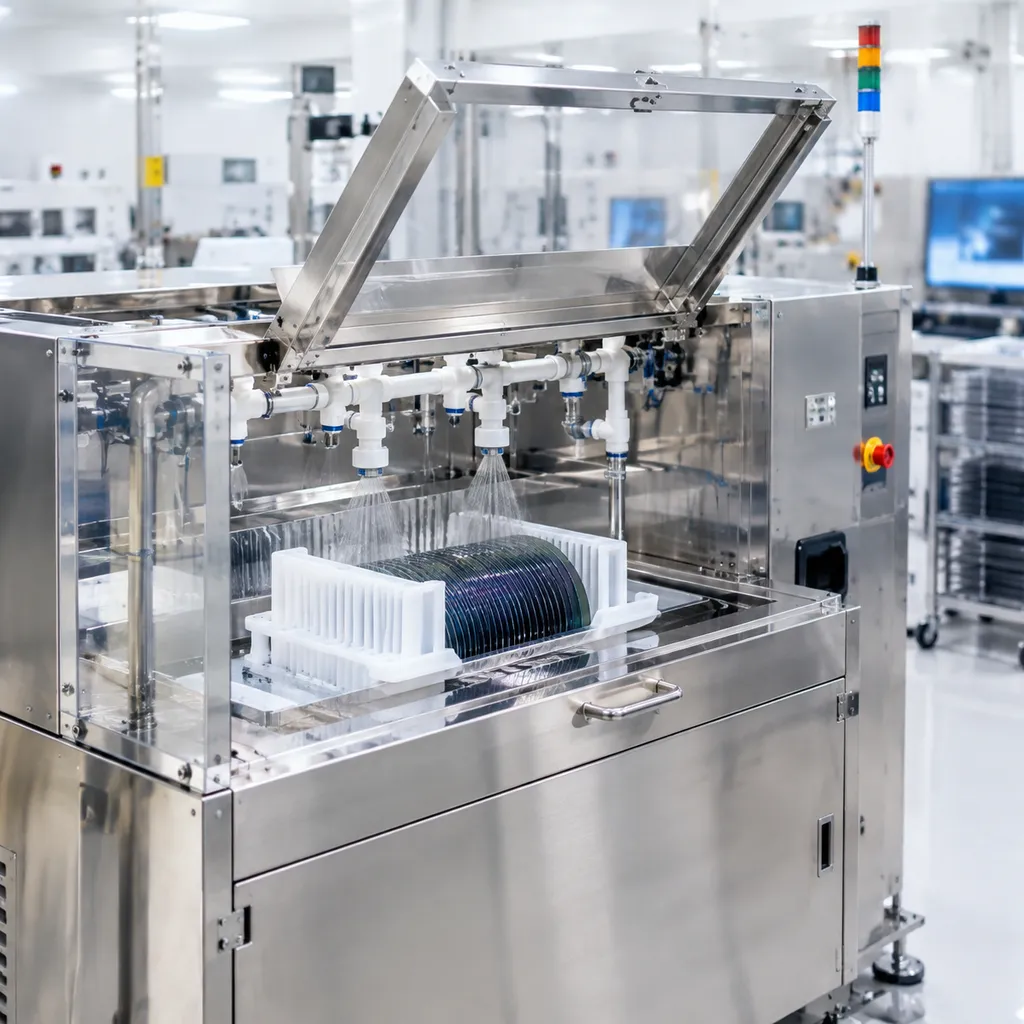
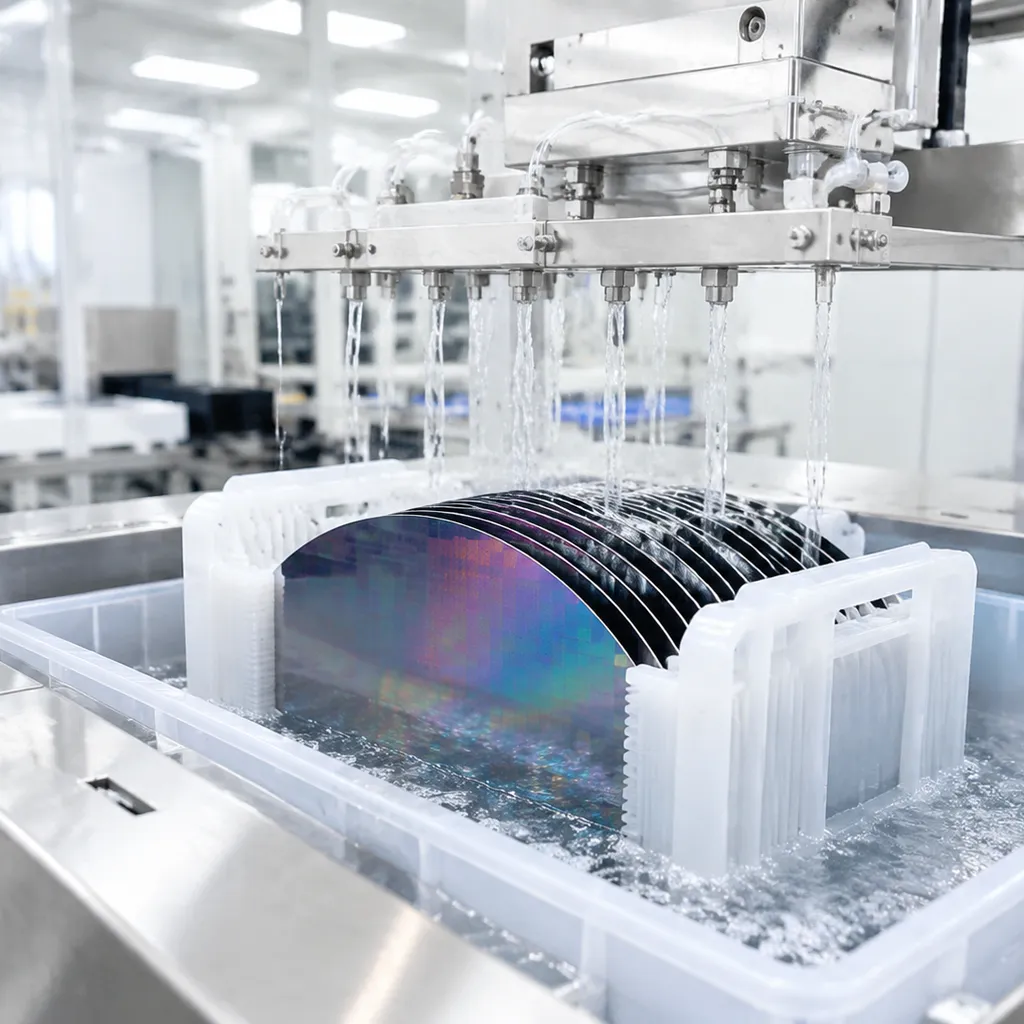
- Overhead High-Velocity Spraying: Angled, non-atomizing PFA/PVDF spray bars blanket both sides of every wafer, continuously flushing chemical residues from the substrate surface during the dump phase.
- Rapid Bottom-Dump Action: Custom pneumatic dump gates open in under 2.0 seconds, dropping the contaminated fluid column instantly via gravity without causing turbulent splashback.
- Multi-Cycle Dynamic Cleansing: Alternating cycles of high-volume bottom filling, overhead spraying, and rapid dumping strip trace ionic contaminants faster than standard immersion baths.
CFD-Optimized Fluid Chamber Design
We applied Computational Fluid Dynamics (CFD) modeling to streamline vessel geometry and optimize flow paths:
-
- Dead-Leg & Vortex Elimination: Swept interior corners and balanced bottom-drain manifolds eliminate low-velocity zones where particles and acid residues typically stagnate.
- DI Water Conservation: Optimized nozzle placement and directed flow dynamics cut Deionized (DI) water consumption by up to 45% compared to conventional cascade overflow designs.
- Fast Resistivity Recovery: CFD-tuned displacement purges contaminants efficiently, returning the bath to baseline 18.2 MΩ·cm ultra-pure water (UPW) resistivity in minimum cycle time.
Multi-Stage Rinsing Sequences and Operational Modes
Our quick dump rinse system uses fully programmable, multi-step recipe sequences designed to strip away chemical boundary layers, dislodge sub-micron particles, and halt etching instantly.
| Process Phase | Fluidic Action | Primary Engineering Purpose |
|---|---|---|
| 1. High-Flow Spray | Overhead PFA/PVDF flat-fan nozzles | Immediate etch stop and surface quenching |
| 2. Rapid Dump | Bottom pneumatic gate evacuation | Boundary-layer displacement (< 2.5 s) |
| 3. N₂ Agitation | Sub-surface micro-bubbling grid | Particle lift-off in high-aspect-ratio trenches |
| 4. Cascade Rinse | Upward laminar overflow | Final ionic removal using 18.2 MΩ·cm DI water |
High-Velocity Overhead Spray Injection
We equip each quick dump rinser with non-clogging, high-purity PFA and PVDF spray manifolds positioned above the carrier envelope.
Instantaneous Quench: Delivers pressurized DI water directly across the wafer surfaces the microsecond the carrier enters the bath, freezing chemical reaction kinetics.
Uniform Wetting: Overlapping spray patterns ensure total coverage across wafer edges and centers without creating mechanical stress or micro-crack risks on thin substrates.
Ultra-Fast Bottom Dump Mechanism
Chemical carryover occurs when viscous chemicals stick to substrate surfaces within the stagnant fluid boundary layer. Our bottom-dump design clears this layer completely:
Rapid Evacuation: Actuated by fast-response pneumatic cylinders, the bottom dump doors drop the entire liquid volume in under 2.5 seconds.
Shear-Force Clearing: The sudden downward draw creates a uniform velocity profile that shears chemicals and dragout fluid away from the wafers rather than letting them redeposit.
Cascade Overflow and Static Immersion Mode
Following repetitive spray-and-dump cycles, the vessel transitions to static immersion paired with continuous upward cascade overflow. Integrated seamlessly into our chemical wet bench for wafer cleaning and etching, this mode sweeps trace ionic contaminants over the polished weir edges, preparing the batch for final chemical-free extraction.
Nitrogen (N2) Sub-Surface Agitation and Chamber Blanketing
-
- Deep Trench Penetration: A dedicated sub-surface N2 sparger injects high-purity micro-bubbles into the DI water bath, generating controlled turbulence that lifts trapped process chemistries out of high-aspect-ratio trenches and contact vias.
- Oxidation Suppression: An integrated top-cover N2 blanket purges oxygen from the headspace during dry-to-wet and wet-to-dry transitions, preventing native silicon oxide growth on exposed active areas.
Quick Dump Rinse System Technical Specifications and Engineering Parameters
Substrate Compatibility and Form Factors
We design our QDR systems to handle single-cassette and dual-cassette batch configurations with adaptable vessel geometries:
-
- Silicon Wafers: Standard 100 mm, 150 mm, 200 mm, and advanced integration for semiconductor wet processing systems for 300mm wafers.
- Compound Semiconductors: Dedicated non-contact carriers for ultra-thin Gallium Nitride (GaN) and Silicon Carbide (SiC).
- Photomasks and Optics: Standard quartz plates up to 9-inch square profiles.
Core Fluidic and Engineering Parameters
The fast dump rinse tank utilizes balanced pneumatic dump doors and optimized spray manifolds to achieve sub-2.5-second cycle times without introducing micro-bubble turbulence or surface defects.
| Parameter | Specification / Range |
|---|---|
| Dump Mechanism Speed | < 2.5 seconds (full chamber evacuation) |
| Chamber Fill Time | 12 – 25 seconds (recipe dependent) |
| DI Water Resistivity Recovery | Fast recovery to 18.2 MΩ·cm endpoint |
| N2 Agitation Pressure | 15 – 30 PSI (ultra-high purity micro-diffusers) |
| Exhaust Requirements | 50 – 100 CFM at 0.5" w.g. static pressure |
| Pneumatic Actuation | 60 – 80 PSI filtered clean dry air (CDA) |
In-Line Process Monitoring and Sensor Arrays
Every DI water dump rinser includes real-time process monitoring to eliminate guesswork during the rinse cycle:
-
- High-Purity Resistivity Monitoring: In-line PFA flow-through resistivity cells measure chemical dragout clearance up to 18.2 MΩ·cm, automatically triggering process completion.
- Non-Contact Optical Level Sensors: Multi-point infrared and capacitance level sensors track low-level, high-fill, and overflow conditions without contacting process chemistry.
- Pneumatic Position Feedback: Magnetic reed sensors confirm complete door closure and full opening to prevent cassette collisions during automated robot loading.
PLC/HMI Automation and Recipe Management
Our control architecture provides full recipe flexibility to match your exact cleaning protocols as outlined in our semiconductor wet bench design and specification guide:
-
- Recipe Customization: Program spray-only, top-fill immersion, nitrogen-bubble agitation, and multi-cycle fast dumps.
- Precision Interval Timing: Millisecond-level adjustments for spray duration, static soak intervals, and bottom-dump sequencing.
- Real-Time Data Logging: Full SECS/GEM and Ethernet communication for historical cycle tracking, DI water consumption analytics, and alarm history logging.
High-Purity Material Construction and Chemical Compatibility
We build every quick dump rinse system using ultra-pure, chemically inert materials to eliminate trace-metal leaching and resist aggressive chemistry. Tank construction is tailored directly to your process chemistry:
-
- Seamless Thermo-Welded Natural PVDF & PFA: For aggressive acid chemistries (including concentrated HF, BOE, and SPM/Piranha), we utilize high-purity virgin PFA and natural PVDF. Our continuous non-contact infrared and hot-gas thermo-welding methods eliminate micro-crevices, preventing chemical entrapment and particle build-up.
- Fire-Retardant Polypropylene (FRPP): Selected for alkaline cleans (such as KOH, TMAH, and SC-1) and general wet processes requiring UL 94 V-0 flammability compliance and structural rigidity.
- High-Purity Quartz Vessels: Engineered for high-temperature operations (up to 150°C+) and advanced FEOL gate-cleans where absolute zero-metal extraction and thermal shock resistance are mandatory.
- Zero-Dead-Volume Fluid Manifolds & FFKM Seals: We integrate precision PFA fluid distribution networks using high-end elastomers for semiconductor wet benches (FFKM perfluoroelastomer seals). Coupled with our high-purity pneumatic diaphragm valve configurations, the fluid paths eliminate stagnant fluid pockets, guarantee instant shutoff, and extend maintenance intervals across millions of dump cycles.
Material Selection Matrix for QDR System Chambers
| Material Grade | Chemical Compatibility | Max Process Temp | Primary Process Target |
|---|---|---|---|
| Natural PVDF / PFA | Concentrated HF, BOE, SPM, HCl, HNO3 | 80°C (PVDF) / 130°C (PFA) | Acid Etch Quench & Gate Oxide Cleans |
| FRPP (Polypropylene) | TMAH, KOH, NH4OH, Solvent Blends | 65°C | Post-Develop Rinse & Alkaline Stripping |
| Fused High-Purity Quartz | Hot H2SO4, H2O2, Hot DIW, Ozone | 150°C+ | Trace-Metal-Free FEOL & High-Temp Cleans |
| FFKM / Pure PFA Seals | Universal Acid / Base / Solvent Resistance | 180°C | Dump Gate Sealing & Fluid Delivery Lines |
Semiconductor and Advanced Microelectronics Process Applications
Key Microelectronics Applications
| FEOL Gate Cleans | BEOL & Advanced Packaging | Compound Semiconductor & MEMS |
|---|---|---|
| DHF native oxide removal | TSV residue removal | SiC / GaN acid quench |
| RCA clean rinses | Metal etch residue wash | High-aspect-ratio MEMS release |
| Sub-0.5 Å process control | Polymer stripping stop / rinse | Anti-stiction processing |
Front-End of Line (FEOL) Surface Prep
In FEOL pre-gate cleans and dilute hydrofluoric (dHF) oxide etching, stopping the etch at the exact targeted time prevents over-etching of thin dielectric layers.
-
- Native Oxide Control: Halts dHF reactions in under 2 seconds to maintain strict oxide thickness targets within ±0.5 Å.
- Chemical Decontamination: Rapidly flushes sulfuric peroxide (SPM) and standard clean (SC-1/SC-2) chemistries before chemical carryover can cause cross-bath contamination.
- Watermark Mitigation: Nitrogen-assisted spray cycles eliminate ambient oxygen contact, preventing dissolved oxygen-induced pitting on bare silicon surfaces.
Back-End of Line (BEOL) and Advanced Packaging
During BEOL processing, our wafer quick dump rinse tank removes trapped etchants and post-strip chemistries from deep topographies. We integrate these rinse modules directly into automated lines for advanced semiconductor packaging, targeting high-density interconnects.
-
- Through-Silicon Via (TSV) Cleaning: High-velocity overhead spray penetration clears stubborn chemistries from high-depth TSV cavities (aspect ratios > 10:1).
- Corrosion Arrest: Instantly quenches acidic solvent strippers on aluminum and copper metallization layers to stop micro-corrosion and galvanic pitting.
- Slurry and Particle Scrubbing: Rapid cyclic dumping removes sub-micron particulates after chemical mechanical planarization (CMP) post-clean stages.
Compound Semiconductors (SiC, GaN) and Optoelectronics
Silicon Carbide (SiC) and Gallium Nitride (GaN) power devices require aggressive acid combinations, including hot phosphoric, nitric, and hydrofluoric acid blends.
-
- Aggressive Acid Quenching: Rapidly halts high-temperature, concentrated acid etch rates without thermal shock damage to brittle compound substrates.
- Defect Passivation: Flushes surface-bound metallic ions to achieve complete surface passivation, reaching target bath resistivity of 18.2 MΩ·cm in under three dump cycles.
MEMS and High-Aspect-Ratio Microstructures
For micro-electro-mechanical systems (MEMS), surface tension during wet processing often causes structural collapse (stiction). Integrated within our high-precision wet benches for semiconductor processing, our QDR system utilizes optimized dump rates and low-impact fluid transitions to preserve delicate, free-standing MEMS beams, micro-mirrors, and cantilever arrays without mechanical breakage.
Safety Standards, Reliability, and Cleanroom Compliance
Process safety and cleanroom integrity drive every mechanical and electrical choice in our quick dump rinse system design. Because a QDR operates immediately downstream from aggressive acid or solvent baths, we engineer multiple layers of hardware fail-safes and secondary containment to protect both your operators and your cleanroom envelope.
Fail-Safe Pneumatic Valve Positioning and Emergency Dump
-
- Spring-Return Pneumatic Actuation: Our bottom dump doors and DI water injection valves utilize normally-open or normally-closed spring-return pneumatic actuators. In the event of main electrical power loss or cleanroom CDA (compressed dry air) failure, the dump doors default to a safe open position to prevent stagnant acid retention on sensitive wafers.
- Emergency Gravity Evacuation: The bottom dump gate linkage allows an unassisted gravity dump in less than 2.0 seconds, instantly clearing corrosive chemistries during emergency EMO (Emergency Off) trips.
- Zero-Pressure Valve Sealing: Precision-machined FFKM/PTFE gate seals maintain positive sealing under static liquid loads without over-compressing, preventing seal creep, micro-vibrations, and premature failure.
Secondary Liquid Containment and Chemical Splash Prevention
To safely integrate our rinse modules into advanced wet bench chemistry equipment for semiconductor cleanroom operations, we build each tank with integrated dual-containment safeguards:
| Safety Feature | Engineering Implementation | Cleanroom Protection Target |
|---|---|---|
| Secondary Outer Basin | Thermo-welded PVDF/FRPP outer tub (110% volume capacity) | Complete capture of inner tank leaks or supply line ruptures |
| Optical Leak Detection | Continuous infrared/optical sensors in the containment basin | Sub-second alarm triggering and automatic upstream supply shutoff |
| Integrated Lip Exhaust | Perimeter exhaust slots pulling 150–250 CFM | 100% capture of chemical vapors and aerosolized DI water mist |
| Splash-Shield Baffling | Hinged or automated PVDF splash covers | Zero droplet escape during high-velocity overhead spray cycles |
SEMI S2, SEMI S8, and CE Compliance
We build and test our wafer quick dump rinse tanks to satisfy global cleanroom and fabrication standards:
-
- SEMI S2 Compliance: Full alignment with environmental, health, and safety guidelines, including chemical compatibility, exhaust balancing, and fail-safe interlocks.
- SEMI S8 Ergonomics: Optimized bath depths, lifter mechanisms, and manual loading angles eliminate operator strain during carrier handling.
- CE & Class 1 Cleanroom Certified: Materials, electrical enclosures, and non-outgassing polymers are certified for direct installation in ISO Class 3 (Class 1) wet processing environments.
Modular Integration and Retrofit Options for Quick Dump Rinse Systems
We design our quick dump rinse system modules for maximum flexibility, whether you are building a new automated line or retrofitting an aging tool. Our drop-in designs integrate seamlessly into fully automated batch immersion wet bench systems for wafer processing as well as operator-guided manual stations.
Automated Robotics and Transfer Station Compatibility
-
- Overhead Robot Interfacing: Low-profile top flanges and precision guide-pin channels allow clean wafer boat handoffs from overhead robotic grippers without spray interference or clearance issues.
- PLC/SECS-GEM Integration: Standardized industrial communication protocols (Ethernet/IP, Modbus, SECS/GEM) allow direct linking to the host wet bench controller for automated recipe execution and cycle logging.
- Synchronized Splash Covers: High-speed, pneumatically actuated covers open and close in sync with robot motion profiles to contain DI water mist and maintain cleanroom air velocity profiles.
Manual Bench Configurations with Hands-Free Actuation
For manual R&D lines and specialized cleaning benches, our fast dump rinse tank modules feature ergonomic control interfaces:
Foot-Pedal Initiation: Operators can trigger the entire dump and spray sequence hands-free without breaking cleanroom glove protocol.
Optical Proximity Sensors: Zero-touch capacitive or optical sensors mounted along the tank deck allow rapid cycle start with a simple hand wave.
Localized Status Indicators: High-visibility LED light rings provide real-time process feedback (Rinsing, Dumping, Resistivity Target Reached, Ready for Unload).
Drop-In Replacement for Legacy OEM Tanks
Replacing obsolete wet bench rinse modules often causes costly deck modifications. We build drop-in QDR modules with custom outer envelopes, flange geometries, and utility connections to match legacy OEM cutouts exactly.
| Integration Type | Actuation & Control | Utility Connections | Mounting / Footprint |
|---|---|---|---|
| Automated Linear Wet Bench | PLC-controlled pneumatic valves; robotic interlock signals | Bottom/rear N2, DI water, and ultra-fast drain manifolds | Standardized deck-mount lip with vibration-damped brackets |
| Manual / Semi-Automated Bench | Hands-free foot pedal; optical deck switches; local HMI timer | Flexible PFA/PVDF flare fittings with quick-disconnect drains | Drop-in top lip mounting with customized deck-cutout dimensions |
| Legacy OEM Retrofit | Direct field-wiring to existing PLC racks or standalone micro-PLC | Matched centerline connections to replace existing plumbing lines | Engineered-to-order flange profiles matching original tool cutouts |
Our team configures each unit for fast, plug-and-play installation into custom wet process stations, reducing tool downtime and getting your wet cleaning line back to target yields quickly.
Frequently Asked Questions About Quick Dump Rinse Systems
How does a quick dump rinse system reduce DI water consumption compared to overflow baths?
Standard overflow baths rely on continuous volumetric dilution, running constant flow rates of 15 to 25 LPM to gradually flush process chemicals. This wastes thousands of gallons of ultra-pure water per shift.
Our quick dump rinse system operates on a rapid cyclic displacement principle:
-
- Pulsed Overhead Sprays: High-velocity PFA/PVDF nozzles blanket the substrate surface to break chemical surface tension instantly.
- Sub-2.5-Second Evacuation: Bottom dump valves evacuate the entire liquid volume in under 2.5 seconds, stripping the depleted chemical boundary layer instead of slowly diluting it.
- Resistivity-Triggered Cutoff: In-line sensors shut off incoming DI water the exact millisecond the bath recovers to 18.2 MΩ·cm.
This targeted sequence cuts total DI water consumption by 50% to 70% per batch while delivering faster etch-stop transitions. For a broader overview of wet bench fluid dynamics, consult our comprehensive wafer cleaning systems guide.
| Rinsing Method | Average DI Flow Rate | Time to 18.2 MΩ·cm Recovery |
|---|---|---|
| Standard Overflow Bath | 18–25 LPM (Static) | 8–12 minutes |
| High-Efficiency QDR Bath | 6–10 LPM (Pulsed) | 2–4 minutes |
What dump gate mechanism is used to prevent wafer vibration and micro-cracking?
Rapid fluid evacuation can generate severe hydraulic shock and turbulence if not properly controlled. In our batch wafer cleaning systems, we engineered a dual-cylinder, pneumatic-damped sliding gate mechanism:
-
- Proportional Pneumatics: Smoothly open the bottom dump plate without mechanical jerking or pressure spikes.
- CFD-Modeled Flow Guides: Funnel the exiting liquid downward in a laminar path, preventing vortex-induced cassette rattling.
- Substrate Protection: Eliminates micro-vibrations that cause micro-cracking, slip lines, and pattern collapse on ultra-thin (<100 µm) wafers and high-aspect-ratio MEMS structures.
How does the QDR system prevent chemical carryover between consecutive batches?
Chemical dragout and cross-contamination ruin yield in multi-step wet benches. We eliminate chemical carryover through deliberate structural design:
-
- Zero-Dead-Leg Manifolds: Fluid delivery channels have no static pockets, ensuring chemistry cannot hide in pipe tees or fitting joints.
- Seamless Natural PVDF/PFA Vessels: Thermo-welded, mirror-finish inner surfaces prevent aggressive acids (like HF, BOE, and SPM) from absorbing into the tank walls.
- Perimeter Nitrogen Blanketing & Bottom Purge: An active sub-surface $N_2$ bubble grid scrubs the tank floor during the dump cycle, sweeping heavy chemical residuals directly into the drain before the next cassette arrives.
Can the rinse tank be customized for non-standard wafer sizes or MEMS carriers?
Yes. We engineer and machine custom wafer quick dump rinse tank configurations to match any production workflow:
-
- Substrate Dimensions: Direct compatibility with standard 100mm, 150mm, 200mm, and 300mm wafers.
- Compound Semiconductors & Photomasks: Specialized low-contact nests for square quartz photomasks, GaN wafers, and thick SiC substrates.
- Carrier Configurations: Custom-machined guide rails to support standard 25-wafer cassettes, single-wafer end effectors, or specialized high-profile carrier boats.
- Retrofit Form Factors: Drop-in dimensional matching to replace legacy OEM tanks on third-party manual or automated wet benches without altering facility plumbing layouts.