Formula details
Product Details
Overview
Core Process Applications for Batch Immersion Wet Bench Systems
RCA Clean and Advanced Surface Preparation
Wafer surface contamination directly limits device yield. Our automated RCA clean configurations provide sequential, multi-tank surface conditioning to eliminate organic films, particulate defects, and ionic impurities:
-
- SC-1 Particle Removal (NH₄OH / H₂O₂ / DIW): Controlled alkaline oxidation and simultaneous surface etching dislodge sub-micron particles via zeta-potential manipulation, enhanced by optional megasonic energy.
- Native Oxide Strip (DHF): Rapid, uniform removal of chemical oxides prepares clean, hydrophobic silicon surfaces prior to subsequent thermal steps.
- SC-2 Metallic Stripping (HCl / H₂O₂ / DIW): Acidic solubilization extracts trace transition metals and alkali contaminants to sub-ppb baseline thresholds.
High-Temperature Acidic Etching
Harsh acidic chemistries operating at elevated temperatures require robust thermal distribution and chemical-inert tank construction. Our acid processing modules support high-rate material removal and selective etching:
-
- SPM Piranha Resist Strip (H₂SO₄ / H₂O₂): Operates at temperatures up to 130°C–150°C to oxidize heavy organic photoresist layers and post-ash residues cleanly without substrate damage.
- Oxide Etching (DHF and BOE): Buffered oxide etch (BOE) and dilute hydrofluoric acid stations deliver linear etch rates for thermal, LPCVD, and PECVD silicon dioxide layers.
- Hot Phosphoric Acid (H₃PO₄): Precision silicon nitride stripping operating at tightly maintained boiling regimes with integrated DI water spiking to control specific gravity and maintain selectivity over underlying oxide.
Anisotropic Silicon Texturing and Micromachining
For MEMS cavities, 3D microstructures, and advanced solar texturing, anisotropic etching demands exact crystallographic plane selectivity and uniform bath circulation:
-
- Heated KOH Baths: Deliver stable etch rates across Si (100) and (110) planes, engineered with recirculated quartz tanks and condensation reflux covers to maintain chemical concentration.
- TMAH Formulations: Metal-ion-free anisotropic etching suited for CMOS-compatible MEMS production without introducing mobile alkali ion contamination.
Solvent Stripping and Post-Etch Residue Removal
Tough cross-linked polymer residues and thick photoresist layers require targeted solvent immersion:
-
- Immersion Chemistries: Fully compatible with NMP, DMSO, and proprietary solvent blends for bulk resist lifting, metal lift-off, and tough post-RIE cleaning.
- Atmospheric Control: Sealed tank covers and continuous high-purity nitrogen blankets prevent solvent evaporation, mitigate flammability hazards, and suppress moisture absorption.
Modular Tank Stations and Hardware Engineering
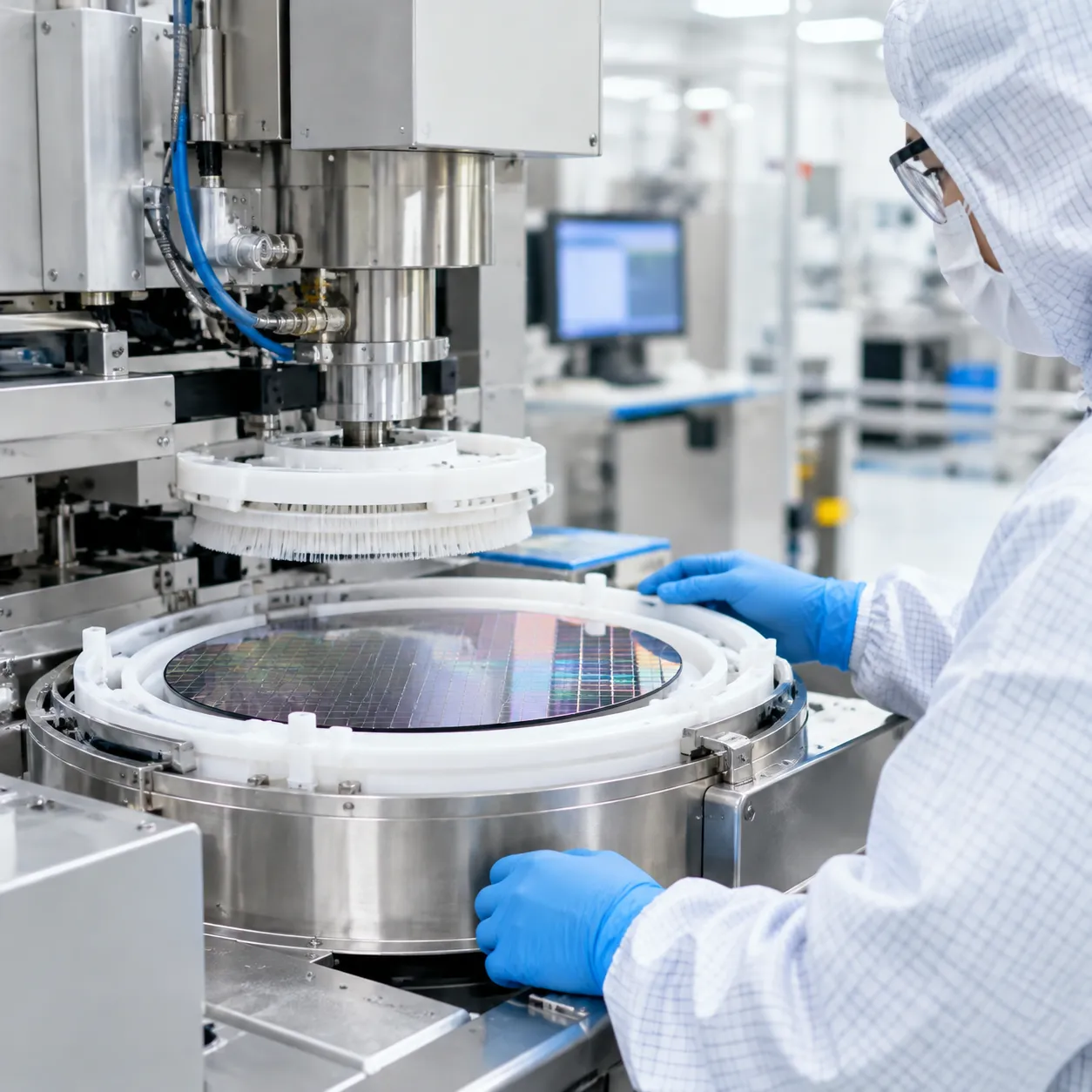
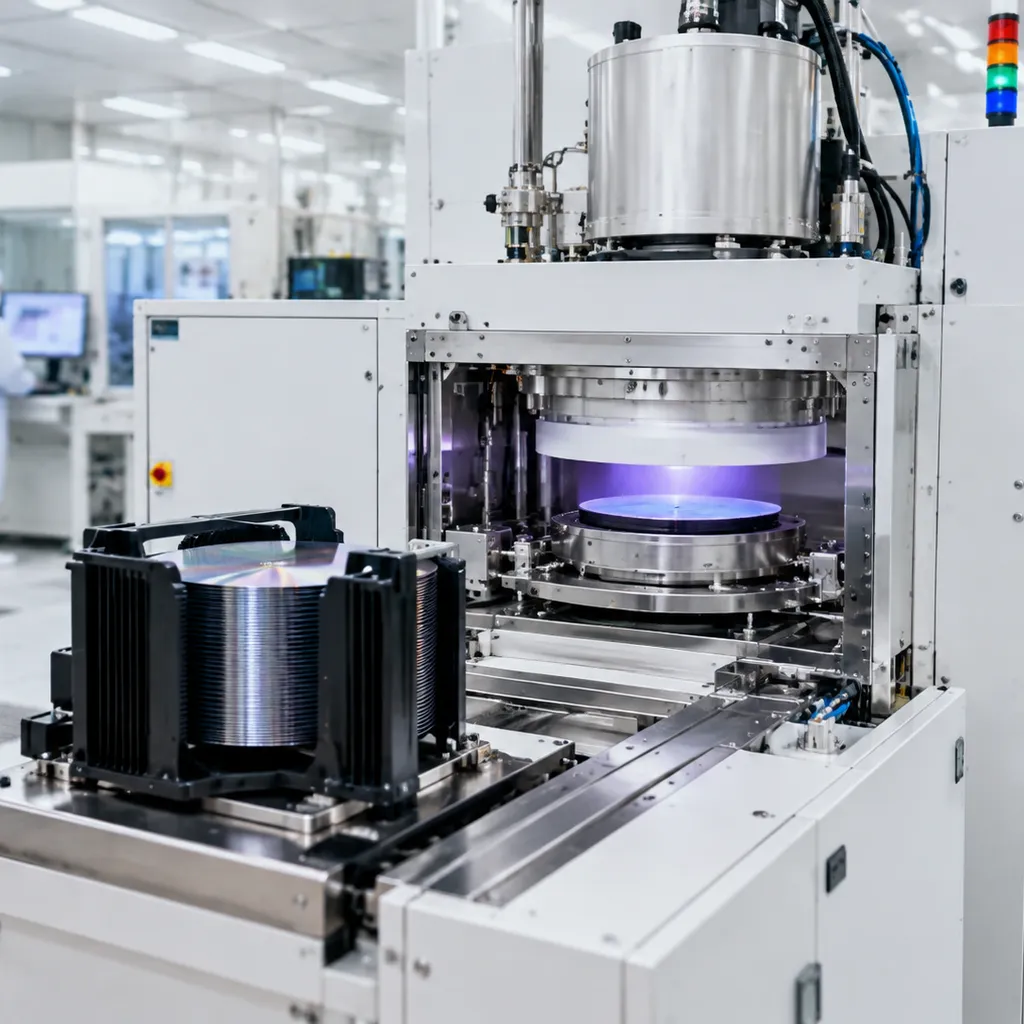
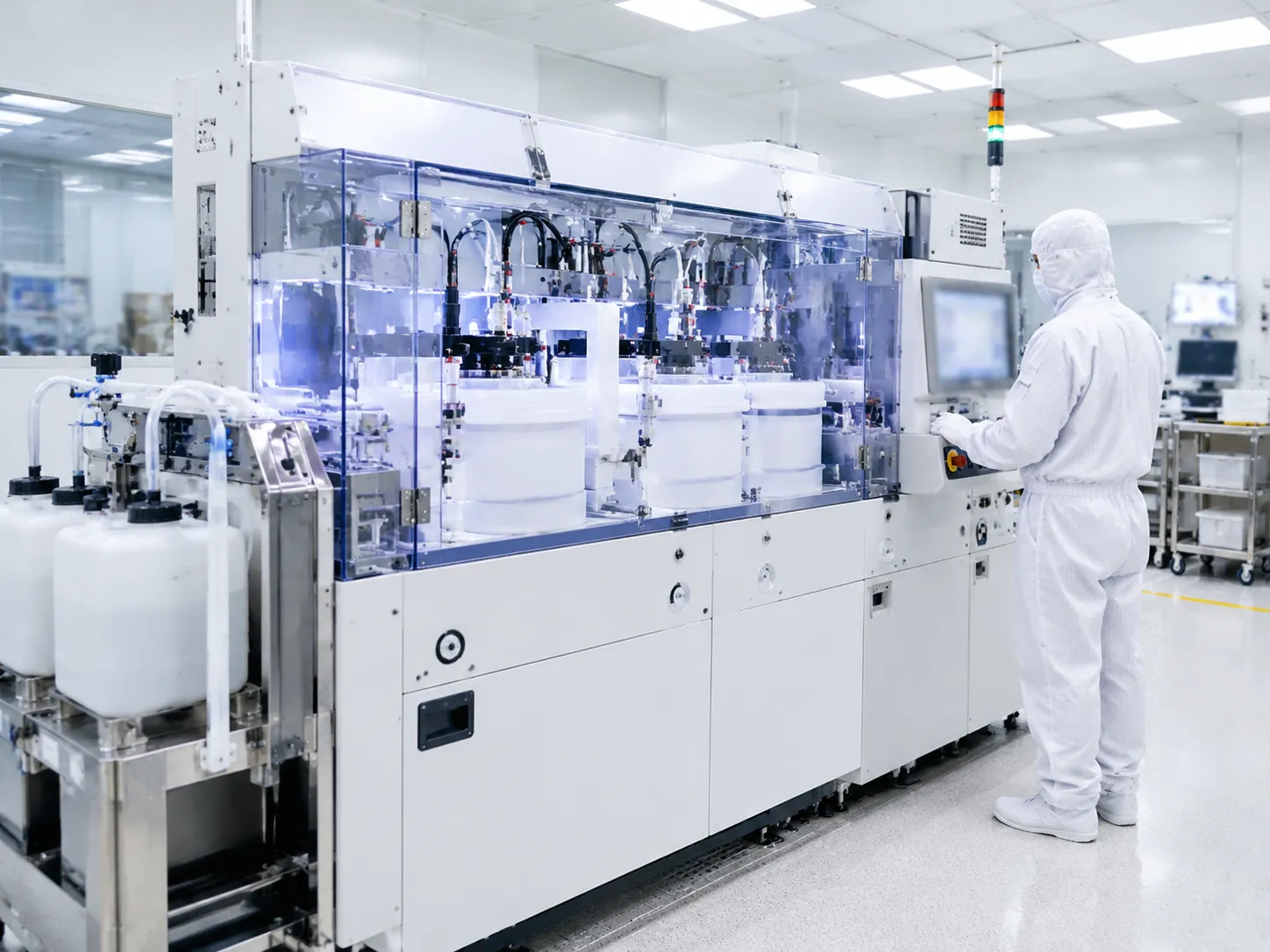
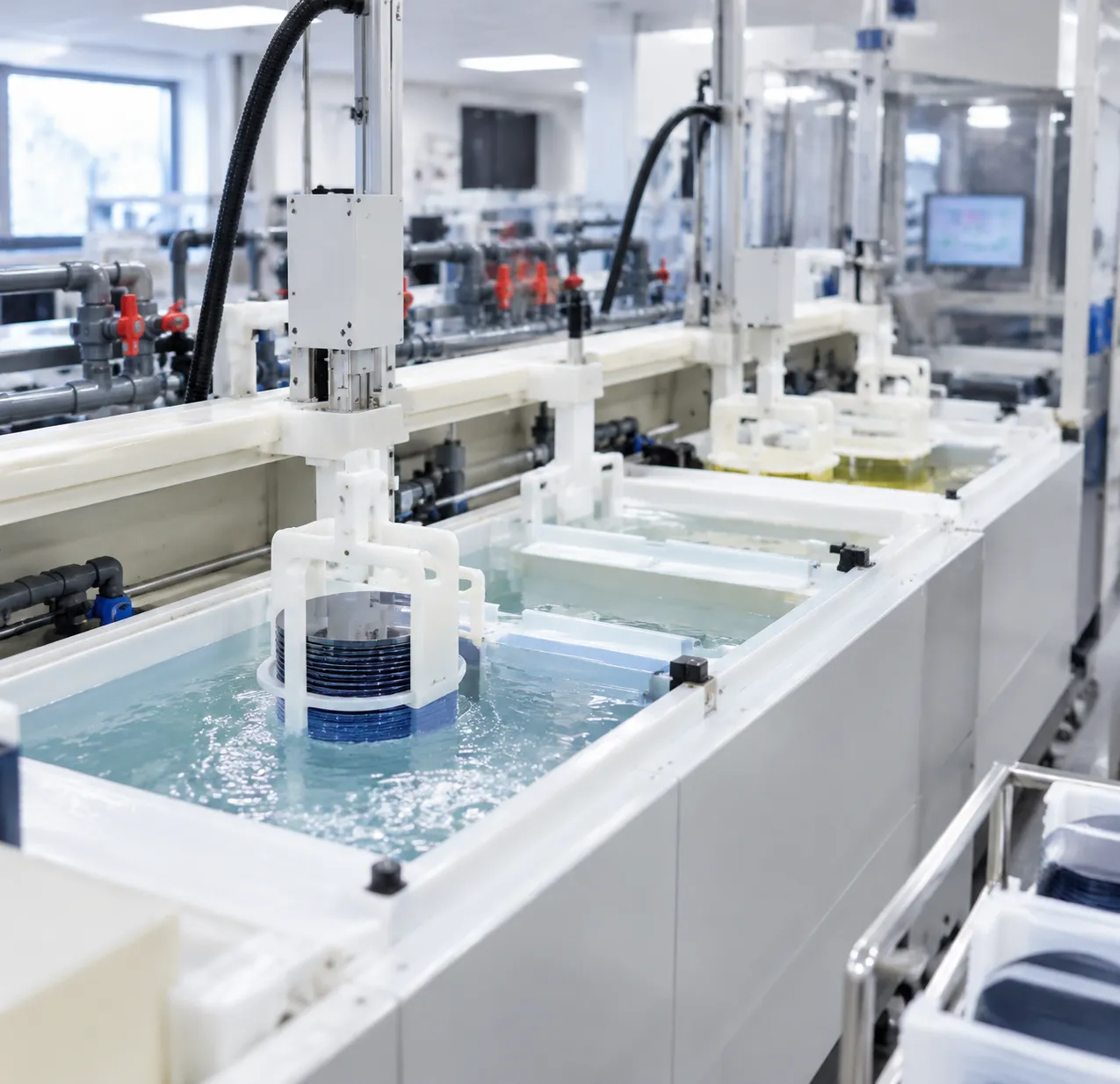
Hardware reliability in batch immersion wet bench systems dictates bath life, particle performance, and process repeatability. We build modular, application-matched tank architectures that integrate seamlessly into high-volume fab lines and pilot production cells. Every module is engineered for maximum uptime, clean maintenance access, and ultra-low particle generation.
Our modular platform designs are detailed across our semiconductor wet bench design and specification guide, providing the exact physical footings, chemistry zoning, and flow schemes required for critical processing.
Recirculated and Filtered Chemical Processing Baths
For aggressive acids, bases, and solvents, we configure high-purity virgin PFA and PTFE processing tanks designed for high turnover and laminar bath circulation:
Continuous Particle Control: Integrated sub-0.1µm fluoropolymer filtration loops capture micro-contaminants continuously during processing.
Optimized Fluid Dynamics: Bottom-up chemical injection manifolds eliminate stagnation zones and prevent localized chemical depletion.
Extended Chemical Lifespan: High-efficiency recirculation loops lower overall chemical consumption and cost of ownership (CoO).
Uniform Heated Quartz Tanks with Precision Multi-Zone Temperature Control
High-temperature processes like hot phosphoric acid etching and SPM resist stripping demand uncompromising thermal control and chemical inertness:
Thermal Uniformity: Multi-zone external heating elements provide tight temperature stability across the entire carrier bath, avoiding edge-to-center thermal gradients.
Pure Fused Quartz Construction: High-grade, fire-polished fused quartz tanks resist thermal shock and severe acid degradation.
Active Overtemperature Protection: Redundant RTD temperature sensors and non-contact thermal switches prevent runaways and thermal degradation.
Megasonic Agitation Systems for Sub-Micron Defect Removal
Removing sub-micron particles from patterned surfaces without causing pattern collapse requires carefully managed acoustic energy:
Uniform Energy Distribution: Direct-bonded or face-mounted transducers eliminate standing wave hot spots across the wafer load.
Variable Frequency & Power Control: Fully programmable power levels let process engineers tailor cavitation intensity for delicate high-aspect-ratio microstructures.
Damage-Free Cleans: Consistent acoustic streaming dislodges sub-0.1µm contaminants while preserving fragile device features.
High-Purity Rinsing Modules (QDR & Cascade Overflow)
Effective rinsing stops chemical reactions instantly and prevents drag-out contamination across process baths. We configure advanced rinse stations for our chemical wet bench for wafer cleaning and etching platforms:
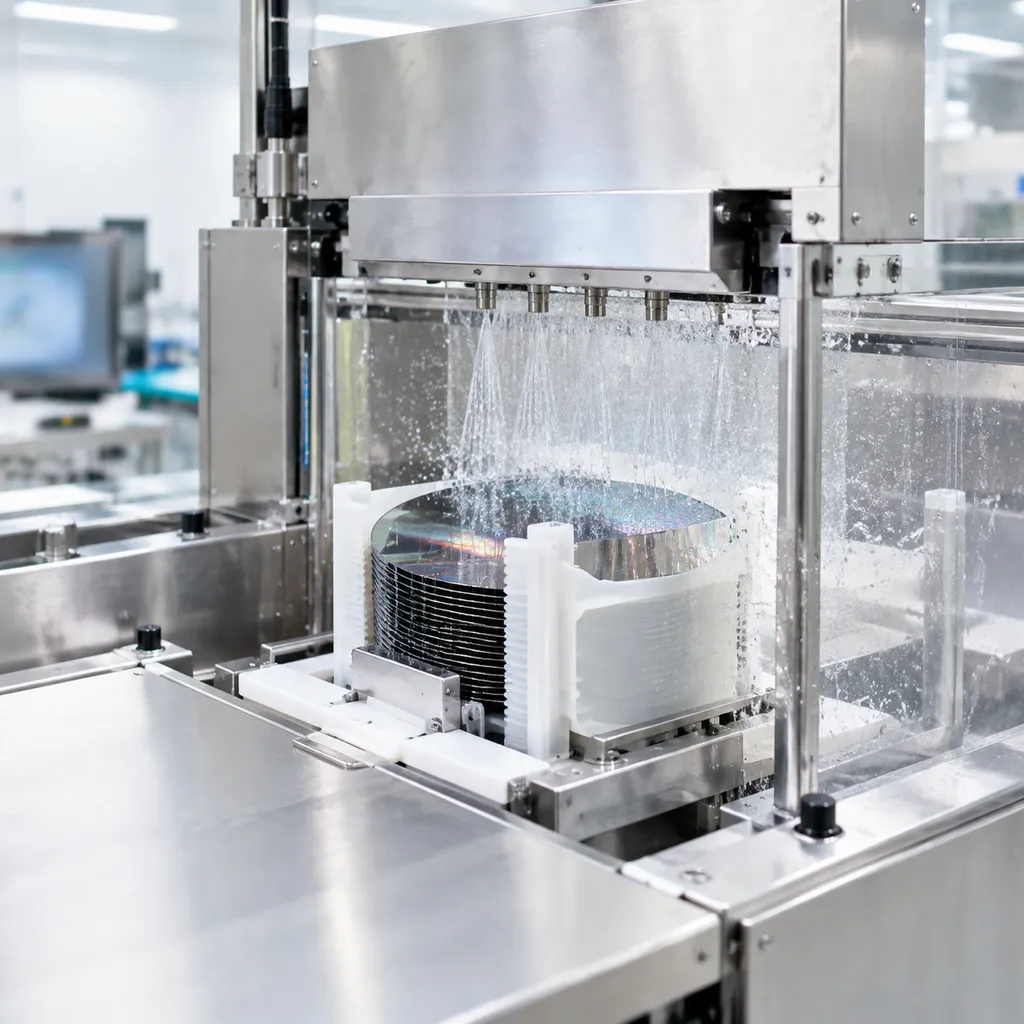
Quick Dump Rinse (QDR) Tanks: High-speed bottom dump valves evacuate DI water within seconds, supported by top-mounted spray nozzles and an inert N2 blanket to suppress surface oxidation.
Multi-Stage Cascade Overflow Rinsers: Counter-current fluid flow continuously pushes clean DI water upwards, flushing trace chemicals over weirs with minimized consumption.
Real-Time Resistivity Monitoring: Integrated inline resistivity sensors verify total ionic extraction before wafers advance to the dry step.
Advanced Substrate Drying Technologies
Watermark formation is a leading cause of yield loss on patterned and hydrophobic silicon surfaces. We integrate three core drying configurations depending on wafer topography and throughput targets:
Marangoni Surface Tension Gradient Drying: Utilizes high-purity isopropyl alcohol (IPA) vapor and slow carrier extraction to achieve zero-residue, watermark-free surfaces on high-aspect-ratio and hydrophobic topography.
Spin Rinse Dryers (SRD): Dual-axis rotational drying with heated high-purity N2 purge for rapid, mechanical batch moisture removal.
Heated N2 Knife Drying: Direct laminar nitrogen knives for flat substrates and robust carrier-level bulk drying.
High-Purity Material Construction and Contamination Control
Chemical-Resistant Wetted Materials
Chemical baths must endure continuous exposure to aggressive acids, aggressive oxidizers, and stripping solvents without leaching impurities into the bath:
-
- High-Purity PFA and PTFE: Ideal for aggressive acid etching, solvent immersion, and hot chemical baths where ultra-low outgassing is mandatory.
- Natural Polypropylene (NPP) & PVDF: Used in robust structural plumbing, general acid/base modules, and dedicated rinse stations to balance structural rigidity and chemical resilience.
- High-Purity Fused Quartz: Dedicated to high-temperature SPM (Piranha) stripping and hot phosphoric acid etching to resist severe thermal shock.
- Ultra-Pure Sealing: Integrated with high-end elastomers for semiconductor wet benches to prevent chemical degradation, micro-leaks, and particulate generation across valve manifolds.
Metal-Free Wet Zones for Trace Contamination Elimination
We eliminate metallic hardware from the process envelope entirely. Robotic lifters, tank mountings, and wafer holding fixtures within the wetted zone rely on non-metallic fasteners and encapsulated components. This metal-free architecture prevents trace metal migration (such as Fe, Cu, and Ni ions) from coming into contact with active wafer surfaces during chemical processing.
FM4910-Compliant Fire-Safe Enclosures and Exhaust Balancing
Safety and cleanroom airflow balance are built into every chassis design:
-
- FM4910 Listed Materials: Fabricated with flame-retardant plastics (such as specialized CPVC and PVDF) to prevent fire propagation and meet cleanroom insurance mandates.
- Dynamic Exhaust Balancing: Segmented exhaust plenums continuously remove acid, caustic, and solvent vapors directly at the tank lip to avoid cross-contamination and maintain cleanroom air quality.
- Integrated Safety Sensors: Differential pressure switches and continuous exhaust monitoring trigger immediate chemical interlocks if exhaust velocity drops below safe thresholds.
Integrated Class 1 to Class 100 Mini-Environments
To protect wafers during transfer between chemical baths and rinsers, we configure self-contained laminar flow mini-environments:
-
- Motorized HEPA/ULPA Fan Filter Units (FFU): Deliver continuous, low-turbulence vertical laminar flow directly over open tanks.
- Particle Elimination: Maintains an ISO Class 3 (Fed Standard Class 1) micro-environment over the chemical baths inside your semiconductor wet bench cleanroom floor space.
- Static Charge Control: Integrated ionizing bars neutralize static buildup on wafer carriers and tank covers, stopping airborne particle attraction before wafers enter the drying phase.
Robotics, Automation, and Industry 4.0 Control Architecture
Multi-Axis Wafer Handling Transfer Robotics
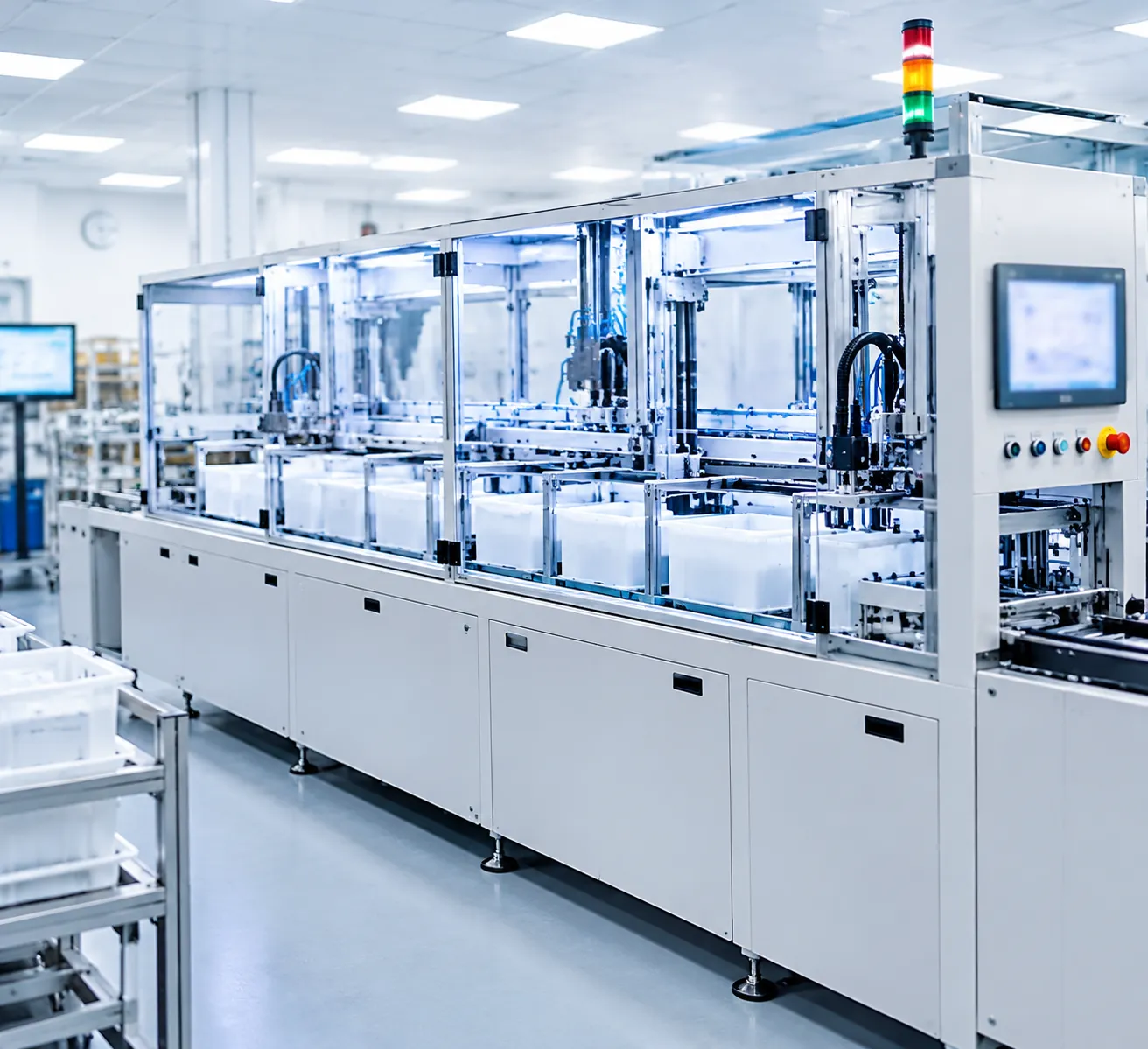
Our robotic transfer systems eliminate operator-induced defects and fluid splashing across high-density tank configurations.
-
- Programmable Velocity Profiles: Multi-axis overhead and side-mounted robotic grippers feature recipe-controlled acceleration and deceleration curves, ensuring smooth immersion and extraction across delicate wafer batches.
- Carrier and Direct Wafer Handling: We support standard cassette handling as well as carrier-less transfer tooling to cut chemical carryover and accelerate bath cycle times.
- Vibration-Free Motion: Closed-loop servomotors prevent mechanical shudder during micro-step positioning, protecting fragile, thinned, or high-aspect-ratio substrates.
SECS/GEM Host Communications and Factory Automation
We configure our automatic wet bench systems for seamless integration into smart fab MES ecosystems.
-
- SEMI Standards Compliance: Native support for SEMI E4 (SECS-I), SEMI E5 (SECS-II), SEMI E30 (GEM), and SEMI E37 (HSMS) protocols enables hands-off recipe downline loading, lot validation, and remote fault diagnostics.
- Full Data Traceability: Process parameters, bath temperatures, immersion dwell times, and lot histories are continuously logged and broadcast to factory hosts for strict quality auditing.
Real-Time Recipe Management and Bath Parameter Monitoring
Our proprietary automation control architecture delivers end-to-end recipe management through intuitive industrial PC and PLC interfaces.
-
- Automated Chemical Replenishment: Inline chemical auto-dosing systems track bath usage, temperature fluctuations, and flow metrics to execute dynamic top-offs or complete spike dumps without line pauses.
- Closed-Loop Environmental Tracking: Continuous telemetry covers bath resistivity, chemical flow rates, tank liquid levels, and exhaust static pressure.
| Control Module Feature | Operational Capability |
|---|---|
| Multi-Axis Robotic Transfer Arm | Programmable immersion / exit speed |
| Factory Interface Protocol | Native SEMI E4, E5, E30, E37 |
| Chemical Monitoring | Real-time dosing & bath-life synchronization |
| Hardware Safety Architecture | Multi-tier SEMI S2/S8 interlocks |
Comprehensive Cleanroom Safety Interlocks
Handling aggressive acids and solvents demands uncompromising safety protocols. We engineer every immersion bench to meet SEMI S2 and SEMI S8 standards with hardwired fail-safes.
-
- Optical Leak Sensors: Double-containment sumps and wetted enclosures integrate dual-redundant optical sensors for immediate chemical detection and automated emergency drain execution.
- Integrated Fire Suppression: Automatic CO2 and N2 fire suppression systems interface directly with emergency power-off (EPO) circuits to isolate thermal sources upon ignition detection.
- Exhaust and Access Monitoring: Differential pressure switches and safety interlock door sensors immediately abort active sequences if exhaust flow dips below safety limits or process bay covers open unexpectedly.
Technical Specifications Matrix and Substrate Compatibility
Supported Wafer Formats and Sizes
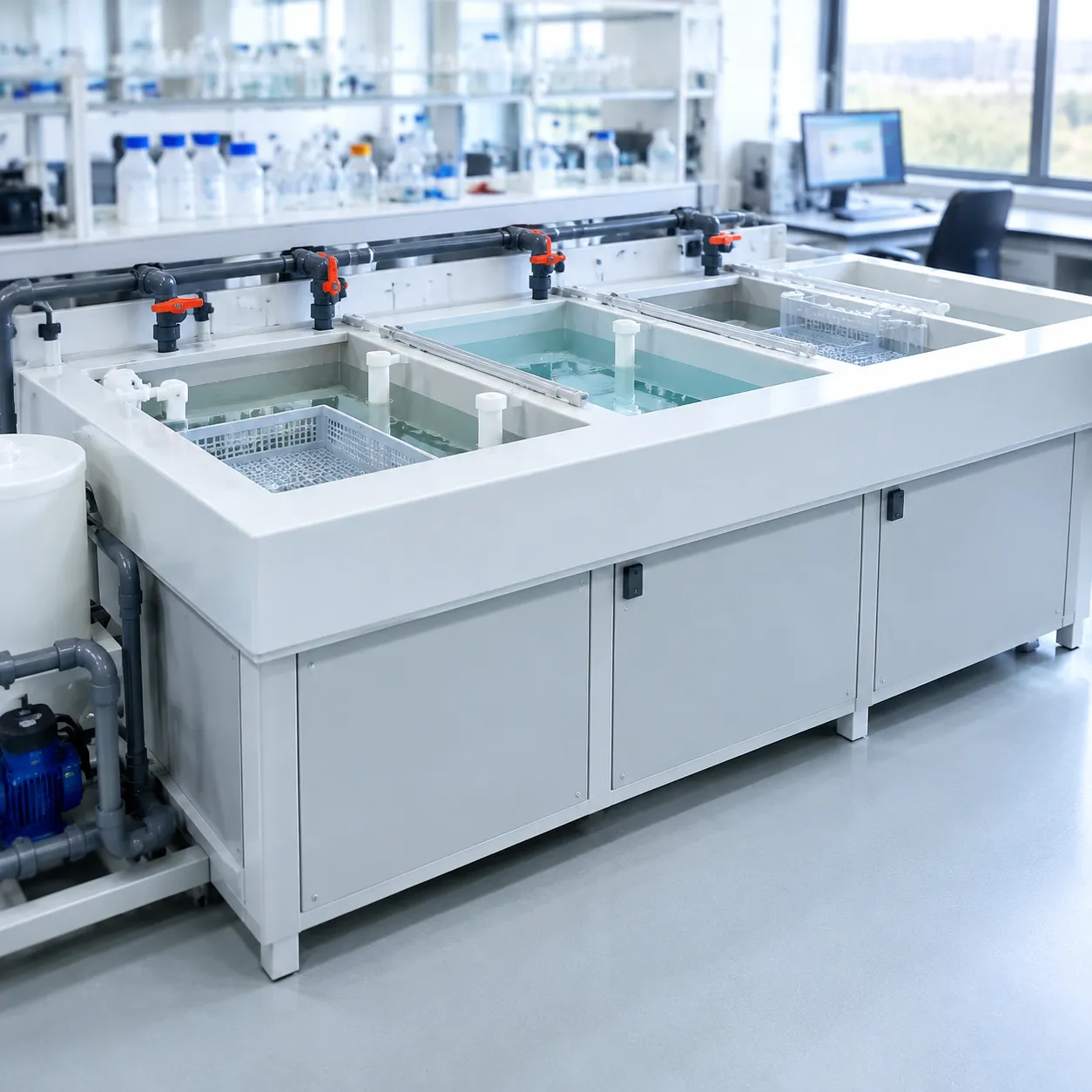
Our batch wet processing equipment handles both standard and custom cassette configurations:
-
- Substrate Types: Silicon (Si), Silicon Carbide (SiC), Gallium Nitride (GaN), fused quartz, and specialized packaging glass.
- Wafer Diameters: 100mm (4"), 150mm (6"), 200mm (8"), and 300mm (12") wafer formats.
- Batch Sizing: 25-wafer single cassette or 50-wafer dual cassette capacities for high-throughput batch immersion.
Station Capacities and Modular Footprint Configurations
We engineer modular frame architectures to balance cleanroom space limitations with high production volumes:
-
- Bath Configurations: 1 to 12 active tank stations arranged in inline configurations for sequential chemical etching, rinsing, and drying.
- Fab Flexibility: Adaptable layout designs that integrate smoothly into production flows alongside our wider lineup of advanced wafer cleaning systems.
- Serviceability: Ergonomic, front-and-rear access panels allowing quick maintenance of valves, chemical dosing pumps, and filter housings without interrupting cleanroom airflow.
Exhaust and Chemical Drain Partitioning
Safe chemical management requires rigid fluidic and vapor isolation:
-
- Segregated Exhaust Plenums: Isolated exhaust channels for acid vapors, solvent fumes, and caustic chemistries to eliminate hazardous mixing risks.
- Dedicated Drain Lines: Dedicated return and waste manifolds for hot acid, solvent, caustic, and DI water recovery lines to simplify fab waste management.
Technical Specifications Matrix
| Feature / Specification | Standard Configuration |
|---|---|
| System Classification | Automated / Semi-Automated Batch Immersion Wet Bench |
| Substrate Compatibility | 100mm, 150mm, 200mm, 300mm (Si, SiC, GaN, Glass) |
| Tank Stations | 1 to 12 modular processing, rinse, and dry baths |
| Wetted Bath Materials | High-Purity PVDF, PP, PTFE, PFA, Quartz, Stainless Steel |
| Rinsing Stations | Quick Dump Rinse (QDR), Cascade Overflow, High-Purity DI Water |
| Drying Options | Marangoni / IPA Vapor Dry, Spin Rinse Dry (SRD), Heated N2 |
| Drain & Exhaust Isolation | Segregated Acid, Solvent, and Caustic lines |
| Defectivity Control | Sub-0.1µm Particle Per Wafer Pass (PWP) target levels |
| Automation & Interface | SECS/GEM (SEMI E4, E5, E30, E37) compliant PLC/PC control |
| Safety Compliance | SEMI S2/S8 standards, integrated fire suppression readiness |
Engineering Customization and Factory Validation Standards
Every fab footprint, substrate geometry, and chemical process comes with distinct integration challenges. We build our batch immersion wet bench systems around tailored mechanical configurations and rigorous factory validation to eliminate production ramp-up delays and yield loss.
| Engineering Customization | Factory Validation Standard |
|---|---|
| Custom Tank Geometry | 9-point bath thermal mapping |
| Dedicated Cassette Tooling | PWP particle qualification testing |
| Closed-Loop Auto-Dosing | Pressure & leak containment checks |
| SECS/GEM Software Profiles | 100+ dry/wet automation cycles |
Custom Bath Geometry, Cassette Tooling, and Chemical Auto-Dosing Systems
Standard tank dimensions often create dead zones, poor fluid turnover, and chemical stratification. We engineer application-specific bath profiles to deliver uniform flow dynamics across every wafer surface:
-
- Custom Tank Geometries & Weirs: Precision-machined weir overflows and angled drain bottoms in high-purity PVDF, PTFE, and quartz to prevent stagnant pockets and optimize fluid replacement rates.
- Specialized Cassette & Substrate Fixturing: Custom-machined PEEK, PTFE, or high-purity quartz carriers designed for thin wafers, compound semiconductors (SiC, GaN), and non-standard substrate carriers.
- Chemical Auto-Dosing Systems: Closed-loop spiked dosing and precision spike-injection manifolds that automatically replenish depleted oxidizers and acids based on bath run time or wafer count, extending chemistry bath life.
- Turnkey Integration: Fully integrated chemical supply loops that link directly into our automated wet bench semiconductor wet processing systems for seamless fab chemical management.
Factory Acceptance Testing Protocols
Before any tool ships to your cleanroom, our engineering team executes a comprehensive Factory Acceptance Testing (FAT) protocol to verify safety, process repeatability, and cleanliness standards:
-
- Thermal Mapping Verification: Multi-point thermocouple logging across heated quartz and PFA process baths to ensure uniform temperature distribution within tight operating bands under full fluid recirculation.
- Particle Per Wafer Pass (PWP) Qualification: Baseline surface inspection testing on clean monitor wafers across the full process cycle to confirm sub-0.1µm defectivity standards.
- Hydrostatic & Chemical Leak Verification: 100% pneumatic and hydrostatic pressure testing on all primary tanks, dual-containment plumbing lines, pneumatic valves, and drain manifolds.
- Robotics & Sequence Validation: Multi-hour dry and wet cycling of the robotic transfer handling systems to guarantee position repeatability, smooth velocity transitions, and flawless recipe execution across all semiconductor wet bench systems.
Frequently Asked Questions About Batch Immersion Wet Bench Systems
How do batch immersion wet benches compare to single-wafer wet processing tools in throughput and cost of ownership?
Batch immersion wet bench systems process entire carriers of 25 to 50 wafers simultaneously across multi-tank chemical sequences. This architecture delivers significantly higher wafer-per-hour (WPH) throughput than single-wafer tools, especially during lengthy etching and strip steps like RCA clean or hot phosphoric acid processing. By sharing recirculated, filtered chemical baths across batches, our batch wafer cleaning systems substantially cut chemical consumption, DI water usage, and overall cleanroom footprint, resulting in a much lower cost of ownership (CoO).
What materials are required for high-temperature SPM and hot phosphoric acid baths?
High-temperature acid processing requires ultra-pure, chemically inert materials capable of withstanding aggressive oxidizers above 120°C without leaching metallic impurities:
High-Purity Fused Quartz: Used for heated baths, offering thermal shock resistance and chemical stability in Piranha (SPM) and phosphoric acid.
PFA and PTFE: Employed in chemical recirculation loops, immersion heaters, valves, and manifold lines to prevent trace metal contamination.
PVDF and Natural Polypropylene (NPP): Utilized for ambient and moderate-temperature acid/caustic enclosures and outer tank housings.
How does Marangoni drying prevent watermarks on high-aspect-ratio wafer topographies?
Marangoni drying relies on a controlled surface tension gradient established at the nitrogen/isopropyl alcohol (IPA) vapor and DI water interface. As the wafer carrier is slowly withdrawn from the rinse bath, the IPA vapor lowers the surface tension of the water meniscus. This gradient pulls the liquid film cleanly off the hydrophobic and hydrophilic surfaces simultaneously, eliminating capillary trapping in deep trenches and preventing watermark formation without structural pattern collapse.
What safety interlocks are standard for SEMI S2 and FM4910 fire compliance?
To ensure operator safety and fab integrity, our wet benches integrate multiple fail-safe hardware and software interlocks:
Continuous Exhaust Monitoring: Differential pressure switches trigger automatic heater cutoffs and chemical isolation if airflow drops below baseline.
Multi-Point Optical Leak Detection: Dual-containment basins and chemical delivery cabinets feature real-time sensors that stop fluid transfer immediately upon leak detection.
Redundant Thermal Cutoffs: Baths feature primary thermocouple controls backed by independent hardwired snap switches to prevent thermal runaway.
Fire Suppression Integration: Automatic CO2 or clean-agent fire suppression systems directly interface with the main tool controller to initiate emergency automated shutdown (EMO).
Can batch immersion systems be retrofitted with automated SECS/GEM factory host integration?
Yes. Our control engineering team configures PLC and industrial PC platforms with full SEMI software protocol support (SEMI E4, E5, E30, and E37). Whether building new automated lines or upgrading existing stations via custom wet process stations, we enable seamless host communication for automated recipe management, wafer lot tracking, bath parameter logging, and alarm reporting directly to your fab Manufacturing Execution System (MES).