Formula details
Product Details
Overview
What Is a High Purity Pneumatic Diaphragm Valve in Semiconductor Wet Benches?
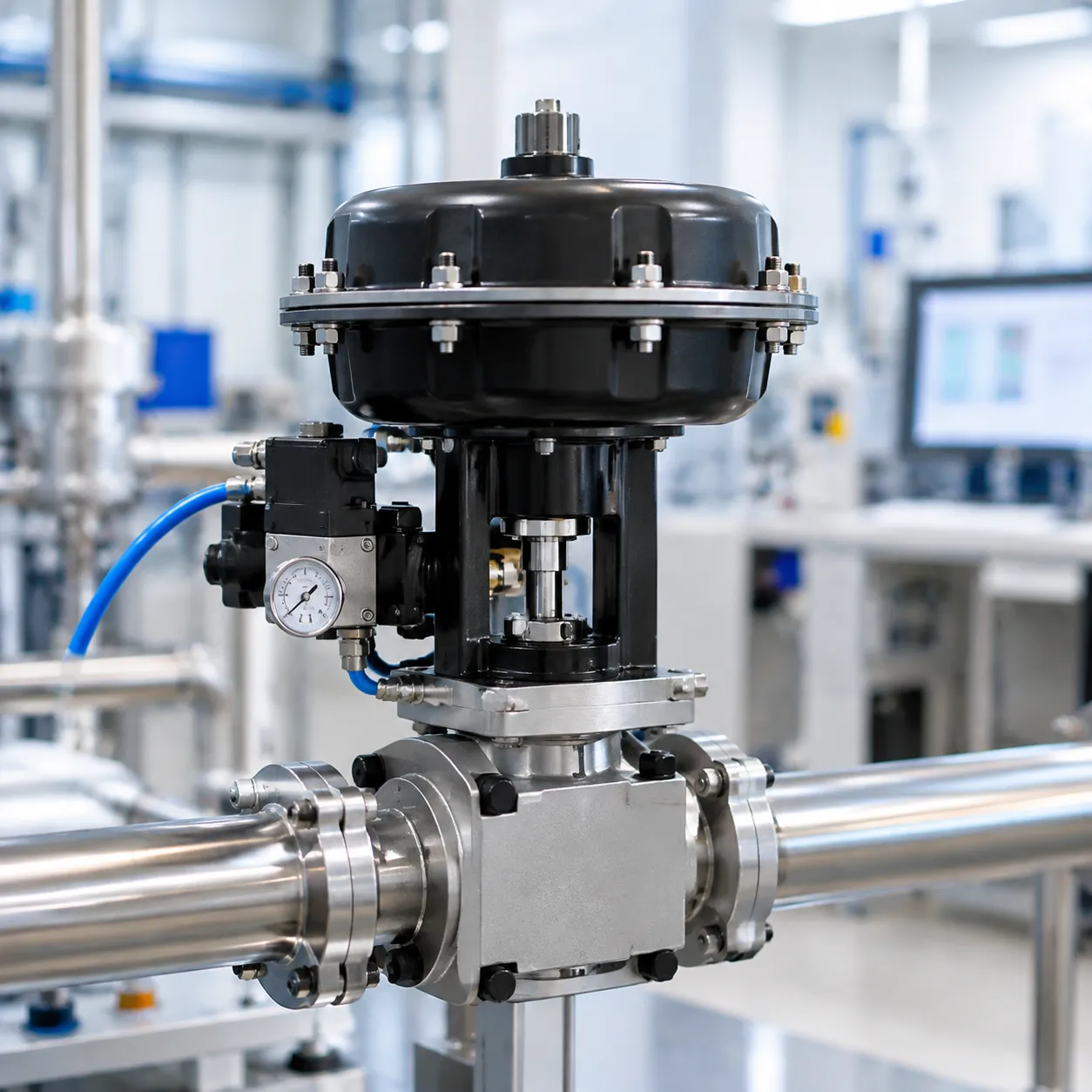
A high purity pneumatic diaphragm valve is the critical flow control component designed to regulate, isolate, and dispense ultra-pure chemicals and deionized water within automated wet processing stations.
Role in Automated Wet Chemical Cleaning, Etching, and Stripping
Inside modern wet benches, chemical delivery systems must execute rapid, highly repeatable fluid dispensing cycles. Our valves serve as the primary automated control points across several critical wet processing stages:
-
- Wafer Cleaning: Precise dosing of SC-1 (ammonium hydroxide/hydrogen peroxide) and SC-2 (hydrochloric acid/hydrogen peroxide) mixtures during RCA clean sequences.
- Chemical Etching: Accurate flow metering of aggressive hydrofluoric acid (HF) and buffered oxide etch (BOE) solutions for selective oxide removal.
- Photoresist Stripping: Reliable handling of hot piranha solutions (sulfuric acid and hydrogen peroxide / SPM) and organic solvents at elevated temperatures.
- UPW Quick-Dump Rinsing: High-flow, rapid shut-off control for ultra-pure water (UPW) cascade and dump rinsers.
Pneumatic Actuation for Zero-Contamination Fluid Control
Pneumatic actuation provides complete mechanical isolation between the operating air supply and the process media. By applying compressed clean dry air (CDA) or nitrogen to flex a high-integrity fluoropolymer diaphragm, our valves achieve instantaneous shut-off and dosing without dynamic mechanical seals or sliding friction surfaces.
-
- Hermetic Boundary: The flexible diaphragm serves as a continuous isolation barrier, eliminating stem leaks, external packing degradation, and atmospheric ingress.
- Non-Wetted Mechanicals: Springs, pistons, and pilot air components remain entirely outside the fluid path, preventing chemical attack on the actuator and keeping metal components away from pure media.
- Fast Response & High Frequency: Pneumatically driven cycling delivers micro-second response times required for automated wafer recipe management.
Essential Protection for Wafer Yield
At advanced sub-nanometer nodes, even single-digit parts-per-billion (ppb) metallic ion extraction or microscopic particle spikes cause immediate gate oxide breakdown and device failure. Integrating UHP pneumatic diaphragm valves directly into wet bench manifolds prevents chemical stagnation, minimizes friction-induced shedding, and maintains chemical purity from the chemical supply cabinet straight to the wafer carrier.
Key Materials and Wetted Path Construction
When handling ultra-pure chemistries, the material boundary of a high purity pneumatic diaphragm valve in semiconductor wet bench setups determines process cleanliness and system longevity. We engineer the wetted flow path exclusively with virgin fluoropolymers to ensure complete chemical inertness, zero metallic ion leaching, and total resistance to stress cracking.
High-Grade PFA and Modified PTFE Wetted Materials
-
- High-Purity PFA Body: Molded from premium, ultra-clean PFA to deliver uncompromising chemical resistance against aggressive acids, bases, and solvents.
- Modified PTFE Diaphragm: Features exceptional flex-life, minimal permeation, and reduced deformation under continuous cycling.
- Zero Metallic Contact: Complete isolation of the fluid stream protects critical wafer cleaning stages from trace metal contamination.
Non-Wetted Actuator Body Selections
Wet bench enclosures expose external components to corrosive chemical fumes. We provide robust non-wetted actuator housings tailored to your specific bench atmosphere:
| Actuator Material | Key Advantage | Best Application Fit |
|---|---|---|
| PVDF | High mechanical strength and acid fume resistance | Standard automated wet etch and strip modules |
| Polypropylene (PP) | Cost-effective and durable against common chemical vapors | General wet chemistry and bulk rinse stations |
| PTFE | Universal chemical immunity in high-concentration vapor zones | Solvent benches and ultra-harsh acid baths |
Ultra-Smooth Surface Finishes (Ra ≤ 0.25 µm)
Microscopic surface roughness creates dead spots where particles lodge and micro-bubbles nucleate. We finish our internal wetted paths to an ultra-smooth standard of Ra ≤ 0.25 µm (10 µinch). This mirror-like profile eliminates particle trap zones, facilitates rapid chemical displacement during rinse cycles, and complies directly with our semiconductor wet bench design and specification guide for zero-defect fluid handling.
Critical Engineering Features for Wet Bench Operations
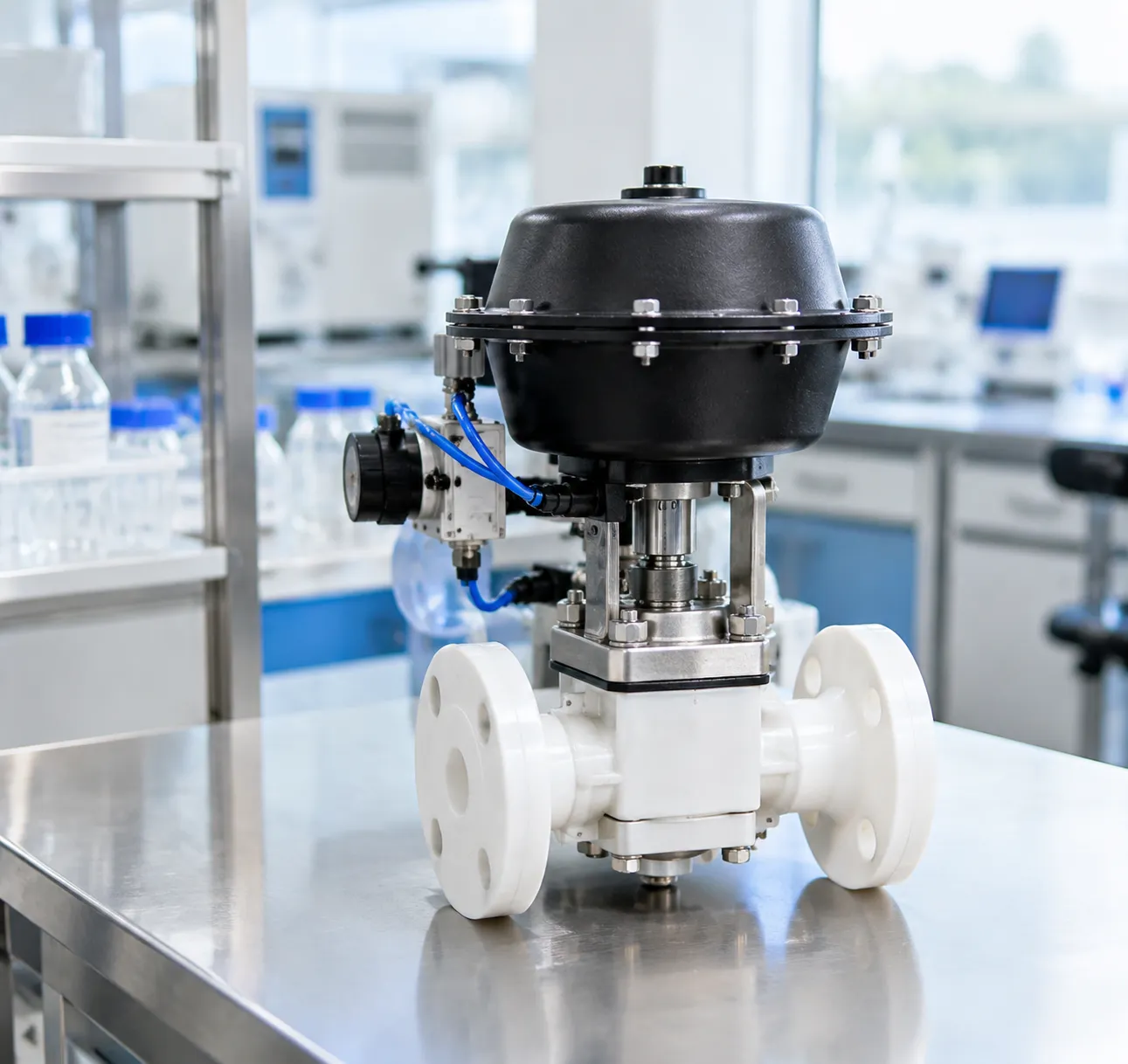
In wafer manufacturing, precision fluid delivery cannot tolerate fluid hang-up or valve fatigue.
Zero Dead-Leg Cavity Design
Chemical stagnation inside a valve body leads to crystallization, micro-bubble retention, and particle traps. Our internal flow paths eliminate un-swept internal pockets completely:
-
- Instant Chemical Sweep: Smooth, uninterrupted fluid dynamics ensure total chemical exchange with zero fluid holdup.
- Rapid UPW Flush Cycles: Quick transition between chemical dosing and ultra-pure water (UPW) rinsing cuts rinse cycle times and reduces water consumption.
- Contamination Prevention: Eliminates bacterial growth in deionized water lines and prevents chemical degradation in concentrated acids.
High Cycle Life Actuators for Fast Dosing
Automated wafer etching and surface prep require continuous, fast-acting valve actuation. We optimize our pneumatic actuators for high-frequency operations across millions of continuous cycles:
-
- Fast Response Switching: Consistent open/close response under 50 milliseconds allows precise chemical micro-dosing.
- Low Actuator Friction: Specially balanced springs and pneumatic piston guides deliver uniform diaphragm travel without mechanical binding.
- Leak-Tight Sealing: Uniform closure force distributes sealing stress across the diaphragm seat to avoid material creeping and seat leakage.
Space-Saving Multi-Port and Integrated Manifolds
Plumbing dense fluid lines inside modern wet bench chemistry equipment for semiconductor cleanroom enclosures demands compact routing. We minimize leak risks by integrating individual valves into consolidated manifold blocks:
-
- Fewer Connection Points: Multi-port valve blocks eliminate intermediate fittings, drastically cutting down potential chemical leak paths.
- Compact Footprint: Reduces the physical space needed for valve assemblies in wet bench service chases and chemical delivery cabinets.
- Custom Porting Options: Available in 2-way, 3-way, mixing, and bypass branch patterns to simplify system architecture.
| Engineering Feature | Technical Implementation | Operational Benefit |
|---|---|---|
| Zero Dead-Leg Path | Internal cavity swept-flow geometry | Zero chemical stagnation, fast rinse-down |
| High-Cycle Actuator | Low-friction pneumatic guide & dual-return spring | Long maintenance intervals, precise dosing |
| Integrated Manifolds | Monolithic fluoropolymer multi-valve blocks | 40%+ footprint reduction, eliminated fitting leaks |
| Direct Diaphragm Interlock | Uniform mechanical clamping mechanism | Eliminates seat creep and micro-leakage |
Chemical Compatibility and Operating Conditions
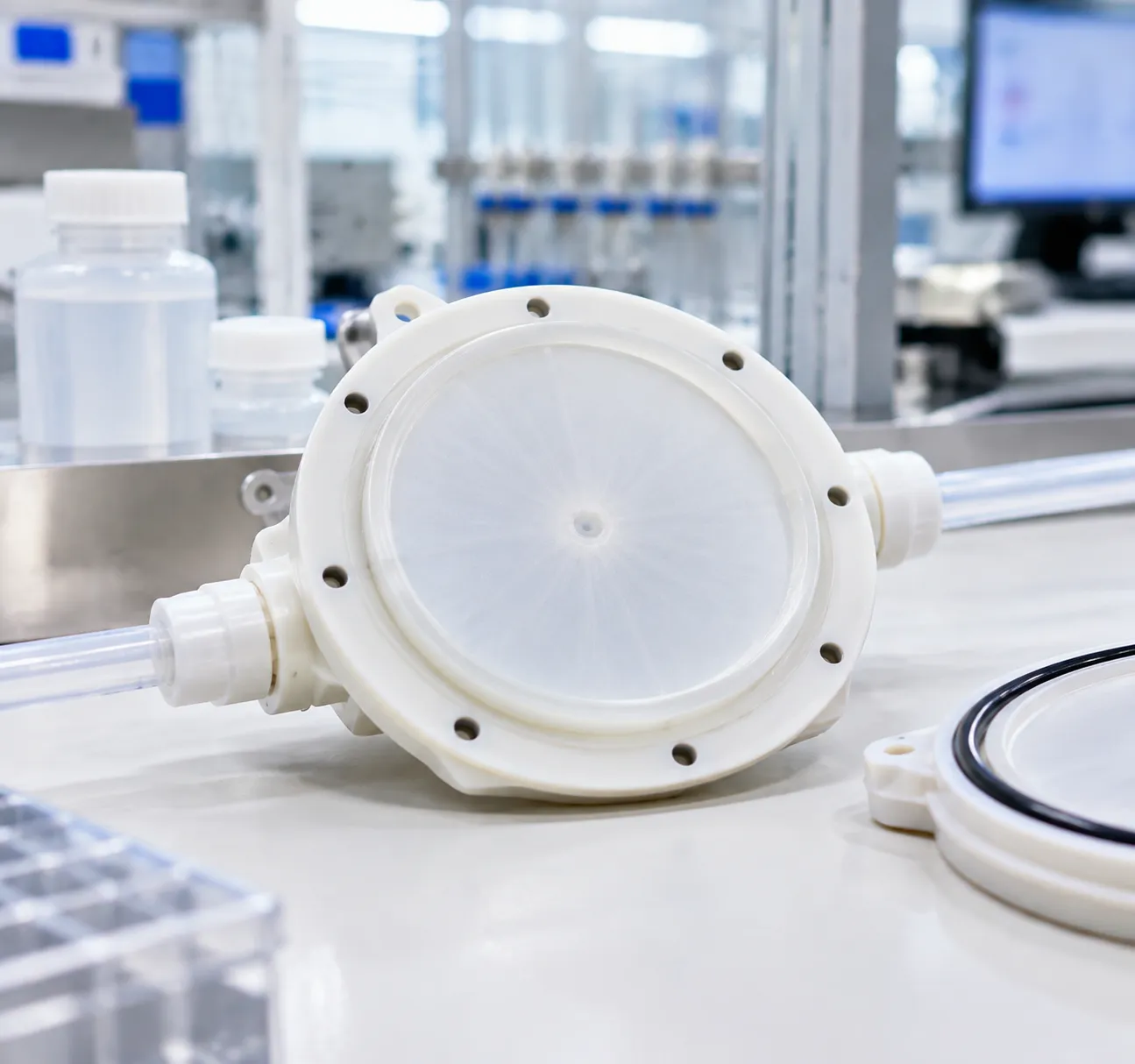
Aggressive Acid and Etch Resistance
Wet bench cleaning and etching processes rely on highly reactive acid chemistries that destroy standard process valves. Our fluoropolymer assemblies provide complete chemical inertness against:
Hydrofluoric Acid (HF) and Buffered Oxide Etch (BOE): Zero silica breakdown, total resistance to fluoride ion attack, and leak-tight shutoff.
Piranha Solution (SPM): Resists high-concentration sulfuric acid and hydrogen peroxide mixtures at elevated reaction temperatures without cracking.
Standard Clean Baths (SC-1 and SC-2): Resists strong alkaline oxidative solutions (NH₄OH/H₂O₂) and acidic oxide-removal mixtures (HCl/H₂O₂).
Organic Solvent Compatibility
Beyond corrosive acids, our PFA and PTFE diaphragm valves handle harsh stripping and drying agents without swelling or softening. They deliver stable performance in:
IPA (Isopropyl Alcohol): Liquid and vapor phase chemical delivery for low-surface-tension wafer drying.
N-Methyl-2-pyrrolidone (NMP) & Acetone: Photoresist stripping and solvent cleaning loops where elastomer seals fail.
Operating Ratings Across Temperature Baths
Safe fluid control demands stable pressure containment under severe thermal cycling. Maintaining precise bath dynamics and vapor recovery is critical to total chemical process management, ensuring cleanroom safety alongside consistent process performance.
| Operating Parameter | Standard Specification | High-Temperature Configuration |
|---|---|---|
| Fluid Temperature Range | 10°C to 100°C (50°F to 212°F) | Up to 180°C (356°F) continuous |
| Max Working Pressure | 0.5 to 0.7 MPa (72 to 100 psi) | 0.4 to 0.5 MPa (58 to 72 psi) |
| Actuator Pilot Pressure | 0.4 to 0.6 MPa (58 to 87 psi) | 0.4 to 0.6 MPa (58 to 87 psi) |
| Wetted Path Material | High-Purity PFA / Modified PTFE | High-Purity PFA / Modified PTFE |
| External Leakage Rate | Zero detectable (< 1x10⁻⁹ atm·cc/sec He) | Zero detectable (< 1x10⁻⁹ atm·cc/sec He) |
How to Choose the Right Valve for Your Wet Processing System
Selecting the ideal high purity pneumatic diaphragm valve semiconductor wet bench setup comes down to flow precision, leak-free connection integrity, and the right actuation control. When configuring high-yield chemical delivery loops or integrating advanced automated wet bench semiconductor wet processing systems, we focus on three core engineering decisions to prevent downtime and pressure drops.
Flow Coefficient (Cv) and Port Sizing
Proper flow sizing guarantees accurate chemical spiking and quick bath refills without creating turbulence or shear-induced micro-bubbles.
-
- Port Sizing: Standard sizes range from 1/4 inch to 1 inch depending on dispense volume.
- Target Cv Calculation: Size the Cv value to match bath turnover rates while keeping line velocity moderate to prevent chemical splashing and flow pulsation.
- Flow Control: Match the valve seat orifice to line pressure to maintain accurate chemical dosing across high-speed process recipes.
Selecting Reliable End Connections
We configure our fluoropolymer valves with industry-standard fittings to guarantee high-integrity, zero-leak fluid handling:
| Fitting Type | Best Application | Key Advantage |
|---|---|---|
| Flaretek | High-purity acid delivery & chemical loops | High seal reliability, simple assembly, compact space |
| Pillar Super 300 | Aggressive thermal cycling & high pressure | Superior anti-loosening design under wide temperature swings |
| Tube Weld Joints | Permanent manifolding & main distribution | Zero mechanical joints, zero leak paths |
Actuation Mode Selection
Match your pneumatic control architecture to process safety and recipe requirements:
-
- Normally Closed (NC): Default safety standard for harsh acids (HF, SPM, SC-1). Air opens the valve; spring instantly closes it during pilot air loss to prevent chemical dumping.
- Normally Open (NO): Primarily used in continuous DI water circulation or drain relief paths where fluid flow must continue if control power drops.
- Double Acting (DA): Utilizes air pressure for both opening and closing. Delivers balanced performance in high-viscosity applications with precise position response and zero spring-fatigue variance.
Cleanroom Assembly, Installation, and Maintenance Best Practices
Installing and servicing a high purity pneumatic diaphragm valve semiconductor wet bench setup requires strict contamination control and disciplined shop-floor habits. Even a microscopic particle or a slight pilot pressure drop can cause valve chatter, chemical leaks, or micro-scratches on product wafers. We follow rigid cleanroom standards and field-proven setup routines to keep chemical delivery lines stable and leak-free.
Class 10 (ISO 4) Cleanroom Cleaning and Packaging
To ensure zero baseline contamination before installation, every valve undergoes rigorous prep before it ever leaves our facility:
-
- Ultra-Pure Water (UPW) Ultrasonic Flushing: We strip out residual ions, airborne dust, and machining traces using continuous UPW baths.
- 100% Helium Leak Testing: Every valve seat and external diaphragm seal is tested under vacuum to verify zero leakage.
- Double Polyethylene Bagging: Valves are purged with filtered high-purity nitrogen, heat-sealed in anti-static Class 10 cleanroom bags, and double-packed to protect integrity during transport into the fab sub-fab or cleanroom chase.
This level of cleanliness is critical when integrating fluid components into automated wafer cleaning systems, where organic or metallic trace contaminants directly degrade die yields.
Pneumatic Line Hookup, Pilot Pressure, and Leak Detection
Proper hookup prevents sluggish actuation and premature seal failure:
-
- Clean Pilot Gas Supply: Always use clean, dry air (CDA) or high-purity nitrogen filtered to at least 0.01 µm. Moisture or oil in the pilot line degrades internal actuator seals.
- Dialing in Pilot Pressure: Maintain the specified pilot pressure (typically 60 to 80 psi). Low pressure leads to incomplete valve opening and restricted flow, while excessive pressure stresses the fluoropolymer diaphragm.
- Torque and Fitting Verification: When connecting PFA flare or Pillar-style tube fittings, use calibrated torque tools and cold-flare tools to avoid pinching tube walls.
- Leak Detection: Conduct a non-destructive pressure decay test and DI water loop run before introducing aggressive chemistries like HF, SC-1, or solvent lines.
Preventative Maintenance, Diaphragm Inspection, and Cycle Tracking
Relying on run-to-failure maintenance in semiconductor fluid handling is a recipe for expensive chemical spills and unscheduled wet bench downtime. We implement structured preventative maintenance (PM) schedules:
| Maintenance Task | Recommended Interval | Key Inspection Point |
|---|---|---|
| Cycle Count Audit | Monthly / Automated PLC log | Replace diaphragms before reaching maximum rated duty cycles (typically 1–3 million strokes depending on chemistry). |
| Visual Diaphragm Check | Quarterly PM shut down | Check for cold-flow distortion, chemical discoloration, or micro-cracking around the flex radius. |
| Pilot Line & Solenoid Check | Bi-annually | Inspect pilot exhaust ports for chemical vapor permeation, signaling micro-leaks across the primary diaphragm barrier. |
| Fitting Retorque | After initial thermal cycling | Check fitting tension after hot chemical runs (e.g., hot SPM or hot phosphoric acid) to compensate for fluoropolymer creep. |
Frequently Asked Questions (FAQ)
What is the typical lifespan of a PTFE diaphragm in concentrated acid service?
In aggressive acid service like hot sulfuric acid, piranha (SPM), or hydrofluoric acid (HF), a modified PTFE diaphragm typically delivers between 2 to 5 million operating cycles under normal thermal and pilot pressure limits. Harsh chemical exposure at elevated bath temperatures above 120°C accelerates polymer fatigue, so keeping track of cycle counts and stocking recommended wet bench spare parts to minimize downtime ensures scheduled preventative swap-outs before micro-fissures develop.
| Service Condition | Typical Chemistry | Average Lifespan (Cycles) | Replacement Trigger |
|---|---|---|---|
| Ambient Clean Chemistry | UPW, SC-1, SC-2, IPA | 3,000,000 – 5,000,000+ | Routine PM schedule |
| Heated Aggressive Acid | Hot SPM, Concentrated HF | 1,500,000 – 3,000,000 | Cycle limit or thermal aging |
| High-Purity Solvents | NMP, Acetone | 2,500,000 – 4,000,000 | Routine visual inspection |
How do high purity pneumatic diaphragm valves prevent particle shedding?
We eliminate particle generation through specific design choices:
Fully fluoropolymer wetted path: Ultra-smooth, molded PFA bodies and modified PTFE membranes feature surface finishes of Ra ≤ 0.25 µm, preventing micro-groove particle entrapment.
No sliding mechanical seals: Unlike spool or gate designs, the diaphragm isolates all moving metallic actuator components from the fluid flow path.
Zero dead-leg geometry: Swept cavity shapes ensure constant chemical velocity during dispenses, eliminating crystallization sites where dried chemical flakes could generate particulate spikes.
What is the difference between PFA diaphragm valves and PTFE bellows valves?
Both valve types handle aggressive fluids in semiconductor wet bench systems, but they serve distinct operational profiles:
-
- High Purity Pneumatic Diaphragm Valves: Offer a more compact footprint, lower internal dead volume, faster cycle response, and superior leak tightness at higher cycle rates. They are the standard for chemical dispensing manifolds, rinse manifolds, and point-of-use dosing lines.
- PTFE Bellows Valves: Feature a longer stroke length and higher flow rates (Cv), making them suitable for bulk chemical supply lines, tank drains, and main distribution headers where larger internal flow volume is required.
Can these valves handle slurry distribution or strictly clean wet chemistry?
Standard high purity pneumatic diaphragm valves are engineered primarily for particle-free, ultra-pure wet chemicals and solvents (such as HF, SC-1, SC-2, and UPW). While modified PTFE membranes handle mild abrasive wear better than standard fluoropolymers, CMP slurry service requires specialized slurry-rated diaphragm valves with reinforced seats to prevent seat scoring, clogging, and localized slurry agglomeration.