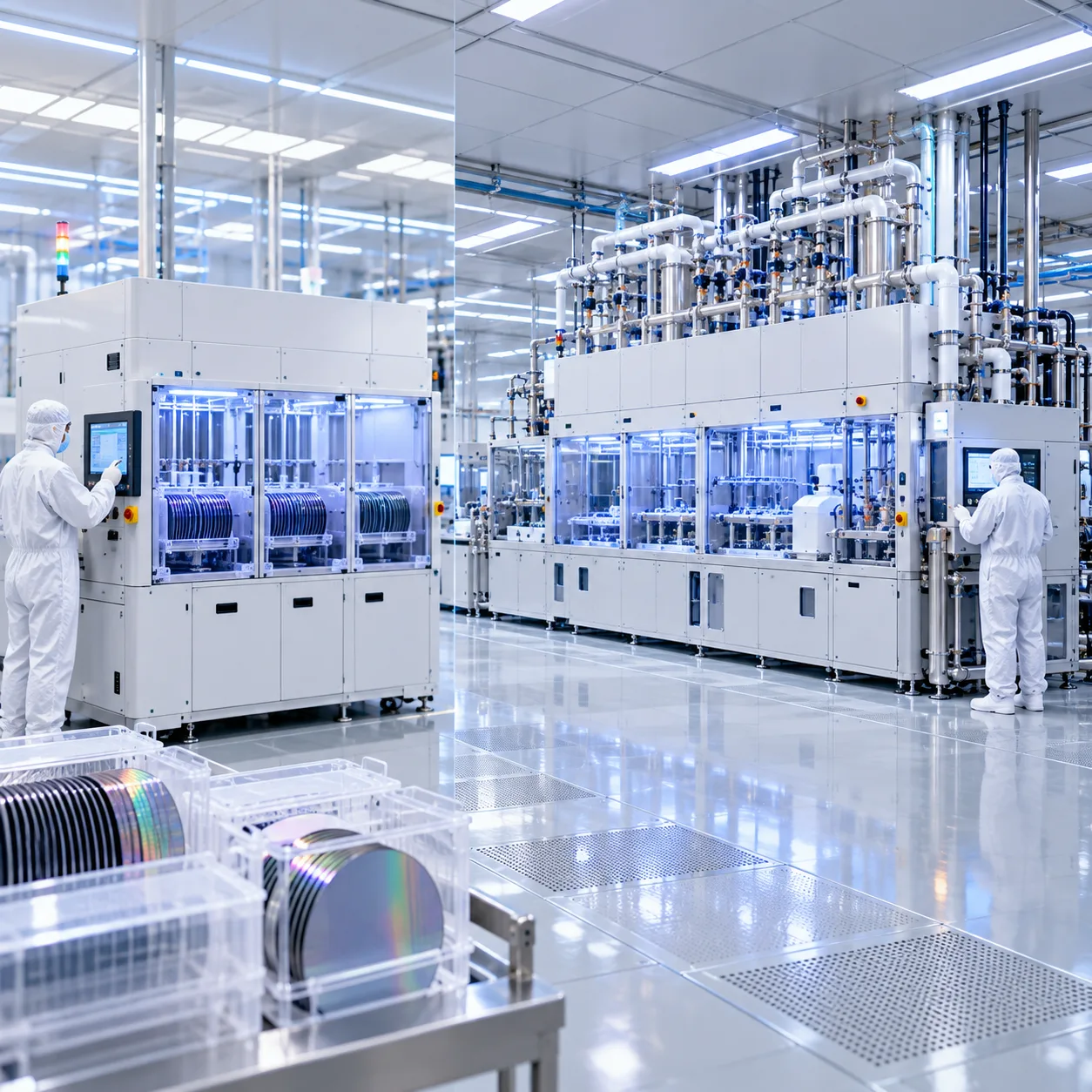
Are you struggling to decide between off-the-shelf machinery and a fully tailored system?
When evaluating standard vs custom wet processing equipment, cost and lead time are the two critical factors that will make or break your production schedule and bottom line.
A pre-engineered system gets you up and running fast, but will it meet your exact chemical compatibility and throughput needs? A tailor-made build offers pinpoint precision, but can your timeline afford the wait?
In this guide, we break down the real-world trade-offs of standard vs custom wet processing equipment: cost and lead time so you can make the smartest, most profitable investment for your facility.
Let’s dive right in.
Standard Wet Processing Equipment: Strengths, Limitations, and Economic Profile
Standard wet processing benches provide fab operations with a pre-engineered, highly reliable route for baseline surface preparation, chemical etching, and clean steps. By deploying proven architectures, these off-the-shelf systems bypass lengthy development phases to support accelerated fab ramps and straightforward process recipes.
Pre-Validated Tank Layouts and Off-the-Shelf Architecture
A standard semiconductor wet bench utilizes fixed, field-proven mechanical and fluidic designs. Instead of engineering every plumbing loop from scratch, these units integrate pre-validated configurations for common chemistries, including:
-
- Piranha / SPM (Sulfuric Acid-Hydrogen Peroxide Mixture) for organic strip operations
- SC-1 / SC-2 (Standard Clean RCA sequences) for particle removal and metallic decontamination
- DHF / BOE (Dilute / Buffered Hydrofluoric Acid) for oxide etching
- Quick Dump Rinse (QDR) and overflow cascade rinse tanks integrated with high-efficiency Nitrogen (N2) / Marangoni dryers
Because these deck layouts rely on standardized P&IDs (Piping and Instrumentation Diagrams) and pre-tested PLC automation routines, our standard systems eliminate the software debugging and mechanical redesign phases associated with one-off equipment builds.
Standard Wet Bench Process Flow
Heated Chemical Bath
Pre-Plumbed Chemical Manifold
↓
QDR / Cascade Rinse
Standard P&ID-Controlled Loops
↓
N₂ / Marangoni Drying
Pre-Mapped PLC Control
Upfront CapEx: Zero NRE Expenses and Predictable Tooling Costs
For procurement teams and fab managers managing tight capital budgets, standard wet processing systems offer complete financial transparency:
-
- Zero Non-Recurring Engineering (NRE) Costs: Fab lines pay exclusively for physical hardware, assembly, and standard quality validation—avoiding engineering labor surcharges.
- Fixed Bill of Materials (BOM): Established supply chains for high-purity valves, PVDF/PFA fluid paths, and standard chemical delivery components protect against component-cost volatility.
- Accurate Cost Forecasting: Standardized documentation and pre-budgeted spare parts kits ensure predictable deployment CapEx from day one.
Lead Time Expectations: 8 to 16-Week Delivery Cycles and Rapid FAT
Standardization directly compresses manufacturing and verification schedules, enabling predictable tool installation cycles.
| Milestone | Standard Platform Timeline | Key Deliverables |
|---|---|---|
| Procurement & Assembly | Weeks 1 – 8 | Standardized frame fabrication, pre-molded tank assembly, and harness routing. |
| Integration & Controls | Weeks 9 – 12 | Standard PLC load, fluidic pressure testing, and sensor calibration. |
| Factory Acceptance Testing (FAT) | Weeks 13 – 14 | Rapid 2-to-3 day dry/wet functional testing verifying SEMI S2/S8 interlocks. |
| Packaging & Fab Delivery | Weeks 15 – 16 | Crated shipment ready for cleanroom hookup and fast-track Site Acceptance Testing (SAT). |
Where Standard Benches Fall Short
While standard equipment is ideal for mature silicon nodes, standard wafer sizes, and R&D labs, operational constraints emerge when running specialized or highly cost-sensitive processes:
-
- Tank Geometry Mismatch: Fixed tank dimensions require standard chemical volumes. Running undersized batches or non-standard substrates wastes valuable bath volume.
- Elevated Chemical and DI Water Waste: Off-the-shelf overflow rinses and static bath recirculation lack the tailored fluid dynamics required to reduce DI water usage and extend chemical bath life.
- Substrate Handling Limitations: Standard end-effectors and cassette fixtures are built for standard silicon wafers. Fragile substrates—such as thin Gallium Nitride (GaN), Silicon Carbide (SiC), or Gallium Arsenide (GaAs)—face increased risk of micro-cracking and edge chipping without specialized Bernoulli or edge-grip handling.
- Limited Process Tuning: Fixed megasonic transducer arrays and standard chemical injection nozzles restrict your ability to fine-tune boundary-layer fluid mechanics across ultra-fine feature aspect ratios.
Custom Wet Processing Equipment: Capabilities, Engineering Cycles, and Cost Drivers

What Defines Custom Wet Processing Systems
Custom wet benches are tailored to exact chemical mechanics and process requirements. Rather than forcing your chemistry into standard tanks, we customize:
-
- Application-Specific Fluid Dynamics: Custom overflow weir angles, quick-dump rinse (QDR) geometries, and cross-flow bath dynamics to prevent dead zones and particle redeposition.
- Targeted Megasonics Integration: Precision-aligned megasonic wafer cleaning tool arrays with multi-frequency transducer positioning to prevent fragile micro-pattern damage.
- Isolated Chemical Processing: Physical barriers and vapor extraction channels engineered for aggressive multi-acid steps (e.g., hot phosphoric acid, Piranha, concentrated HF) without chemical cross-contamination.
Upfront Investment and NRE Costs
Building a custom wet bench requires an upfront capital investment that includes Non-Recurring Engineering (NRE) fees. These costs cover the dedicated engineering hours required before manufacturing begins:
-
- 3D CAD Modeling & Kinematics: Full layout design integrating custom tank manifolds, ergonomic access panels, and automated robotic transfer arms.
- Computational Fluid Dynamics (CFD): Flow and exhaust simulations to verify fluid turnover rates, bath chemical homogeneity, and cleanroom laminar airflow integration.
- FM4910 Material Fabrication: Machining and welding high-purity, fire-retardant fluoropolymer materials (such as PVDF, PTFE, and PFA) tailored to chemistry compatibility and cleanroom safety compliance.
Custom engineering typically adds 15% to 35% in upfront NRE expenses over standard models, depending on automation complexity and chemical delivery architecture.
Lead Time Breakdown: The 24 to 40+ Week Critical Path
Custom wet processing systems require longer lead times due to iterative engineering, validation, and component sourcing.
| Phase | Timeline | Core Activities |
|---|---|---|
| Design & Engineering | Weeks 1–8 | 3D CAD, CFD modeling, P&ID sign-off, and Hazard Analysis (HAZOP) |
| Material & Component Sourcing | Weeks 9–18 | Procurement of FM4910 plastics, custom quartz/PTFE baths, and specialized pumps/valves |
| Chassis Build & Fluidics Assembly | Weeks 19–28 | Structural welding, chemical plumbing manifold assembly, and electrical harness wiring |
| Software, Automation & FAT | Weeks 29–34 | PLC/HMI recipe integration, dry/wet cycling, and Factory Acceptance Testing |
| Shipment, Install & SAT | Weeks 35–40+ | Fab delivery, facility hookup, chemical qualification, and Site Acceptance Testing |
For detailed hardware requirements and specifications, review our semiconductor wet bench design and specification guide to align engineering parameters before kick-off.
Long-Term ROI: Yield Protection and Space Efficiency
While custom equipment increases initial CapEx and requires longer deployment schedules, it delivers long-term returns in high-stakes manufacturing environments:
-
- Micro-Uniformity Control: Tailored chemical flow achieves repeatable within-wafer and wafer-to-wafer etch uniformity down to tight single-digit tolerances.
- Cleanroom Footprint Optimization: Custom chassis layouts adapt directly to fab structural constraints, maximizing wafer throughput per square foot of expensive cleanroom space.
- Yield Maximization: Dedicated bath geometries, optimized dry cycles, and engineered chemical isolation reduce wafer scrap rates on high-value products.
Standard vs. Custom Wet Bench Comparison: Cost, Lead Time, and Engineering Trade-offs
Choosing between pre-configured and purpose-built wet processing systems requires balancing upfront capital allocation against line ramp schedules and yield targets. We routinely evaluate these trade-offs across five critical dimensions: CapEx, delivery timelines, fab footprint, substrate versatility, and process repeatability.
| Evaluation Metric | Standard Wet Bench | Custom Wet Bench |
|---|---|---|
| Initial CapEx & NRE | Lower baseline CapEx; $0 NRE | Higher base CapEx; $25,000–$100,000+ NRE |
| Delivery Timeline (PO to FAT) | 8 to 16 weeks (Pre-engineered) | 24 to 40+ weeks (Design + Build) |
| Installation & SAT | 1 to 2 weeks (Plug-and-play hookup) | 3 to 6 weeks (On-site tuning & recipe debug) |
| Throughput Density (WPH) | Fixed carrier pitch; baseline WPH | Maximized tank layout; up to 40% higher WPH |
| Substrate Compatibility | Standard 100mm–300mm Silicon | Fragile SiC, GaN, GaAs, thinned, or warped wafers |
| Etch & Clean Yield Control | Standard bath circulation; broad specs | Tight micro-uniformity (<1.5%), custom fluidics |
Initial CapEx vs. Custom Engineering and NRE Breakdown
Standard wet processing equipment minimizes initial capital expenditure by using fixed tank configurations, standardized plumbing manifolds, and pre-written software blocks. Because the engineering is already amortized across multiple builds, you avoid non-recurring engineering (NRE) fees entirely.
Custom wet benches require dedicated mechanical 3D modeling, fluid dynamics simulations, custom chemical isolation enclosures, and specialized PLC programming. These custom NRE costs typically add 15% to 35% to the total project invoice, but they eliminate process compromises on specialized production lines.
Lead Time Comparison: Build-to-FAT and Installation Schedules
-
- Standard systems: Fabricated from stocked structural plastics (polypropylene, PVDF) and standard pump racks. Factory Acceptance Testing (FAT) takes place within 8 to 16 weeks, followed by rapid Site Acceptance Testing (SAT) at your facility.
- Custom equipment: Involves iterative design reviews, hazardous chemical compatibility sign-offs, and custom machining. Build-to-FAT spans 24 to 40+ weeks, with extended on-site installation required to calibrate custom chemical delivery units (CDU) and robotics.
Footprint Adaptability and Wafer Throughput Density (WPH)
Standard platforms feature fixed rectangular dimensions that can lead to wasted floor space in non-standard cleanroom bays. Throughput is capped by standard tank volumes and single-axis transfer mechanisms.
Custom systems solve cleanroom constraints by packing maximum bath volume into available floor space. By engineering multi-carrier transfer heads, integrated dump rinsers, and zero-clearance side service access, custom benches significantly raise wafer throughput density (WPH) per square foot. Understanding your layout options between a batch immersion vs single wafer wet processing comparison helps clarify whether linear deck expansion or single-chamber density makes sense for your targets.
Substrate Handling: Standard Silicon vs. Fragile SiC and GaN
Standard equipment handling mechanisms use standard cassette grips optimized for rigid, standard-thickness silicon. When handling heavy, transparent, or brittle wide-bandgap materials—such as silicon carbide (SiC), gallium nitride (GaN), or ultra-thin compound wafers—standard end-effectors increase edge-chip rates and micro-crack defects.
Custom wet benches integrate:
Bernoulli-effect or specialized soft-touch vacuum end-effectors
Custom PEEK and PTFE carrier boats designed for non-standard wafer pitch
Optical and acoustic edge-detection sensors to handle warped, transparent substrates reliably
Process Tuning and Yield Optimization Across Critical Etch and Clean Steps
For standard strip and general degreasing, off-the-shelf wet benches deliver acceptable bath stability. However, when managing critical gate oxide pre-cleans, anisotropic etching, or sub-micron particle removal, standard agitation loops often leave boundary-layer dead zones.
Custom-engineered baths incorporate targeted megasonic arrays, inline point-of-use chemical spike injection, and precision heating jackets that maintain bath temperature tolerances within ±0.5°C. This level of fluidic control prevents cross-contamination, tightens etch rate uniformity across the wafer surface, and protects device yield on high-value lots.
Total Cost of Ownership (TCO): Evaluating Long-Term Fab Economics
When comparing standard and custom wet processing tools, initial CapEx only tells part of the story. Over a typical 5 to 10-year production lifecycle, ongoing utility consumption, yield protection, and cleanroom real estate dictate the actual return on investment.
Total Cost of Ownership (TCO) = Upfront CapEx + NRE + (OpEx × Operating Years) - Yield Loss Savings
Chemical and DI Water Consumption: Lowering Ongoing OpEx
Standard wet benches use fixed-dimension immersion tanks sized for general wafer carriers. While functional, these standard volumes often lead to excessive chemical turnover, higher drag-out losses, and elevated DI water consumption during dump rinsing.
Through our engineering reviews, we find that deploying application-tuned custom wet process stations significantly slashes ongoing utility bills:
-
- Minimized Bath Volumes: Custom weir profiles and chamber contours match exact batch sizes, lowering process bath volumes by 20% to 35%.
- Targeted Quick-Dump Rinsing (QDR): Configurable spray patterns and bottom-fill dynamics reduce DI water rinse volumes by up to 40%.
- Chemical Life Extension: Integrated spiked-dosing loops and closed chemical delivery units (CDUs) keep chemical baths active longer, cutting chemistry replacement cycles.
Yield Protection vs. Scrapped Wafer Costs
In high-value compound semiconductor manufacturing—such as Silicon Carbide (SiC), Gallium Nitride (GaN), and Gallium Arsenide (GaAs)—the cost of wafer loss outweighs initial machine price differences.
-
- Mechanical Stress Reduction: Standard automated grippers and generic fluid agitation can induce micro-cracks and edge chipping in brittle substrates.
- Micro-Uniformity and Etch Precision: Custom fluid routing eliminates stagnant flow pockets, achieving across-wafer etch uniformity below 1.5% (1-sigma).
- Scrap Economics: In an active SiC production line, saving just 10 to 15 prime wafers per month easily offsets initial engineering and NRE investments within the first year of operation.
Maintenance, MTBF, and Spare Parts Availability
Operating reliability depends heavily on the component strategy behind the build:
-
- Standard Platforms: Utilize widely sourced, off-the-shelf pneumatic valves, pumps, and quick-disconnect fittings. Mean Time to Repair (MTTR) is lower, and spare parts are stocked globally with short lead times.
- Custom Platforms: Built with application-specific chemical manifolds, specialized megasonic transducers, and resilient high-end elastomers for semiconductor wet benches to resist harsh chemistries like heated SPM and hot phosphoric acid. While MTBF is significantly higher under aggressive chemical attack, fabs must maintain dedicated spares in-house for custom-machined parts.
Cleanroom Footprint Value and Cost-per-Square-Foot Efficiency
Class 1 and Class 10 cleanroom floor space commands premium costs ($1,500 to $3,000+ per square foot annually in operating overhead).
Standard benches carry a fixed aspect ratio that can leave unutilized "dead zones" in the service chase or aisle. Custom wet equipment consolidates fluid handling, electrical racks, and vapor exhaust routing within a tailored physical envelope. This optimizes cleanroom footprint and delivers maximum Wafer Throughput Density (WPH per square foot).
| TCO Metric | Standard Wet Processing Equipment | Custom Engineered Wet Processing Bench |
|---|---|---|
| Initial Tool CapEx | Baseline (Lowest upfront investment) | 30%–60% higher (Includes design & NRE) |
| Chemical & DIW OpEx | Standard baseline consumption | 20%–40% reduction via optimized fluidics |
| Compound Wafer Scrap Risk | Moderate to High (Generic handling) | Ultra-Low (Substrate-tailored robotics) |
| Component Replacement MTBF | Moderate (Standard materials) | High (Targeted fluoropolymers & elastomers) |
| Floor Space Efficiency | Fixed, non-optimized footprint | High throughput density (WPH/sq. ft.) |
| Typical Payback Window | Immediate for low-mix R&D | 12–24 months in active HVM production |
The Modular Alternative: Bridging Standard Lead Times and Custom Performance
When balancing standard vs. custom wet processing equipment, fabs often face an uncompromising choice: wait 30+ weeks for ground-up engineering or settle for rigid, off-the-shelf tank layouts. We bridge this gap using a modular wet bench design. This hybrid approach pairs a pre-engineered structural and fluidic backbone with configurable process modules to deliver custom-grade performance on an accelerated timeline.
Standardized Chassis Backbone with Configurable Fluidic Modules
Instead of redesigning a tool from scratch, we build upon a field-tested base architecture with unified utility distribution, exhaust channels, and automated transfer tracks. Process engineers can configure application-specific stations directly into the frame:
-
- Process-Specific Wet Stations: Drop in heated quartz baths, megasonic cleaning cells, ambient solvent baths, or Quick Dump Rinsers (QDR) based on recipe requirements.
- Targeted Chemical Delivery: Integrate dedicated chemical spiked baths and metering systems into standardized sub-plumbing bays.
- Adaptable Motion Profiles: Program transfer robotics to handle delicate compound wafers or standard silicon cassettes without structural tool redesigns.
Check out our versatile semiconductor wet bench systems to explore how modular architectures adapt to distinct fab requirements.
Minimizing NRE Expenses While Accelerating Tool Delivery
Because the primary chassis, power distribution, and software frameworks are already validated, modular tools eliminate the heaviest NRE cost semiconductor line items. You bypass lengthy 3D CAD modeling, custom CFD flow simulations, and non-standard fabrication cycles.
| Architecture Metric | Standard Wet Bench | Modular Wet Bench | Full Custom Tool |
|---|---|---|---|
| Typical Lead Time | 8 – 16 Weeks | 12 – 18 Weeks | 24 – 40+ Weeks |
| NRE Surcharge | Zero | Minimal (5% – 10%) | High (20% – 35%+) |
| Process Tailoring | Fixed / Rigid | High (Interchangeable) | Complete Freedom |
| Delivery Predictability | High | High | Variable |
Meeting Strict SEMI S2/S8 Compliance and Substrate Handling Needs
Compliance delays can stall fab commissioning. Modular platforms eliminate this risk because the underlying structural framework, emergency chemical interlocks, and exhaust ventilation designs are pre-validated to meet SEMI S2/S8 compliant wet processing standards and FM4910 material guidelines.
For specialized facilities processing fragile SiC, GaN, or ultra-thin wafers, our modular automatic wet bench systems incorporate gentle end-effector handling and precision fluid dynamics to safeguard yield—delivering the high-level process control of a bespoke system with standard-tier lead times.
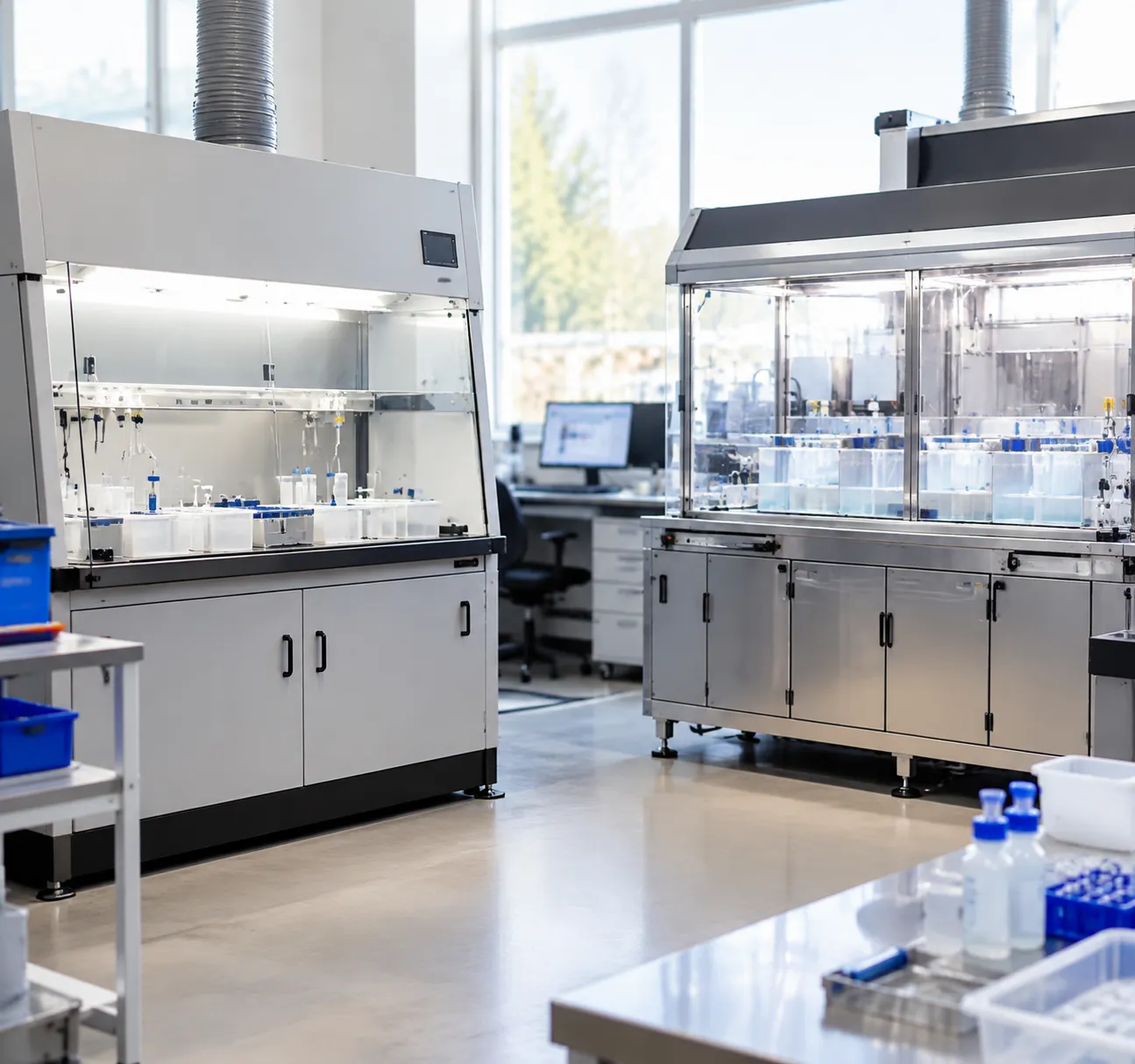
Decision Framework: Standard vs Custom Wet Processing Equipment
When to Deploy Standard Wet Benches
Standard wet benches are optimal when speed to production is the top operational priority and process windows do not demand bespoke fluid mechanics:
-
- Pilot Lines and Academic R&D: Facilities requiring fast installation, standard substrate sizes, and broad recipe flexibility without prolonged engineering reviews.
- Mature Semiconductor Nodes: Well-established etch and strip steps with predictable thermal and chemical profiles.
- Urgent Tool Delivery Schedules: Projects facing tight installation windows where the standard 8 to 16-week build-to-FAT timeline prevents cleanroom startup delays.
- Strict Initial CapEx Budgets: Budget scenarios that cannot absorb Non-Recurring Engineering (NRE) charges. Pre-configured platforms like standard batch immersion wet bench systems for wafer processing deliver reliable capability with predictable equipment expenses.
When to Invest in Custom Wet Processing Equipment
Custom-engineered platforms are essential when unique wafer handling, non-standard chemistry, or cleanroom space limitations dictate tool architecture:
-
- High-Volume Manufacturing (HVM): Fabs focused on maximizing wafer throughput density (WPH) with multi-axis automated transfer robotics and optimized bath turnover rates.
- Fragile Substrates and Advanced Nodes: Applications utilizing thin SiC, GaN, or GaAs substrates that require precise end-effector handling, zero-contact fluid drying, and targeted megasonic agitation.
- Aggressive or Proprietary Chemistries: Extreme etch processes requiring FM4910-compliant materials, fully isolated solvent/acid zones, and specialized chemical delivery unit (CDU) integration.
- Cleanroom Footprint Optimization: Facilities with non-standard utility drops, irregular floor plans, or chase-access constraints that necessitate bespoke enclosure geometries. Deploying tailored high-precision wet benches for semiconductor processing guarantees that every square foot of cleanroom space generates maximum yield.
Key Evaluation Criteria for Fab Managers and Procurement Teams
| Decision Metric | Standard Wet Bench Strategy | Custom Wet Bench Strategy |
|---|---|---|
| Delivery Schedule | Rapid deployment (8–16 weeks to FAT) | Extended engineering cycle (24–40+ weeks to SAT) |
| Initial Upfront CapEx | Low initial cost; zero NRE fees | Higher upfront investment with engineering NRE |
| Process Control | Standard bath immersion and overflow | Tuned micro-uniformity, CFD-modeled fluidics |
| Substrate Compatibility | Standard silicon wafer sizes (100mm–300mm) | Thin, warped, or fragile compound wafers (SiC/GaN) |
| Footprint Integration | Fixed modular dimensions | Custom dimensional tailoring to existing fab space |
| Automation Level | Manual or standardized linear transfer | Fully automated recipe-driven robotic transfer |
| Long-Term OpEx & TCO | Higher chemical/DI water consumption | Optimized bath volumes lower long-term chemical OpEx |
Frequently Asked Questions (FAQs)
What is the average lead time difference between standard and custom wet benches?
The lead time gap between standard and custom platforms ranges from 12 to 24+ weeks.
-
- Standard Wet Benches (8–16 Weeks): Pre-engineered tanks, off-the-shelf plumbing diagrams, and standardized control software enable rapid assembly and accelerated Factory Acceptance Testing (FAT).
- Custom Wet Processing Equipment (24–40+ Weeks): Requires dedicated 3D CAD modeling, Computational Fluid Dynamics (CFD) simulation, custom FM4910 plastic fabrication, bespoke recipe programming, and exhaustive cleanroom Site Acceptance Testing (SAT).
| Metric | Standard Bench | Custom Bench |
|---|---|---|
| Design & Engineering | 0–2 weeks | 6–12 weeks |
| Fabrication & Assembly | 6–10 weeks | 12–18 weeks |
| FAT & SAT Commissioning | 2–4 weeks | 6–10 weeks |
| Total Lead Time | 8–16 Weeks | 24–40+ Weeks |
How much does Non-Recurring Engineering (NRE) add to custom equipment costs?
NRE typically adds 15% to 35% to the base capital expenditure of a wet processing tool. In complex automated platforms with unique chemical delivery unit (CDU) integration or robotic handlers, NRE covers:
-
- Detailed fluid dynamic modeling for micro-uniformity across non-standard substrates.
- Custom structural framing and exhaust manifold designs to match tight cleanroom footprints.
- Custom automation scripting to integrate fab-specific SECS/GEM and MES tracking protocols.
- SEMI S2/S8 third-party safety and ergonomic validation testing.
Can standard wet processing equipment handle SiC and GaN substrates effectively?
Standard off-the-shelf tools can run basic cleans on compound wafers, but they carry significant operational risks. Silicon carbide (SiC) and gallium nitride (GaN) substrates are brittle, highly prone to micro-cracking, and often require aggressive chemistries such as heated phosphoric acid or high-concentration piranha blends.
Standard tank geometries and standard robotic grippers lack the tailored edge-grip end-effectors, fluid turbulence damping, and chemical isolation needed to protect these high-value wafers. Implementing dedicated automated wet bench semiconductor wet processing systems ensures the exact temperature control and gentle mechanical handling required to safeguard compound semiconductor yields.
How does modular wet processing balance lead time and custom process needs?
A modular wet bench design bridges the gap between pre-engineered delivery speed and custom processing power.
-
- Standardized Core Infrastructure: We utilize a pre-validated frame, baseline electrical architecture, exhaust distribution, and universal software core.
- Configurable Process Modules: Engineers drop in application-specific chemical etch baths, heated quartz tanks, megasonic wafer cleaning stations, and quick-dump rinsers (QDR).
This approach reduces custom NRE costs by up to 60% and compresses tool delivery schedules down to 12 to 18 weeks while fulfilling strict recipe and substrate requirements.
Which option delivers a lower Total Cost of Ownership (TCO) over a 5-to-10 year lifecycle?
The lower-TCO option depends entirely on fab volume, chemistry costs, and wafer value:
-
- Standard Equipment: Delivers lower TCO in R&D labs, academic cleanrooms, and low-volume, mature silicon nodes where upfront CapEx is the primary financial constraint.
- Custom & Modular Equipment: Delivers significantly lower TCO in high-volume manufacturing (HVM) and compound semiconductor fabs. Tailored bath geometry minimizes chemical and deionized (DI) water consumption by 20% to 40%, while optimized fluid dynamics maximize wafer throughput density (WPH) and eliminate costly scrap.
Reviewing advanced wet process technology options during early fab planning helps calculate these precise OpEx savings against initial capital outlays.