
Formula details
Product Details
Overview
Solvent Wet Bench Overview & Core Capabilities
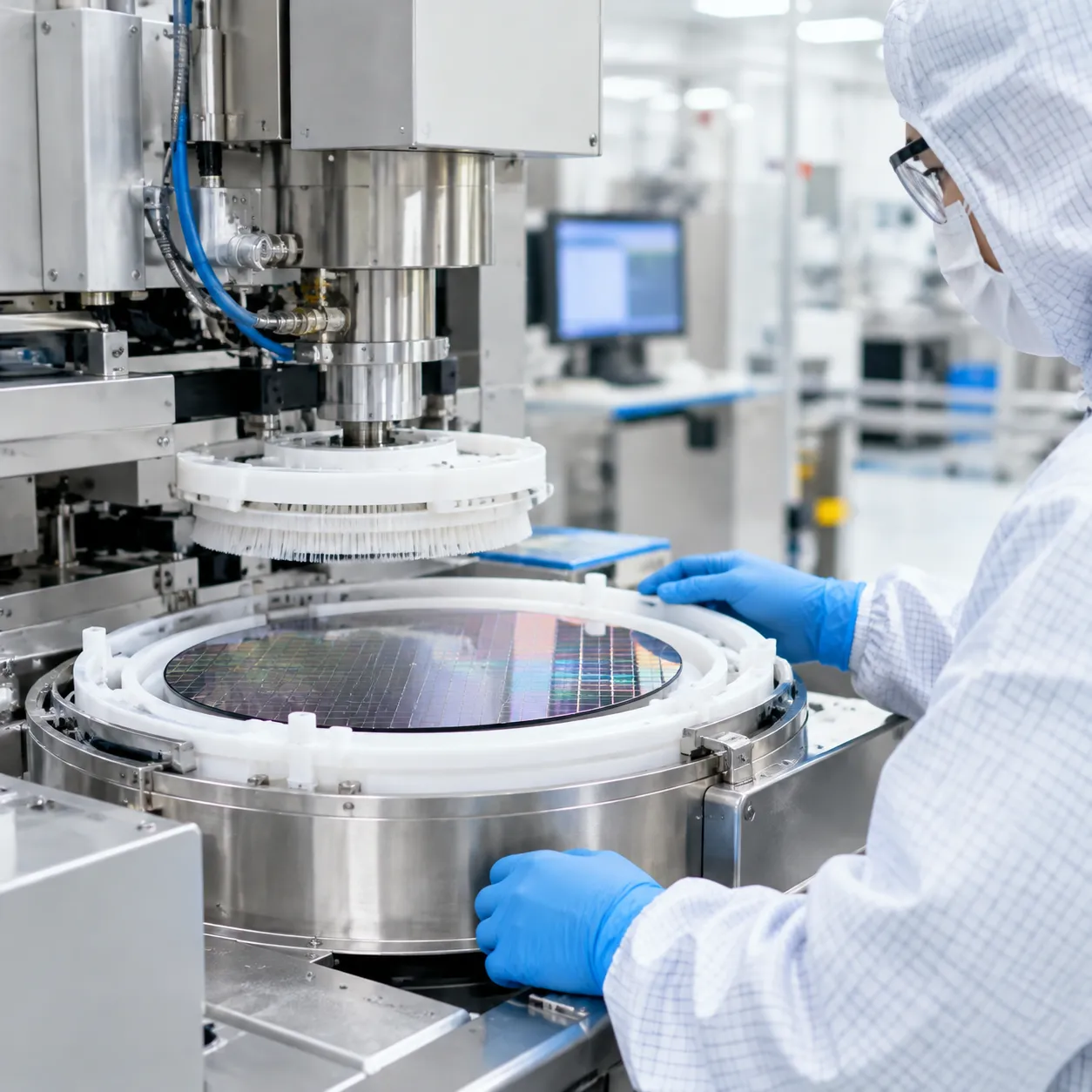
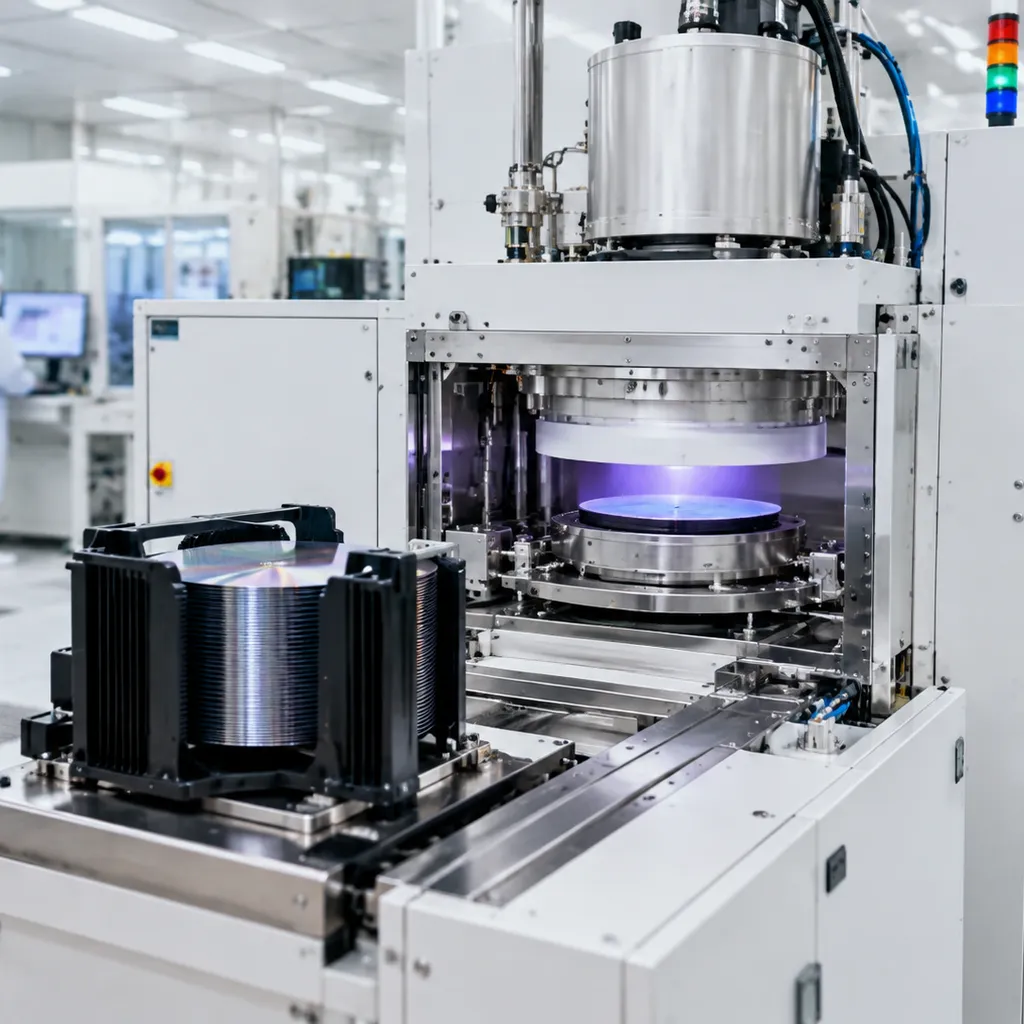
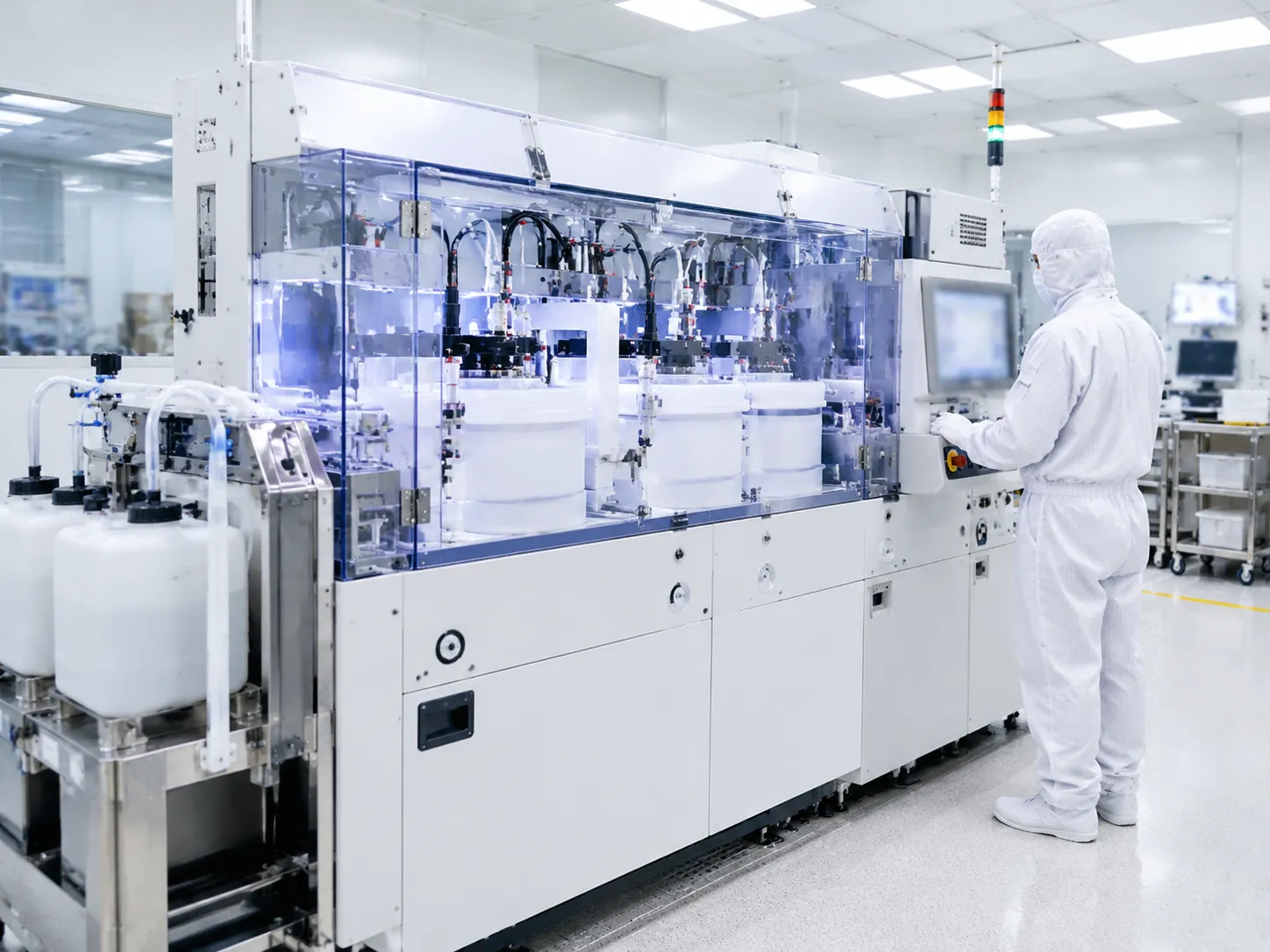
We engineer modular solvent wet bench platforms designed for critical surface preparation, photoresist stripping, metal lift-off, and solvent degreasing. Built to meet the stringent demands of advanced semiconductor manufacturing, MEMS fabrication, and compound semiconductor processing, our systems balance precise chemical delivery with high-integrity process control.
┌────────────────────────────────────────────────────────────────────────┐
│ SOLVENT WET BENCH PLATFORM TIERS │
├───────────────────┬────────────────────────────┬───────────────────────┤
│ Manual Stations │ Semi-Automated Systems │ Fully Automated (HVM) │
│ • Low-volume R&D │ • Recipe-driven immersion │ • Robotic dry-to-dry │
│ • Operator dipped │ • Pneumatic wafer lifters │ • Dual linear robots │
│ • Compact bench │ • Auto tank timers/covers │ • SECS/GEM integrated │
└───────────────────┴────────────────────────────┴───────────────────────┘
Supported Solvent Chemistries
Our solvent wet processing stations feature inert fluid paths, precision thermal management, and robust vapor containment to handle standard and aggressive organic solvents:
-
- Acetone & Isopropyl Alcohol (IPA): High-efficiency bulk degreasing, solvent cleaning, and moisture displacement rinsing.
- N-Methyl-2-pyrrolidone (NMP) & Dimethyl Sulfoxide (DMSO): Heavy-duty photoresist stripping and post-etch residue removal at elevated process temperatures.
- Proprietary Strip Chemistries & Solvents: Optimized for solvent lift-off, polyimide removal, and custom formulation delivery (e.g., ACT935, EKC, PGMEA).
Available Automation & Handling Configurations
We provide three distinct automation tiers to fit specific throughput metrics, operator interaction limits, and budget requirements:
| Configuration Tier | Substrate Handling Mechanism | Typical Application | Key Features |
|---|---|---|---|
| Manual Solvent Wet Station | Direct operator transfer via chemical-resistant fluoropolymer cassettes or fixtures | University labs, failure analysis, pilot-line R&D | Ergonomic deck cutouts, manual deck-mounted aspirators, and analog process timers |
| Semi-Automated Wet Bench | Motorized or pneumatic Z-axis agitation and automated tank cover actuation | Low-to-medium volume production, specialized pilot lines | Touchscreen recipe selection, automatic cycle start, and precise immersion timing control |
| Fully Automated Robotic Bench | Enclosed overhead Cartesian or dual-axis linear transfer robot (dry-to-dry) | 24/7 high-volume semiconductor wafer fabrication | SMIF/FOUP load ports, bar-code/RFID lot tracking, and SECS/GEM fab host integration |
Critical Safety & Explosion-Proof Engineering for Solvent Wet Stations
Handling volatile, low-flashpoint chemistries like Acetone, IPA, and NMP demands zero-compromise safety architecture. We design every solvent wet bench with multi-layered, redundant safeguards to completely isolate ignition sources, eliminate hazardous vapor buildup, and protect both operators and cleanroom assets in strict alignment with cleanroom safety and compliance standards.
|
Safety Layer |
Protection Measures |
|---|---|
|
Detection |
Optical flame detection & multi-point over-temperature sensors |
|
Suppression |
Automated Novec 1230 / CO₂ injection & dedicated N₂ blanketing |
|
Containment |
Lip exhaust scavenging & real-time differential airflow interlocks |
|
Isolation |
Class I, Division 1/2 or ATEX-rated purged enclosures; FM 4910-compliant materials & 316L stainless steel body |
Certified Fire Suppression & Electrical Isolation
Our explosion-proof cleanroom bench systems deploy active containment and automated suppression loops designed to extinguish thermal events within milliseconds:
-
- Automated Fire Suppression Systems: Integrated fast-response optical infrared/UV flame detectors paired with direct-line Novec 1230 or CO2 suppression manifolds. We route dedicated nitrogen (N2) purge lines directly into process bath headspaces to suppress flammable vapor blankets continuously.
- Explosion-Proof Electrical Integration: Full Class I, Division 1 and Division 2 (NEC 500) as well as ATEX Zone 1/2 compliance. All critical wiring, motor drives, and electronic controls sit inside positive-pressure, N2-purged Z-purge or X-purge stainless enclosures with intrinsically safe barriers.
Vapor Containment & Structural Integrity
-
- Laminar Flow Lip Scavenging: High-capture perimeter exhaust slots pull heavier-than-air solvent vapors down and away from the operator breathing zone directly into dedicated solvent exhaust ducts.
- Continuous Velocity & Static Pressure Monitoring: Real-time differential pressure switches and airflow sensors immediately place the tool in a safe standby state if exhaust velocity drops below programmed thresholds.
- Robust Chemical-Resistant Construction: Built using seam-welded, electropolished 316L stainless steel for grounding and solvent resistance, or FM4910-listed flame-retardant plastics (such as PVDF and CPVC) for mixed-use wet processing environments.
Redundant Fail-Safe Interlock Matrix
To prevent dry-fire scenarios, chemical boil-over, or static discharge, our SEMI S2 certified wet station platforms rely on hardwired, fail-safe safety logic:
| Safety System | Monitoring Mechanism | System Response |
|---|---|---|
| Liquid Level Control | Dual-point optical sensors & float switches | Cuts bath heaters immediately upon low chemical levels |
| Thermal Protection | Multi-point redundant RTD probes & snap switches | Triggers hardware-level power cutoff on over-temperature |
| Exhaust Verification | Differential pressure transmitters (VAV linked) | Locks bath covers, inhibits dispense, and sounds alarm |
| Emergency Power Off | Multi-zone SIL-rated EMO pushbuttons | Trips primary contactors and isolates all chemical delivery |
Configurable Solvent Wet Bench Process Modules & Tank Configurations
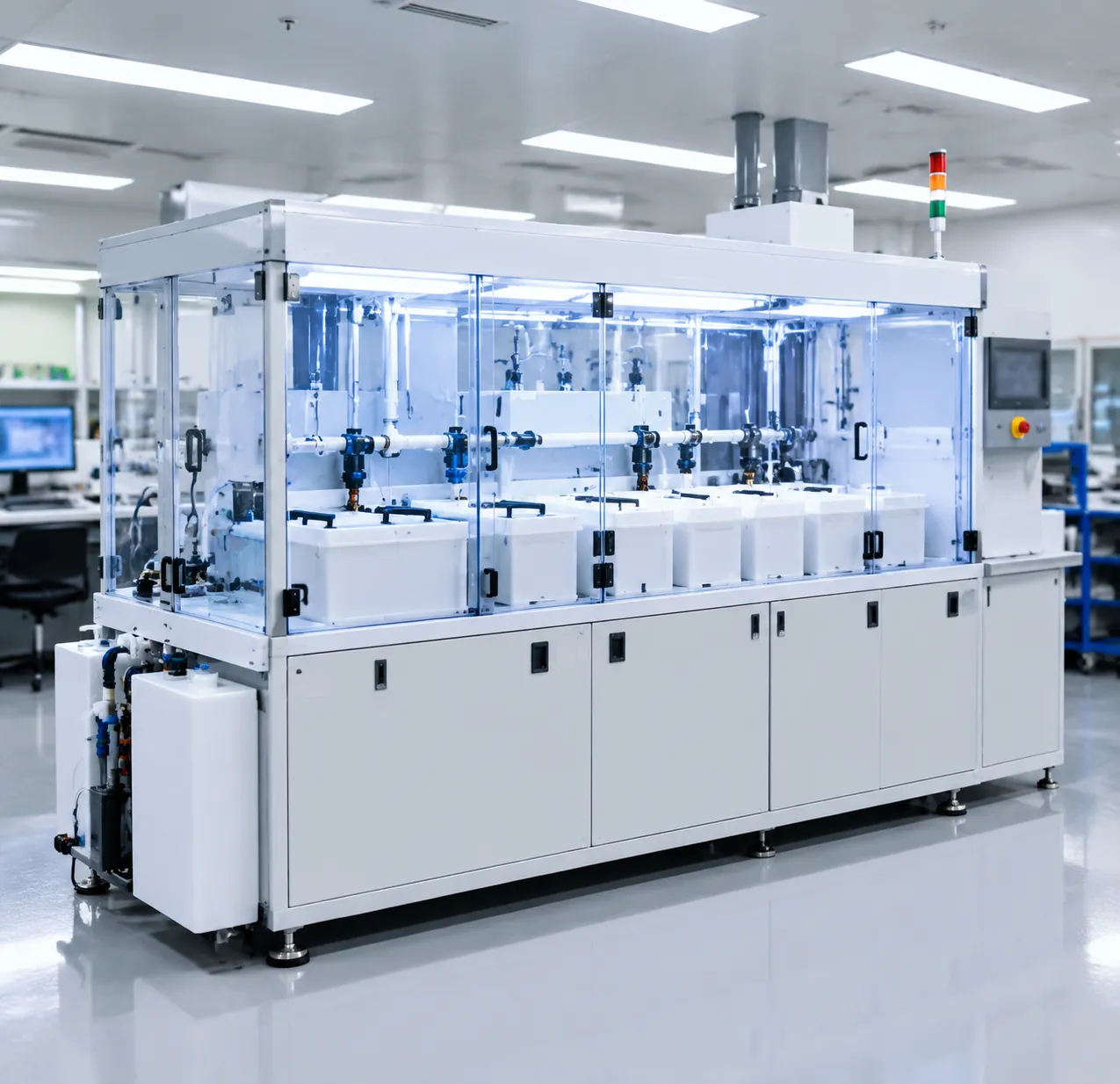
We configure every solvent wet bench to match your exact chemistry, thermal boundaries, and particle limits. From high-throughput photoresist removal to high-precision lift-off, our modular tanks integrate directly into our batch immersion wet bench systems for wafer processing to deliver stable chemical delivery, precise temperature regulation, and clean rinsing.
Solvent Tank & Module Configurations
| Module Type | Process Mechanism | Primary Chemistries & Functions |
|---|---|---|
| Recirculated Immersion Bath | Indirect fluid heating with 0.1 µm POU filtration | Acetone, NMP, DMSO; photoresist stripping and bulk degreasing |
| Acoustic Agitation Tank | Single/multi-frequency megasonic & ultrasonic transducers | Sub-micron particle removal and fine surface clearing |
| High-Pressure Spray / Lift-Off | Multi-axis high-pressure solvent spray manifolds | Dedicated metal lift-off and heavy polymer removal |
| DI Water Rinsing Station | Quick Dump Rinser (QDR) & multi-stage cascade overflow | Complete chemical displacement with real-time resistivity tracking |
| Advanced Wafer Dryer | Marangoni, IPA vapor drying, or Spin Rinse Dryer (SRD) | Zero-watermark drying for high-aspect-ratio patterns |
Core Wet Processing Capabilities
-
- Indirectly Heated & Recirculated Solvent Baths: We utilize external fluid-jacketed heating and non-contact heat exchangers to eliminate direct element contact with flammable chemistries. Continuous magnetic-drive recirculation coupled with 0.1 µm point-of-use (POU) filtration captures dislodged polymers and keeps bath turnover uniform across the entire carrier.
- Megasonic & Ultrasonic Agitation Systems: Our megasonic solvent cleaning system modules operate at targeted frequencies (from 430 kHz up to 1+ MHz) to lift stubborn sub-micron particles and residue without damaging fragile gates, thin films, or high-aspect-ratio microstructures.
- Targeted High-Pressure Spray & Lift-Off Modules: Designed for metal lift-off and stubborn post-etch residues, these stations combine point-of-use solvent fan sprays with high-pressure fluid vectors to cleanly shear away metal films and heavy photoresists without re-depositing flakes onto the substrate.
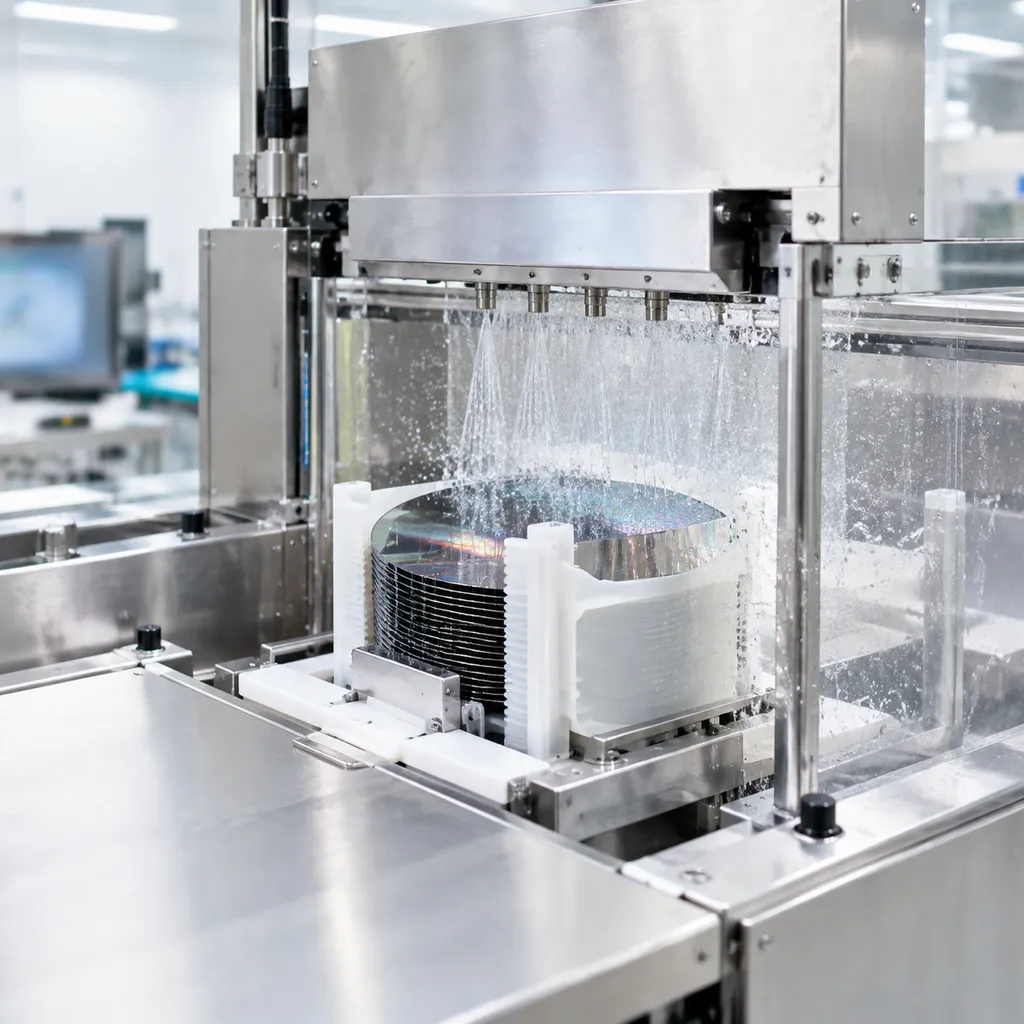
- Quick Dump Rinsers (QDR) & Cascade Overflow Tanks: Fast bath turnover is critical to halting solvent reactions instantly. Our high-purity QDR units feature multi-angle top-spray nozzles and bottom dump doors to purge process chemicals in seconds, backed by cascade overflow tanks for final resistivity stabilization.
- Advanced Wafer Drying Modules: To eliminate watermark defects, we equip systems with surface-tension-gradient Marangoni dryers, enclosed IPA vapor dryer chambers, or fully balanced dual-cassette Spin Rinse Dryers (SRD). Each drying module prevents fluid entrapment in deep trenches and microcavities.
Detailed configuration requirements and plumbing schematics are available in our semiconductor wet bench design and specification guide.
Technical Specifications & Cleanroom Compatibility
Substrate Handling & Throughput Capacity
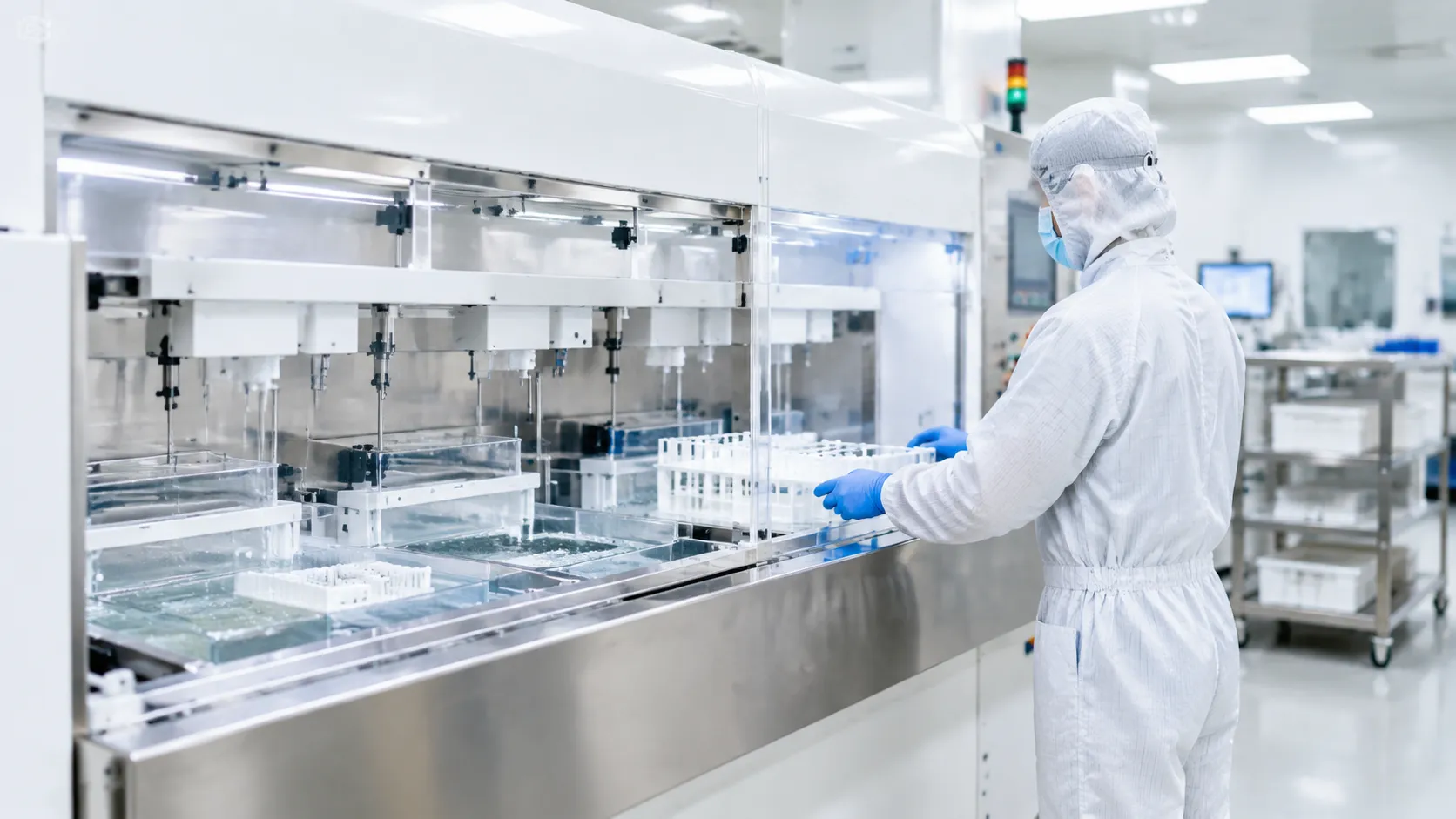
Our stations accommodate all standard cleanroom carriers and piece parts with custom end-effectors:
-
- Substrate Sizes: 2-inch, 3-inch, 100mm, 150mm, 200mm, and 300mm wafers; square substrates and photomasks up to 9" x 9".
- Substrate Materials: Silicon, Silicon Carbide (SiC), Gallium Nitride (GaN), Gallium Arsenide (GaAs), Indium Phosphide (InP), quartz, and glass.
- Carrier Handling: Single-boat (25 wafers), dual-boat (50 wafers), or custom low-mass PEEK and PTFE cassettes.
- Throughput Optimization: Automated multi-axis robotic transfer arms reduce transfer times between solvent baths and rinse tanks to < 5 seconds, delivering up to 100–150 wafers per hour depending on solvent soak recipes.
Cleanroom Standards & Environmental Integration
We build each station to integrate seamlessly with modern fab air-handling systems and semiconductor wet bench cleanroom protocols:
-
- Cleanroom Rating: Fully compatible with ISO Class 3 to Class 6 (FS209E Class 1 to Class 1,000) environments.
- Airflow Management: Integrated mini-environment with top-mount ULPA/HEPA filtration modules delivering vertical laminar downflow at 0.45 m/s (±20%).
- Bulkhead or Standalone: Available in flush cleanroom wall-mount (bulkhead) designs to save chase space or standalone enclosed footprints.
Technical & Utility Specifications
| Utility / Parameter | Engineering Requirement | Connection & Interface |
|---|---|---|
| DI Water (UPW) | 18.2 MΩ·cm resistivity, 0.2–0.4 MPa, 20–40 LPM | Flaretek / PFA tube connections |
| N2 (High-Purity Purge) | 99.999% purity, 0.4–0.6 MPa, 50–100 SLPM | 316L VCR or Swagelok compression |
| Clean Dry Air (CDA) | Dew point <-40°C, 0.5–0.7 MPa, oil-free | 3/8" or 1/2" PTFE / SS fittings |
| Dedicated Solvent Exhaust | Static pressure: -250 Pa to -500 Pa; velocity monitored | Stainless steel / ECTFE-coated exhaust collar |
| Electrical Power | 208V / 380V / 480V AC, 3-Phase, 50/60 Hz, 30–60A | Explosion-proof NEMA 7 / ATEX junction box |
| Drain Interface | Gravity or pumped segregated solvent drain lines | PVDF / 316L SS flanged connections |
Primary Industry Applications for Solvent Wet Benches
Semiconductor Wafer Fabrication & Post-Etch Residue Removal
In high-volume wafer fabrication facilities, removing post-reactive ion etch (RIE) polymers and hardened photoresists requires precise chemical control without substrate erosion.
Photoresist Stripping: Heated NMP, DMSO, or custom solvent formulations break down ion-implanted and baked resists.
Residue Clean: Point-of-use recirculated filtration keeps solvent chemistry particle-free down to 0.1 µm.
Compatibility: Fully compatible with silicon, polysilicon, and delicate low-k dielectric layers.
Compound Semiconductor Processing (SiC, GaN, GaAs, and InP)
Wide-bandgap and III-V materials have strict thermal and chemical sensitivity requirements during surface preparation. Our semiconductor solvent bench setups deliver controlled, non-destructive cleaning before epitaxial growth and gate dielectric deposition.
Surface Degreasing: Eliminates airborne organic contaminants, oils, and protective tape residues.
Oxide & Organic Mitigation: Multi-tank sequences combine solvent baths with precise DI water rinses to prevent surface haze and interface traps.
MEMS and Microfluidic Device Fabrication (Critical Lift-Off)
Thick resists and multi-layer metal stacks in MEMS manufacturing demand dynamic solvent agitation. When configured as a dedicated wafer solvent lift-off system, our equipment removes excess metal films (such as Ti, Pt, and Au) without redeposition:
Targeted Mechanical Action: Combines high-pressure fluid sprays with multi-frequency megasonics.
Bridging Prevention: Scavenging weir designs keep lifted metal flakes away from active micro-structures.
Photomask Cleaning & Flat Panel Display (FPD) Strip
Mask shops and display manufacturers rely on our solvent cleaning wet station platforms for high-throughput organic stripping on large-area quartz plates and glass substrates.
Zero-Haze Stripping: Gentle chemical agitation removes pellicle adhesive residues, fingerprints, and organic films.
Controlled Rinsing: Integrated with our high-precision wet benches to ensure spotless, watermark-free dry cycles across large surface areas.
Application Process Matrix
| Industry Segment | Target Contaminant / Task | Primary Chemistries | Key Hardware Module |
|---|---|---|---|
| Advanced Silicon Logic / Memory | Hardened resist & post-ash polymers | NMP, DMSO, Acetone, IPA | Heated recirculated bath + Megasonics |
| Power Devices (SiC & GaN) | Surface organic films & tape residue | Acetone, IPA, Solvent strippers | Overflow cascade bath + QDR |
| RF & Optoelectronics (GaAs / InP) | Pre-metallization surface clean | High-purity Acetone / IPA | Solvent immersion with N2 bubbler |
| MEMS / Sensors | Thick-resist metal lift-off | Specialized solvent strippers | High-pressure point spray + Lift-off tank |
| Photomask / Reticle Shops | Pellicle glue & sub-micron organics | Safe solvent blends, IPA | Heated soak + Point-of-use filter loop |
Automation Architecture & Software Integration for Solvent Wet Benches
+-----------------------------------------------------------------------+
| Fab Host / MES Network |
+-----------------------------------------------------------------------+
│ SECS/GEM (SEMI E4, E5, E30, E37)
▼
+-----------------------------------------------------------------------+
| Industrial PLC & Real-Time Controller |
+-----------------------------------------------------------------------+
│ │ │
▼ ▼ ▼
┌───────────────┐ ┌─────────────────┐ ┌─────────────────┐
│ Multi-Tier │ │ Closed-Loop │ │ Automated │
│ Touchscreen │ │ Process Loops │ │ Safety & Sensor │
│ HMI Interface │ │ (Temp/Dispense) │ │ Interlocks │
└───────────────┘ └─────────────────┘ └─────────────────┘
Multi-Level Touchscreen HMI Controls
Our solvent wet bench software provides role-based access control to maintain process integrity and cleanroom safety across all operational shifts:
-
- Operator Level: One-touch recipe selection, live lot tracking, real-time bath status, and clear visual alarm prompts.
- Process Engineer Level: Full parameter editing, multi-step recipe creation, robotic transfer profiling, and dynamic bath lifetime configurations.
- Maintenance Level: Direct manual input/output overrides, closed-loop calibration routines for heaters and flow meters, and comprehensive diagnostics logs.
Precise Recipe Programming & Process Execution
To ensure uniform chemical processing and zero surface degradation across sensitive substrates, our platform delivers exact parameter control across every wet process step:
-
- Closed-Loop Temperature Control: Precision bath heating managed via PID loops, maintaining solvent temperatures to within ±0.5°C.
- Chemical Dispense & Dosing: Programmable point-of-use flow rates and automated spiked replenishment tied to real-time chemical process management routines.
- Cycle Time & Submersion Sequencing: Sub-second timing for soak sequences, multi-cycle agitation, quick-dump cycles, and automated wafer transfers within our automated wet bench semiconductor wet processing systems.
| Control Parameter | Configurable Range | Resolution / Accuracy |
|---|---|---|
| Bath Temperature | Ambient up to 130°C (chemistry dependent) | ±0.5°C |
| Process Cycle Time | 1 to 9,999 seconds per station | 0.1 s |
| Megasonic Agitation | 0% to 100% power output (430 kHz – 1 MHz) | 1% increments |
| Solvent Dispense Flow | 0.5 to 15.0 LPM | ±0.05 LPM |
| Exhaust Pressure Interlock | Real-time differential pressure | Continuous differential readout |
SECS/GEM Cleanroom Integration & Traceability
Our software suite natively supports standard factory automation protocols to integrate your solvent wet bench with cleanroom MES environments:
-
- SEMI Standard Compliance: Fully compliant with SEMI E4 (SECS-I), E5 (SECS-II), E30 (GEM), and E37 (HSMS) standards.
- Real-Time Data Logging: Continuous time-stamped tracking of bath temperatures, tank fluid levels, exhaust flow rates, and active lot IDs.
- Host Control & Alarms: Remote recipe validation, automated carrier tracking, and instant alarm notification broadcast directly to the factory host system.
Custom Engineering & Fab Integration Services for Solvent Wet Benches
Every cleanroom has unique space constraints, chemical delivery systems, and workflow requirements. We design and build custom solvent wet bench platforms that drop directly into your existing fab infrastructure while meeting strict process and safety specifications.
┌─────────────────────────────────────────────────────────────┐
│ FAB INTEGRATION WORKFLOW │
├─────────────┬─────────────┬─────────────┬───────────────────┤
│ Design │ FAT │ Installation│ SAT │
│ 3D Layout & │ Dry/Wet Run │ Hookup & Fab│ Process Tuning & │
│ Footprint │ & Safety IL │ Integration │ Site Sign-Off │
└─────────────┴─────────────┴─────────────┴───────────────────┘
Application-Tailored Bench Footprints
We adapt each stainless steel solvent wet bench layout to maximize floor space efficiency and operator ergonomics:
-
- Linear Configurations: Standard in-line layouts for streamlined batch transfers and direct chase access.
- U-Shaped & L-Shaped Layouts: Compact footprints designed for tight cleanroom bays or dedicated R&D lab cells.
- Back-to-Back Systems: High-density production designs sharing central exhaust drops, fire suppression lines, and utility chases.
Our team ensures seamless equipment integration by aligning deck heights, plumbing bulkheads, and electrical feeds with your facility's exact hookup points.
Comprehensive FAT and SAT Protocols
To guarantee seamless qualification, every solvent cleaning wet station goes through rigorous verification before and after delivery:
| Testing Stage | Key Verification Items | Pass Criteria |
|---|---|---|
| Factory Acceptance Testing (FAT) | Safety interlocks, fire suppression loop, bath temperature stability, spray patterns | Zero safety faults, 100% interlock trip confirmation |
| Site Acceptance Testing (SAT) | Full chemical run, SECS/GEM MES communications, exhaust balance, particle counts | Compliance with ISO cleanroom limits & recipe targets |
Global Cleanroom Retrofits and Lifecycle Support
We support your equipment long after installation to keep production moving and eliminate unplanned tool downtime:
-
- Cleanroom Retrofits: Upgrading manual benches with automated transfer robots or adding high-flow solvent baths to legacy tools.
- Rapid Spares Fulfillment: Direct access to critical, high-wear components using our recommended wet bench spare parts stock, including explosion-proof valves, level sensors, static eliminators, and bath heaters.
- Preventive Maintenance Programs: Structured calibration routines, seal replacements, and safety interlock certifications to maintain your SEMI S2 certified wet station at peak operational safety.
Solvent Wet Bench FAQs
What safety mechanisms are used to handle low-flashpoint solvents like Acetone?
We build multi-layered active and passive safety controls directly into every solvent wet bench to safely manage volatile, low-flashpoint chemicals:
Continuous N2 Blanketing: Pressurized nitrogen purges bath headspaces to keep oxygen levels well below combustion thresholds.
Explosion-Proof Architecture: All electrical components, sensors, and routing comply with Class I, Division 1/2 and ATEX standards.
Static Dissipation: Dedicated earthing grids and static-conductive materials prevent charge accumulation during fluid transfers.
Exhaust Interlocks: Airflow differential sensors immediately shut down heaters and chemical delivery if exhaust drops below certified CFM rates.
Can solvent wet benches be retrofitted for mixed-chemistry processing?
Yes, but cross-contamination must be strictly prevented. When process flows require both solvents and aqueous rinses, we isolate the plumbing and drainage.
For facilities managing both solvent lift-off and specialized acid etch steps, we design dedicated compartments within our modular manual wet bench systems using physical vapor barriers and segregated exhaust ducting to prevent volatile organic compounds (VOCs) from mixing with acid vapors.
How does the integrated fire suppression system trigger during an alarm state?
Our automated solvent cleaning wet station platforms utilize fast-acting optical UV/IR flame detectors coupled with linear heat-sensing cables across process tanks and exhaust plenums:
1. Instant Detection: The system detects thermal or flame anomalies within milliseconds.
2. Immediate Equipment E-Stop: Heaters, pumps, and ultrasonic generators shut down instantly, while pneumatic tank covers close.
3. Clean Agent Discharge: Pressurized Novec 1230 or CO2 floods the specific module and exhaust collar to smother the fire without leaving residue on wafer surfaces.
4. Facility Signaling: An isolated dry-contact relay signals your cleanroom SCADA/MES to trigger building-wide emergency protocols.
[ Flame / Thermal Detection (<50ms) ]
│
▼
[ Emergency E-Stop & Tank Lid Closure ]
│
▼
[ Clean Agent Flood (Novec 1230 / CO2) ] ──> [ Exhaust & MES Alarm Signal ]
Are these solvent wet benches compliant with SEMI S2/S8 and FM4910 safety standards?
Yes. Our systems are fully certified for SEMI S2 (Environmental, Health, and Safety) and SEMI S8 (Ergonomics). To meet global fire protection standards, we fabricate our wet benches from electropolished 316L stainless steel and FM4910-listed plastics (such as PVDF and CPVC). This ensures zero flame propagation and minimal smoke generation in cleanroom environments.
What wafer drying technology is recommended post-solvent rinse to prevent watermarks?
The best drying method depends on your device topography and aspect ratios:
| Drying Technology | Best Suited For | Key Advantage |
|---|---|---|
| IPA Vapor Drying | High-aspect-ratio MEMS & deep silicon trenches | Zero surface-tension pull; eliminates pattern collapse |
| Marangoni Drying | Sub-micron semiconductor nodes & flat substrates | Surface-tension gradient creates watermark-free drying |
| Spin Rinse Dryers (SRD) | Standard planar wafers & high-throughput lines | Fast cycle times with heated N2 envelope drying |
Our engineering team integrates these drying solutions directly into our core wet process technology to optimize throughput and yield across critical solvent-to-rinse transitions.