Formula details
Product Details
Overview
Acid Wet Bench Architecture and Construction Materials
FM4910-Compliant Polymer Construction
To mitigate fire risks and withstand harsh oxidizers and acids, our wet processing stations are fabricated exclusively from certified materials selected for specific thermal and chemical exposure:
-
- PVDF (Polyvinylidene Fluoride): Ideal for hot acid handling, mechanical stability, and high-purity piping networks.
- PTFE / PFA: Chemically inert fluoropolymers deployed for ultra-pure chemical baths, fluid lines, and elevated temperature wet etching.
- C-PVC (Chlorinated Polyvinyl Chloride): Excellent mechanical rigidity and FM4910 fire-safe properties for structural bench framing and general acid exhaust enclosures.
- FRPP (Flame Retardant Polypropylene): Robust chemical resistance for structural body components and ambient chemical routing.
| Material | Primary Chemical Compatibility | Operating Temp. Limit | Cleanroom Application |
|---|---|---|---|
| PVDF | Hot inorganic acids (HNO₃, HCl, H₂SO₄) | Up to 120°C | Process decks, fluid loops |
| PFA / PTFE | Hydrofluoric acid (HF), Piranha (SPM) | Up to 180°C | Immersion tanks, plumbing |
| C-PVC | General acids, ambient-temperature clean chemistries | Up to 80°C | External housing, structural support |
| FRPP | Mild chemical etching, rinse utilities | Up to 90°C | Base frames, secondary enclosures |
Fluid-Zone Isolation and Sub-System Separation
To prevent cross-contamination, corrosion of critical hardware, and vapor infiltration, we implement complete three-compartment physical partitioning:
-
- Process Chemistry Bay: Fully isolated upper working deck equipped with targeted lip exhaust to continuously evacuate acid fumes.
- Pneumatic & Fluid Utility Bay: Lower segregated maintenance space housing fluoropolymer double-containment plumbing, valves, and flow meters.
- Electrical & Control Enclosure: Completely sealed, N2/CDA-purged bay isolated from all chemical paths to prevent vapor-induced electronic component failure.
Continuous Secondary Containment and Leak Detection
We integrate continuous dual-containment infrastructure beneath all chemical zones:
-
- Welded Secondary Basins: 110% capacity containment sumps engineered directly into the bench base.
- Multi-Point Optical Leak Sensors: Fast-response fluoropolymer optical probes placed at low-point collection points to trigger immediate auto-shutoff interlocks.
- Emergency Drain Segregation: Dedicated gravity-fed isolation valves that divert leaks directly to the targeted neutralization waste stream.
ISO Class 5 and Class 7 Cleanroom Compatibility
Every acid wet processing station is designed to maintain laminar airflow dynamics and eliminate sub-micron particle generation:
-
- Aerodynamic Flush Decks: Seamless CNC-machined surfaces that minimize airflow turbulence under cleanroom ceiling HEPA/ULPA units.
- Non-Shedding Fasteners and Welds: Continuous hot-gas and butt-fusion welded joints with zero exposed metal hardware.
- Sub-Micron Surface Finishes: Mirror-smooth interior polymer surfaces that prevent particulate entrapment and simplify chemical wipe-down protocols.
Core Acid Wet Bench Features and Process Controls
Precision Chemical Management and Thermal Control
-
- High-Purity Quartz and PTFE Baths: Built for aggressive acids (such as hot H₃PO₄, SPM, and HF), featuring closed-loop ±0.5°C PID temperature regulation with dual-interlocked over-temperature protection.
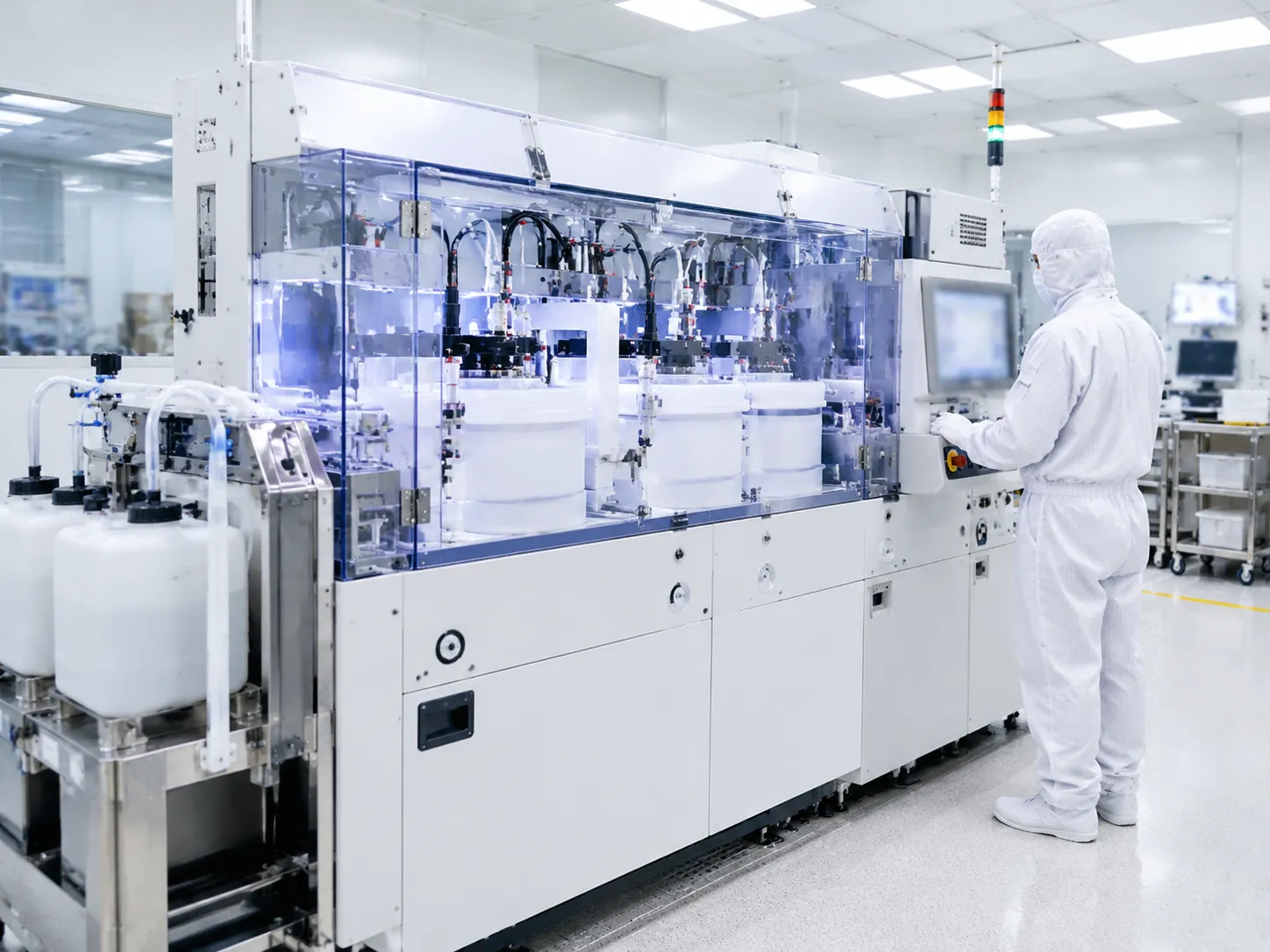
- Real-Time Bath Concentration Monitoring: Integrated inline analytical sensors (conductivity, refractometry, and acoustic velocity) monitor chemical depletion and trigger automated spiking to maintain target bath chemistry.
- Fluoropolymer Re-Circulation Loops: Continuous fluid movement through magnetic-drive or air-operated double diaphragm (AODD) PFA pumps with sub-micron fluoropolymer filtration down to 0.05 µm for reliable particle reduction.
High-Efficiency Rinsing and Surface-Tension Drying
-
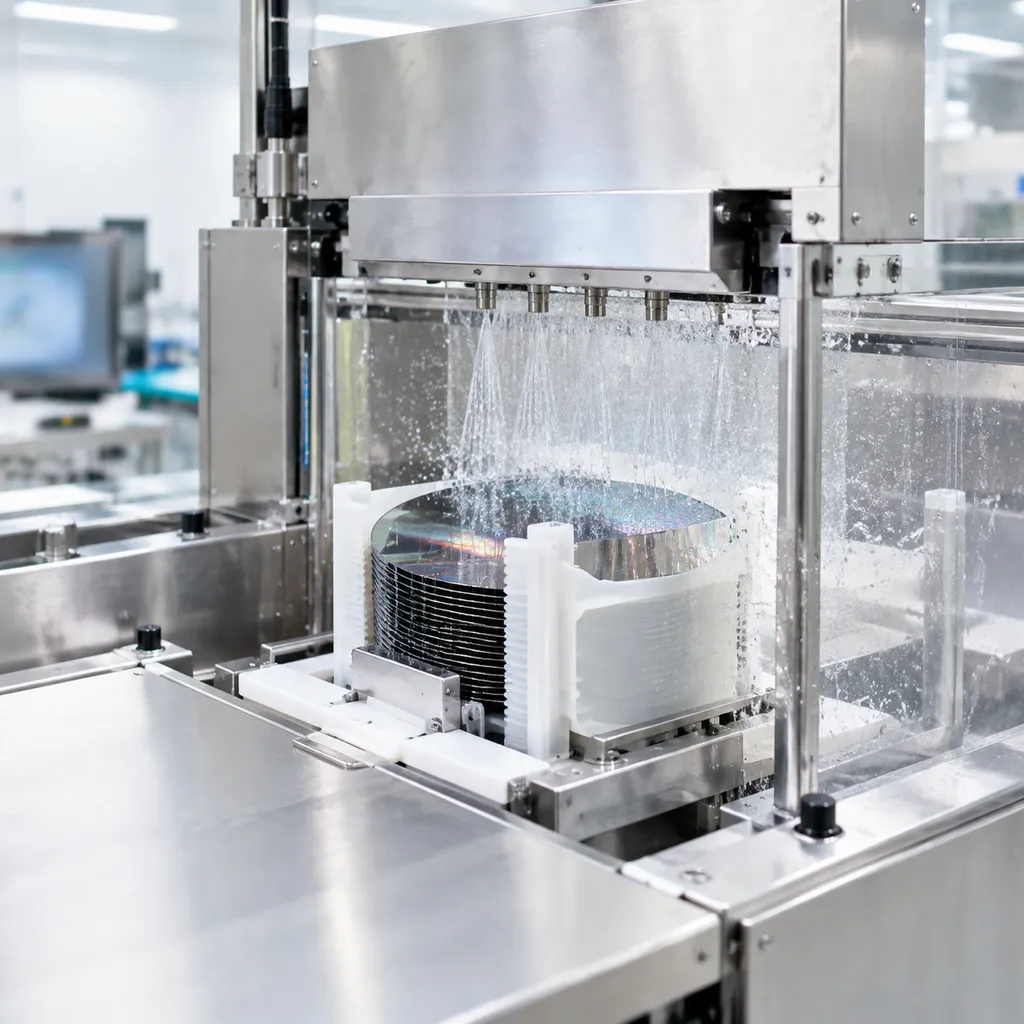
- Quick Dump Rinsers (QDR): Multi-cycle bottom-dump actuation and top spray nozzles eliminate boundary layer acid residues within seconds, slashing DI water consumption.
- Overflow Rinsers (OFR): High-resistivity cascade overflow tanks provide continuous fluid replacement for sensitive post-etch neutralization.
- Marangoni and Surface-Tension Dryers: Low-IPA consumption drying modules eliminate water-mark defects and substrate capillary bridging on high-aspect-ratio wafer topography.
Automated Wafer Transfer and Cleanroom Integration
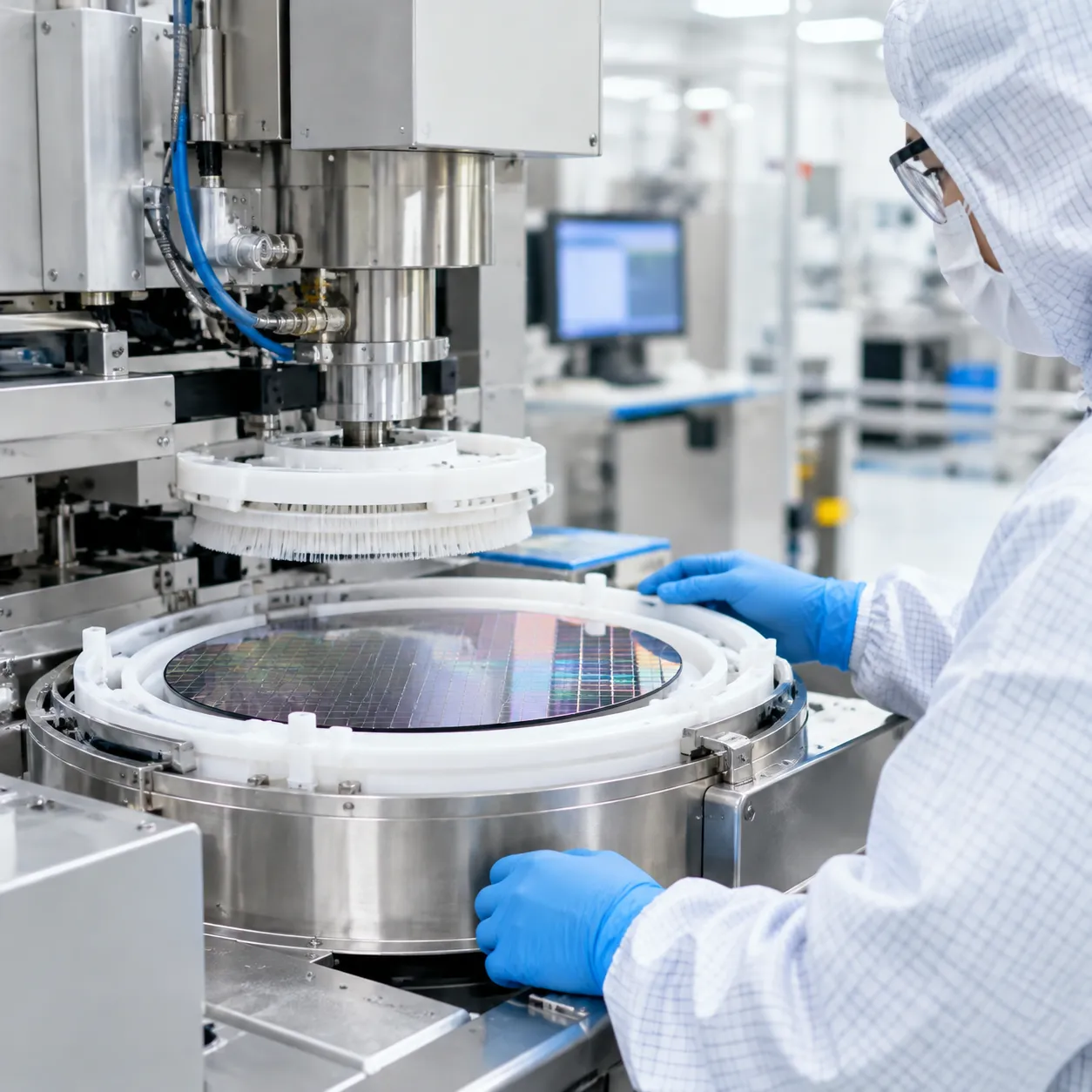
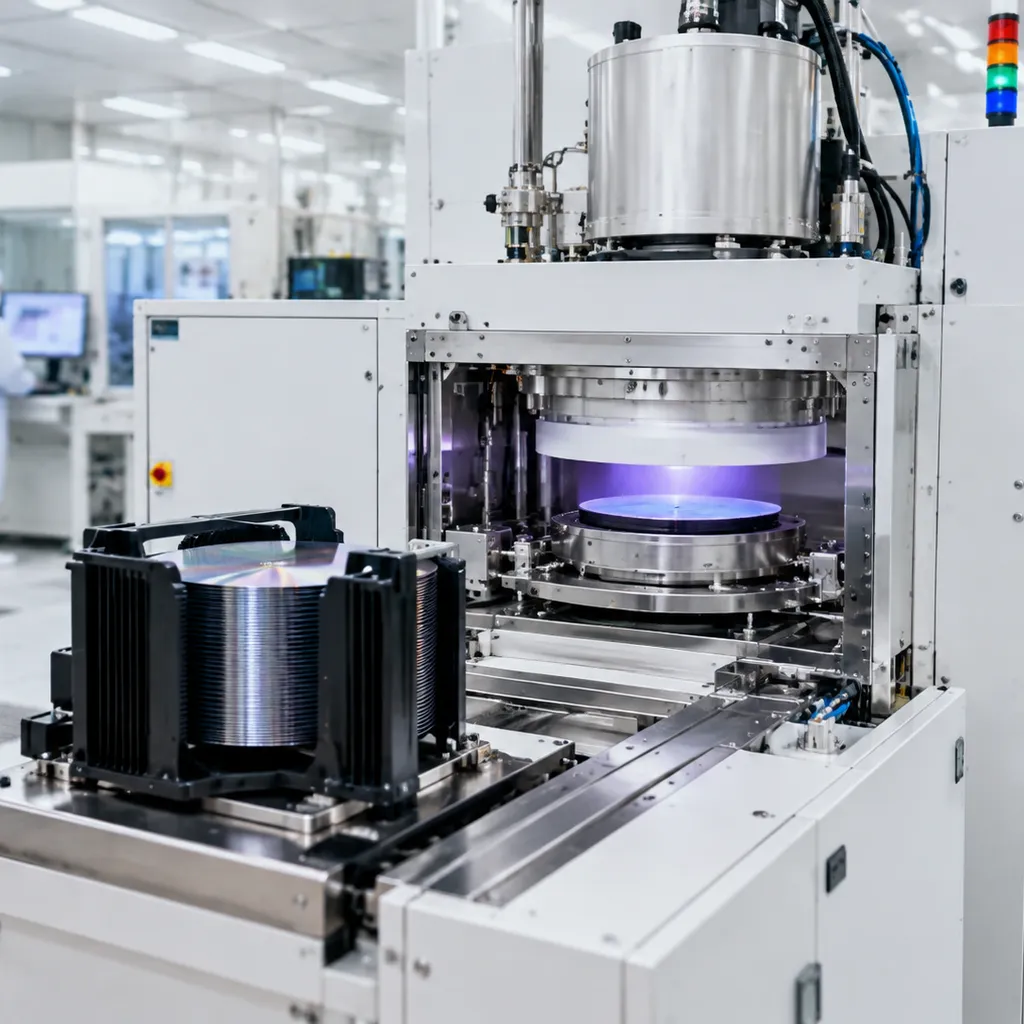
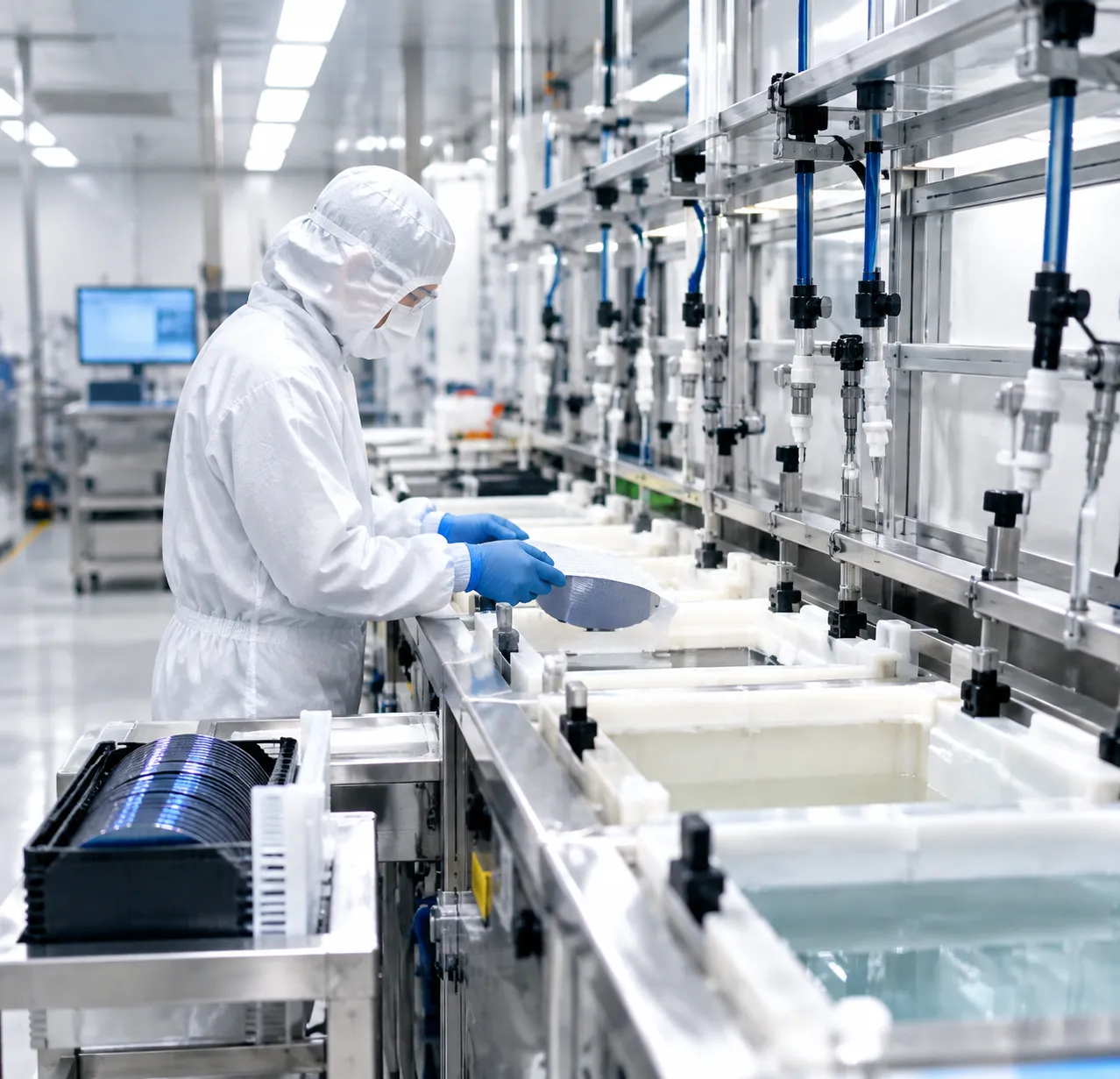
To eliminate operator exposure and ensure wafer-to-wafer consistency, our batch immersion wet bench systems incorporate high-precision 3-axis servo gantry robotics with SECS-II/GEM300 communication interfaces for full fab MES automation.
| System Feature | Technical Specification | Operational Benefit |
|---|---|---|
| Immersion Tank Heating | Quartz / PTFE with ±0.5°C PID loops | Stable etch rates across batch runs |
| Bath Filtration | 0.05 µm / 0.1 µm PTFE membrane filters | Continuous sub-micron defect control |
| Wafer Handling | 3-axis automated robotic transfer | Eliminates manual handling variation |
| Fume Extraction | Dedicated 360° lip-exhaust hoods | Complete acid vapor capture at source |
| Air Management | Mini-environment Class 1 HEPA / ULPA | Sub-micron clean laminar air zone |
Our localized lip-exhaust extraction continuously sweeps corrosive acid vapors directly from bath perimeters into dedicated exhaust drops, while top-mounted mini-environment HEPA/ULPA units supply ISO Class 1 laminar airflow directly over the deck of each chemical wet bench for wafer cleaning and etching.
Semiconductor Cleaning and Etching Chemistries for Acid Wet Benches
| Process Sequence | Standard Chemistry | Operating Temp. | Primary Tank Material |
|---|---|---|---|
| SC-1 (RCA Clean) | NH₄OH / H₂O₂ / H₂O | 65°C–80°C | High-Purity Quartz |
| SC-2 (RCA Clean) | HCl / H₂O₂ / H₂O | 65°C–80°C | High-Purity Quartz |
| SPM / Piranha | H₂SO₄ / H₂O₂ (3:1–5:1) | 90°C–130°C | Molded Quartz (Dual-Wall) |
| DHF / BOE Etch | HF / H₂O or NH₄F / HF | Ambient (20°C–25°C) | Natural Polypropylene / PFA |
| Silicon Nitride Etch | H₃PO₄ (85%) | 150°C–165°C | Quartz with Reflux Lid |
| Metal Etch (PAN/AR) | H₃PO₄ : HNO₃ : CH₃COOH / AR | 35°C–60°C | PVDF / PFA / Quartz |
Standard RCA Clean Sequences (SC-1 and SC-2)
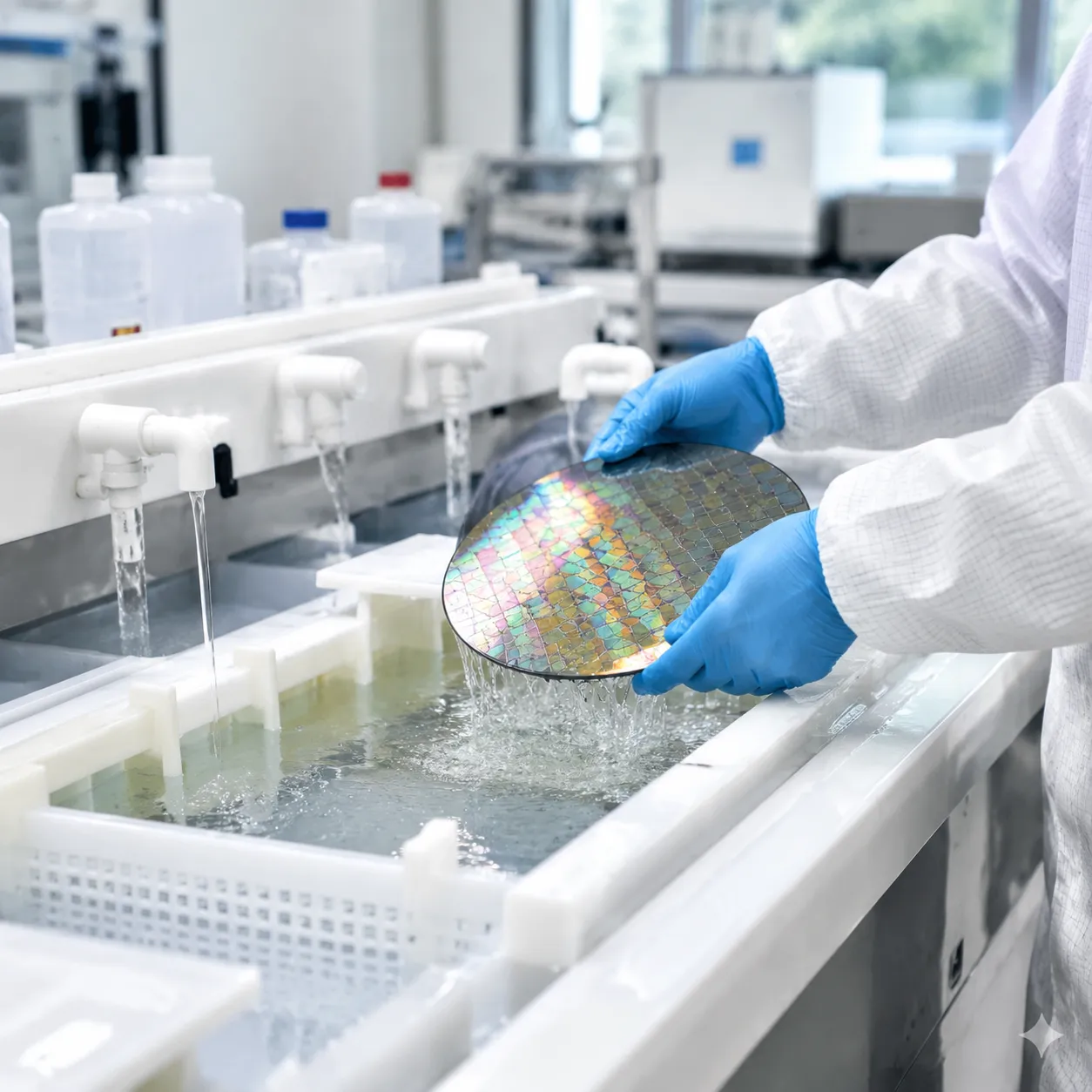
Our RCA clean station modules remove organic films, sub-micron particles, and ionic trace metals through a standardized two-step treatment:
- SC-1 (Standard Clean 1): Combines ammonium hydroxide, hydrogen peroxide, and UPW (NH₄OH : H₂O₂ : H₂O) to remove organic residues and displace light particles via controlled surface micro-etching.
- SC-2 (Standard Clean 2): Uses a hydrochloric acid mixture (HCl : H₂O₂ : H₂O) to remove metallic contaminants and alkali metal ions, leaving a clean substrate surface.
For advanced wafer fabs, our RCA cleaning wet bench for semiconductor wafer cleaning integrates automated chemical spiking and continuous concentration monitoring to extend chemical bath life while preserving surface uniformity.
Organic and Resist Stripping: SPM and SOM
For thick photoresist removal and post-ion-implantation cleaning, we configure dedicated Piranha clean bench (SPM station) setups:
- Piranha / SPM (Sulfuric Peroxide Mix): Blends sulfuric acid and hydrogen peroxide (H₂SO₄ : H₂O₂) at elevated temperatures up to 130°C. The aggressive exothermic oxidation breaks down hardened organic layers and carbon residues.
- SOM (Sulfuric Ozone Mix): Replaces peroxide with dissolved ozone gas (O₃), reducing chemical consumption and chemical waste while maintaining rapid photoresist strip rates.
- Thermal Safety: All SPM baths feature dual-wall quartz tanks, external IR heating blankets, and rapid cool-down heat exchangers to manage heat spikes safely.
Oxide and Nitride Etching: BOE, DHF, and Hot Phosphoric Acid
Our HF etching wet bench and chemical wet processing modules provide uniform etch rates and sharp selectivity:
- Dilute HF (DHF): Controlled ambient mixtures (0.5% to 10% HF) selectively strip native oxides and prepare hydrogen-terminated wafer surfaces before gate-dielectric deposition.
- Buffered Oxide Etch (BOE): Formulations of NH₄F : HF (such as 6:1 or 20:1) with integrated surfactant additives maintain stable etch rates on thermal silicon dioxide (SiO₂) and help control pattern undercutting.
- Hot Phosphoric Acid (H₃PO₄): Strips silicon nitride (Si₃N₄) selectively over silicon dioxide at 150°C–165°C. We outfit these tanks with condenser reflux lids and auto-spiking UPW systems to prevent acid dry-out and boiling-point drift.
As part of our turnkey wet bench chemistry equipment for semiconductor cleanroom platforms, each semiconductor etching bench includes PFA re-circulation lines, magnetic-drive fluoropolymer pumps, and sub-micron particulate filtration.
Metal and Compound Semiconductor Etching
We build specialized etching stations tailored to compound semiconductors (GaAs, GaN, SiC, and InP) and thin-film metals:
- Aqua Regia (HCl : HNO₃): Rapidly etches noble metals like gold (Au) and platinum (Pt) while stripping deep-seated metallic contamination.
- PAN Etch: Blends phosphoric, acetic, and nitric acids (H₃PO₄ : CH₃COOH : HNO₃) for controlled wet etching of aluminum (Al) and aluminum alloy interconnects.
- Acid-Resistant Wetted Tracks: All acid wet processing stations utilize solid PVDF or PFA fluid paths, dedicated isolated drains, and targeted lip exhaust slots to minimize acid vapor crossover within your cleanroom envelope.
Acid Wet Bench Technical Specifications and Configurations
Substrate Handling & Material Compatibility
Our acid wet processing stations handle industry-standard wafer carriers, single-wafer chucks, and custom-machined fixtures:
-
- Substrate Sizes: 2-inch (50 mm), 3-inch (75 mm), 100 mm, 150 mm, 200 mm, and 300 mm wafers, plus specialized pieces and photomasks.
- Material Compatibility: Prime Silicon (Si), Silicon Carbide (SiC), Gallium Nitride (GaN), Gallium Arsenide (GaAs), Indium Phosphide (InP), sapphire, and quartz substrates.
- Carrier Types: Standard 25-wafer cassettes, low-profile carriers, coin stacks, and custom-machined PTFE/PFA carriers for non-standard substrates.
System Configurations & Automation Levels
Depending on throughput and operator intervention limits, we deliver platforms across three primary automation tiers:
-
- Manual Wet Benches: Open or enclosed configurations with manual deck transfer, pneumatic safety shields, and automated bath timers. Ideal for university labs and low-volume R&D.
- Semi-Automated Systems: Integrated pneumatic dunkers, motorized lifters, and recipe-timed immersion cycles that reduce operator contact with chemistry while maintaining flexible batch sizes. Explore our custom wet process stations for application-specific deck footprints.
- Fully Robotic Systems: Multi-axis cleanroom-rated overhead gantry or articulated robotic transfer. Our automated wet bench systems feature complete SECS/GEM host integration, continuous lot tracking, and automated carrier transfer between etch, rinse, and dry zones.
Industrial PLC Controls & Standards Compliance
| System Component | Standard Configuration |
|---|---|
| Controller Platforms | Siemens S7, Allen-Bradley, or Beckhoff EtherCAT PLCs |
| Touchscreen HMI | 12"–19" multi-touch HMI with role-based access |
| Recipe Management | Multi-step recipes, real-time parameter logging, and PID temperature feedback (±0.5°C) |
| Host Integration | SECS-II / GEM300 interface for MES batch tracking |
Technical Specifications Matrix
| Feature | Specification Details |
|---|---|
| Footprint Configurations | Single-sided inline, double-sided, or modular split-deck architectures |
| Exhaust & Airflow | Lip-exhaust acid vapor extraction with top-mounted laminar flow HEPA/ULPA units |
| Tank Materials | High-purity quartz, solid molded PTFE, PVDF, and PFA |
| Leak & Safety Sensors | Multi-point optical fluoropolymer leak sensors with automatic interlocked N2/drain shutoffs |
| Electrical Enclosure | Purged NEMA 4X / IP66 enclosures completely isolated from fluid zones |
| Safety Certifications | SEMI S2-0715, SEMI S8-0715, CE Certified, NFPA 45/79, and UL 508A listed |
Modular Bath Configurations for Custom Acid Wet Benches
We engineer our custom acid wet bench systems with modular, application-specific process vessels that easily drop into standardized deck cutouts. These specialized baths provide precise chemical dosing, thermal stability, and contamination control across demanding semiconductor fabrication steps, matching the exact process recipes of our high-precision wet benches for semiconductor processing.
Megasonic Immersion Tanks
-
- Damage-Free Particle Removal: Uses direct-bonded high-frequency transducers (0.8 MHz to 3 MHz) to dislodge sub-micron particles from high-aspect-ratio wafer features without pattern collapse.
- Uniform Energy Distribution: Multi-faceted acoustic array design minimizes dead zones and hot spots across the entire carrier volume.
- Wetted Materials: High-purity quartz and molded PFA constructions prevent metallic ion cross-contamination during active agitation.
Infrared Heated Quartz Baths
-
- Non-Contact Thermal Transfer: External infrared heating lamps heat chemistries rapidly and evenly through high-purity quartz vessels, avoiding direct fluid contact with heating elements.
- Dual-Wall Secondary Containment: Quartz process tanks sit within an outer protective liner to catch leaks and vent corrosive vapors directly to the bench exhaust plenum.
- Over-Temperature Safety Interlocks: Redundant snap-switch thermal cutoffs and isolated process thermocouples trigger immediate shutdowns if liquid levels drop or temperatures spike.
Circulating Filtered Baths
-
- Fluoropolymer Pump Selection: Choose between sealless magnetic-drive centrifugal pumps for smooth, pulse-free delivery or air-operated double diaphragm (AODD) PFA pumps for high-viscosity chemicals.
- Sub-Micron Filtration: In-line PTFE and PFA filter housings accept 0.05 µm to 0.2 µm filter elements to remove particulates continuously from recirculating acid solutions.
- Fluid Dynamics Optimization: Weir-overflow tank designs with bottom-up injection promote uniform laminar flow across all wafer surfaces.
Silicon Nitride Etch Tanks
-
- Reflux Condensing Systems: Integrated cold-water reflux condensers capture evaporating water vapor from hot phosphoric acid (160 °C to 180 °C), returning condensate back into the bath to stabilize boiling points.
- Automated Deionized Water Replenishment: High-precision closed-loop spiking systems continuously balance acid-to-water ratios to maintain a constant etch rate for silicon nitride films over oxide underlayers.
Modular Bath Configuration Overview
| Bath Type | Compatible Chemistries | Operating Temperature | Vessel Material | Key Feature |
|---|---|---|---|---|
| Megasonic Tank | SC-1, SC-2, DHF | Ambient to 70°C | Quartz / PFA | 0.8–3 MHz uniform acoustic cleaning |
| IR Heated Quartz | SPM (Piranha), SC-2 | Up to 180°C | Semiconductor-Grade Quartz | Non-contact heating with dual containment |
| Recirculating Filter | BOE, DHF, Solvents | Ambient to 80°C | PVDF / PTFE / PFA | Continuous 0.05 µm particle filtration |
| Silicon Nitride Etch | Phosphoric Acid (H₃PO₄) | 150°C–180°C | Quartz / PVDF Housing | Reflux condenser with auto-dosing |
Acid Wet Bench Safety Protocols and Facility Integration
Integrated Fire Suppression Systems
To meet SEMI S2 and NFPA standards for heated chemical processes, our chemical stations feature dedicated, multi-point fire protection:
-
- Direct-Delivery FireTrace Tubing: Pressurized polymer sensor tubing routes above high-temperature bath decks, bursting instantly at flame contact to discharge extinguishing agents directly at the source.
- Total-Flooding CO2 Systems: Automated carbon dioxide suppression covers the electrical enclosure, chemical delivery bay, and exhaust plenums.
- Automated Shutdown Interlocks: Triggering the fire suppression immediately cuts electrical power to immersion heaters, isolates chemical feed lines, and alerts the facility central monitoring system.
Segregated Waste and Drain Management
Mixing incompatible chemistries creates severe fire and toxic gas risks. We isolate waste streams right at the deck using dedicated drain manifolds controlled by automated high-purity pneumatic diaphragm valves.
| Waste Stream | Typical Process Chemistry | Drain Material & Routing |
|---|---|---|
| General Acid Drain (ACD) | HCl, H2SO4, HNO3, Piranha/SPM | Continuous-welded PVDF / PFA piping |
| Fluoride Drain (HF/F-Waste) | DHF, BOE, buffered oxide etchants | Pure PVDF / PTFE segregated lines to neutralizers |
| Solvent Drain (SOL) | IPA, organic strippers (if hybrid deck) | Dedicated C-PVC or stainless steel with vapor traps |
| City/Neutral Drain | Final cascade DI water rinses | High-flow FRPP gravity drain to reclaim system |
Operator Protection and Active Interlocks
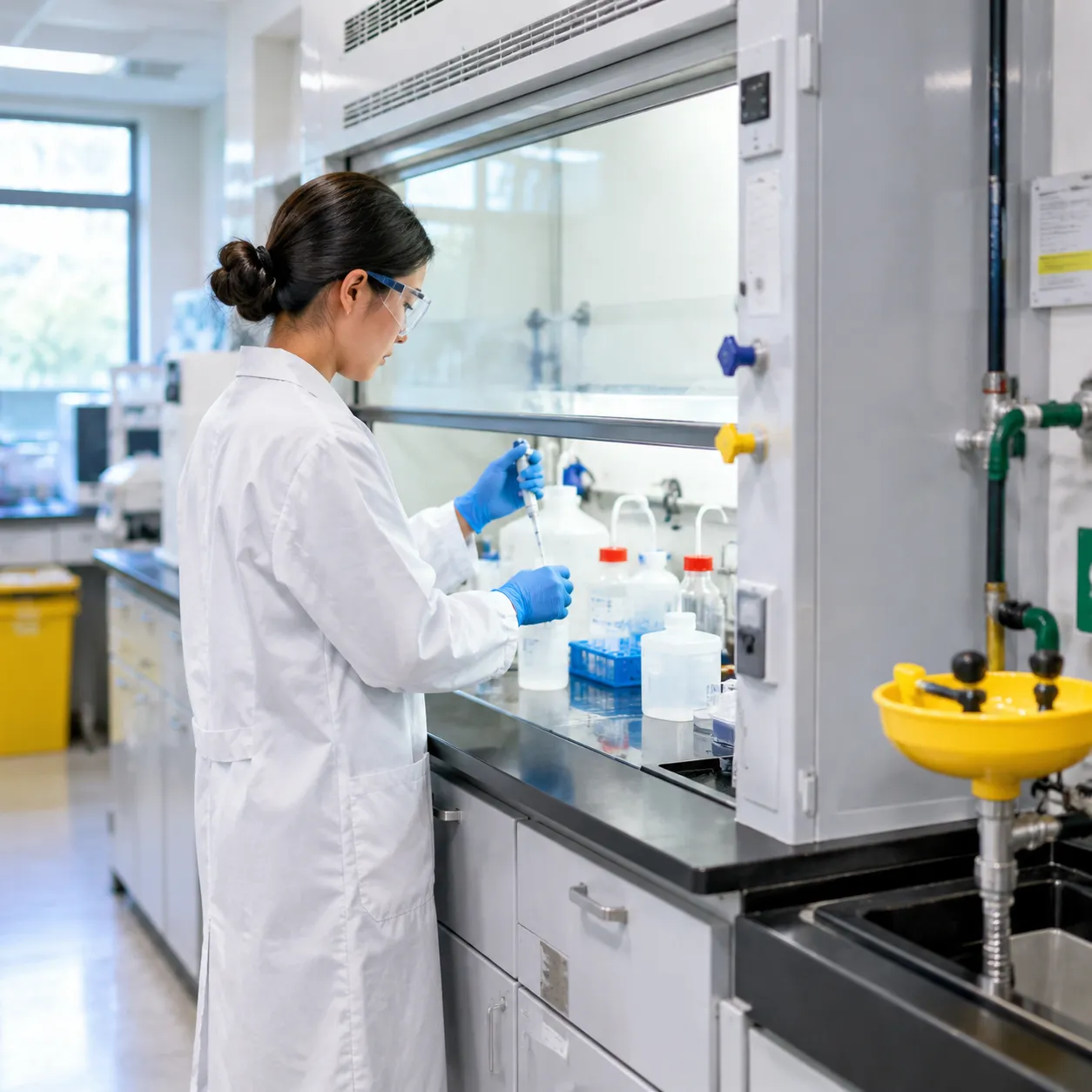
Every acid wet processing station features physical and sensor-driven safeguards to protect operators during active etching and cleaning cycles:
-
- Counterbalanced Safety Shields: Heavy-duty, transparent PVC/polycarbonate shields with magnetic sensors ensure heated chemical baths stay covered during active agitation or process cycles.
- Hands-Free Controls: Foot-switch activation for quick-dump rinsing and DI water spray guns lets operators maintain a secure two-handed grip on wafer carriers.
- Multi-Zone EMO Controls: High-visibility Emergency Off (EMO) buttons placed across the front fascia, side panels, and maintenance access points instantly isolate mains power, CDA, and chemical pumping.
Facility Utility Interconnects
We standardize all utility connections at a single, organized interface bulkhead to accelerate cleanroom hookup and commissioning:
-
- Ultra-Pure Water (UPW): Orbitally welded PVDF or PFA plumbing loops with continuous sample ports and auto-purging to avoid stagnant dead-legs.
- Pneumatics & Gas (CDA / N2): Regulated distribution blocks with integrated pressure transducers for valve actuation, tank blanket purge, and drying nozzles.
- Exhaust Differential Pressure Sensors: Continuous static pressure switches monitor airflow to the facility acid gas scrubbers. If exhaust pressure drops below preset safety thresholds, the wet bench automatically disables tank heaters and chemical supply to prevent toxic vapor escape.
Custom Acid Wet Bench Manufacturing and Support Services
We design, build, and support every acid wet bench to match specific fab throughput targets, substrate dimensions, and chemistry footprints. From initial fluid dynamics modeling to final recipe verification, our engineering team manages the complete lifecycle to guarantee seamless integration into your cleanroom line.
Application-Specific Deck Layout and Bath Sequence Engineering
Every wet chemical process demands a purpose-built deck configuration to maximize throughput and eliminate cross-contamination:
Custom Deck Architecture: We engineer linear, rotary, or side-by-side configurations for manual, semi-automated, or fully robotic transfer.
Sequential Bath Positioning: Immersion tanks, Quick Dump Rinsers (QDR), and Marangoni or spin dryers are sequenced to minimize robot transit time and eliminate chemical drag-out.
Substrate Carrier Customization: We engineer dedicated end-effectors, single-wafer chucks, and quartz/PTFE cassettes compatible with silicon, SiC, GaN, GaAs, and specialized glass substrates.
Review our wet bench selection guide to evaluate optimal deck configurations and automation levels for your target process.
| Service Phase | Key Engineering Deliverables | Core Validation Focus |
|---|---|---|
| Deck Layout Engineering | Custom P&ID, 3D CAD modeling, footprint sizing | Ergonomics, exhaust balance, bath sequencing |
| Pre-Shipment FAT | DI water cycling, sensor verification, dry robotics run | Pressure testing, thermal stability (±0.5°C), leak detection |
| On-Site SAT & Setup | Cleanroom utility hookup, exhaust tuning, full-chemical run | SEMI S2/S8 interlocks, SECS/GEM comms, recipe sign-off |
Factory Acceptance Testing (FAT)
Before any semiconductor acid bench leaves our manufacturing floor, it undergoes comprehensive functional validation:
DI Water & Chemical Cycling: Complete plumbing loops undergo extended pressurized DI water runs to verify pump flow rates, filtration efficiency, and drain timing.
Thermal & Control Verification: Closed-loop inline heaters, quartz immersion baths, and chemical spiking systems are tested to maintain process stability within ±0.5°C.
Safety Interlock Validation: Multi-point optical leak sensors, exhaust differential pressure switches, counterbalanced shield interlocks, and automated FireTrace systems undergo manual trip testing.
Cleanroom Installation, SAT, and Recipe Optimization
Our field service engineers provide on-site technical support to accelerate production qualification:
Turnkey Hookup & SAT: We manage utility connections (UPW, CDA, N2, facility drains, and localized lip exhaust) followed by strict Site Acceptance Testing. Learn more about our field deployment standards through our cleanroom wet bench installation protocols.
Process Recipe Development: We assist process engineers with configuring multi-step etch, RCA clean, and resist strip sequences directly on the PLC/HMI interface.
Field Support & Training: We provide practical training modules for fab technicians covering preventive maintenance, bath changeout procedures, and automated robotic teaching.
Frequently Asked Questions About Acid Wet Benches
Which materials best resist hot hydrofluoric acid and piranha mixtures?
Material compatibility depends on the chemistry and operating temperature of the bath:
-
- Hydrofluoric Acid (HF / DHF / BOE): We use high-purity virgin PTFE and PFA for process tanks, tubing, and fittings. Quartz cannot be used because hydrofluoric acid rapidly dissolves silica.
- Piranha / SPM (H2SO4 + H2O2): We engineer immersion vessels using high-purity fused quartz or specialized fluoropolymers capable of handling exothermic reactions up to 130°C–150°C.
- Bench Enclosures: We fabricate outer chassis and structural panels from FM4910-rated PVDF or C-PVC to eliminate structural degradation and maintain flame-retardant compliance in corrosive cleanroom environments.
How do acid wet benches integrate into cleanroom exhaust and CDS systems?
Our acid wet processing stations connect seamlessly to central facility utilities:
-
- Chemical Delivery: We integrate dual-containment PFA supply lines directly into facility Central Chemical Distribution Systems (CDS) for automated spiked dosing and closed-loop bath filling.
- Vapor Extraction: Localized lip-exhaust slots and under-deck plenums draw heavy acid fumes away from the operator, routing fumes directly into cleanroom wet scrubber systems with real-time static pressure monitoring.
- Drain Segregation: Dedicated multi-zone drains keep concentrated acids, dilute rinse water, and hazardous chemistries isolated to prevent volatile chemical reactions in waste lines.
What design measures ensure SEMI S2 and FM4910 safety compliance?
We engineer every SEMI S2 compliant wet station with multi-barrier fail-safe mechanisms:
-
- FM4910-Tested Polymers: Non-combustible, flame-retardant PVDF and C-PVC materials prevent flame propagation and reduce smoke generation.
- Secondary Containment: A fully welded lower containment deck provides over 110% chemical capacity, backed by multi-point optical leak detection sensors tied directly to emergency shutoff valves.
- Hardware Interlocks: Counterbalanced safety shields, liquid-level sensors, dual redundant over-temperature thermocouples, and cleanroom-accessible EMO switches isolate power and chemical flow in fault conditions.
- Fire Suppression: Automatic FireTrace tubing or CO2 injection nozzles protect electrical enclosures and heated chemical bath zones.
What is the standard build and lead time for custom acid wet benches?
Build schedules depend on the level of automation and bath complexity:
| Configuration | Typical Lead Time | Included Scope |
|---|---|---|
| Manual Cleanroom Wet Bench | 8 – 12 Weeks | Custom deck layouts, manual tank covers, quick dump rinsers, and basic PLC controls. |
| Semi-Automated Wet Processing Station | 12 – 16 Weeks | Pneumatic substrate lifters, auto-dosing modules, flow sensors, and recipe-driven touchscreen HMIs. |
| Fully Automated Robotic Wet Bench | 16 – 24 Weeks | 3-axis gantry robots, SECS/GEM fab automation interfaces, integrated dryers, and complete FAT validation for our wet station semiconductor equipment. |